
结合红外多光子解离和紫外光解离对泛素进行表征。
Combined Infrared Multiphoton Dissociation with Ultraviolet Photodissociation for Ubiquitin Characterization.
机构信息
Institut Lumière Matière, Université Lyon 1 - CNRS, Université de Lyon, 69622, Villeurbanne, France.
Université de Lyon, Institut des Sciences Analytiques, UMR 5280, CNRS, Université Lyon 1, ENS Lyon, 69100, Villeurbanne, France.
出版信息
J Am Soc Mass Spectrom. 2016 Sep;27(9):1435-42. doi: 10.1007/s13361-016-1419-8. Epub 2016 Jun 10.
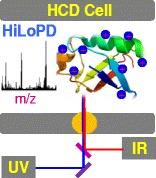
Herein we report the successful implementation of the consecutive and simultaneous photodissociation with high (213 nm) and low (10.6 μm) energy photons (HiLoPD, high-low photodissociation) on ubiquitin in a quadrupole-Orbitrap mass spectrometer. Absorption of high-energy UV photon is dispersed over the whole protein and stimulates extensive C-Cα backbone fragmentation, whereas low-energy IR photon gradually increases the internal energy and thus preferentially dissociates the most labile amide (C-N) bonds. We noticed that simultaneous irradiation of UV and IR lasers on intact ubiquitin in a single MS/MS experiment provides a rich and well-balanced fragmentation array of a/x, b/y, and z ions. Moreover, secondary fragmentation from a/x and z ions leads to the formation of satellite side-chain ions (d, v, and w) and can help to distinguish isomeric residues in a protein. Implementation of high-low photodissociation in a high-resolution mass spectrometer may offer considerable benefits to promote a comprehensive portrait of protein characterization. Graphical Abstract ᅟ.
在此,我们报告了在四极杆轨道阱质谱仪上成功实现了连续和同时用高能(213nm)和低能(10.6μm)光子(HiLoPD,高低能光解)对泛素的光解。高能 UV 光子的吸收遍布整个蛋白质,并刺激广泛的 C-Cα 骨架断裂,而低能 IR 光子则逐渐增加内部能量,从而优先解离最不稳定的酰胺(C-N)键。我们注意到,在单个 MS/MS 实验中,用紫外和红外激光同时辐照完整的泛素,可提供丰富且平衡的 a/x、b/y 和 z 离子的碎裂谱图。此外,a/x 和 z 离子的次级碎裂会形成卫星侧链离子(d、v 和 w),有助于区分蛋白质中的异构残基。在高分辨率质谱仪中实施高低能光解可能会带来很大的益处,以促进蛋白质特征的全面描述。



 Zotero 插件