
使用数字液滴PCR检测法定量新一代测序文库制备方案的效率——用于Illumina测序的DNA文库制备试剂盒的系统比较
Quantitation of next generation sequencing library preparation protocol efficiencies using droplet digital PCR assays - a systematic comparison of DNA library preparation kits for Illumina sequencing.
作者信息
Aigrain Louise, Gu Yong, Quail Michael A
机构信息
Wellcome Trust Sanger Institute, Wellcome Trust Campus, Hinxton, Cambs, CB10 1SA, UK.
出版信息
BMC Genomics. 2016 Jun 13;17:458. doi: 10.1186/s12864-016-2757-4.
BACKGROUND
The emergence of next-generation sequencing (NGS) technologies in the past decade has allowed the democratization of DNA sequencing both in terms of price per sequenced bases and ease to produce DNA libraries. When it comes to preparing DNA sequencing libraries for Illumina, the current market leader, a plethora of kits are available and it can be difficult for the users to determine which kit is the most appropriate and efficient for their applications; the main concerns being not only cost but also minimal bias, yield and time efficiency.
RESULTS
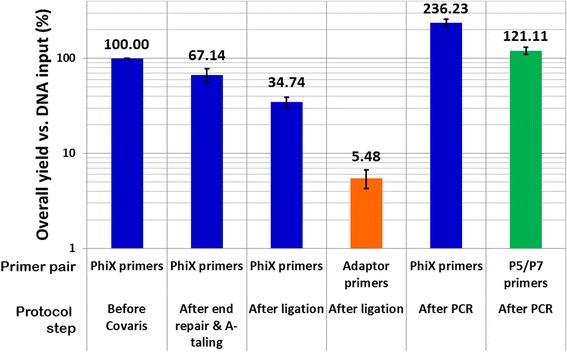
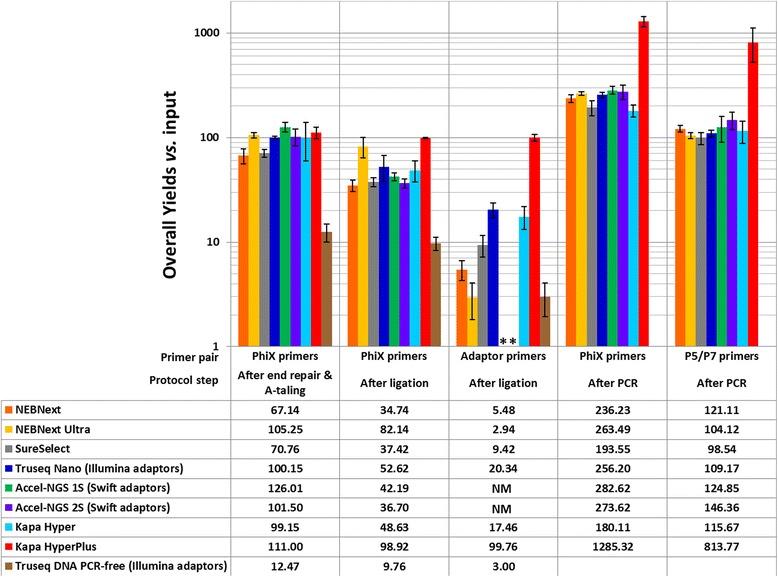
We compared 9 commercially available library preparation kits in a systematic manner using the same DNA sample by probing the amount of DNA remaining after each protocol steps using a new droplet digital PCR (ddPCR) assay. This method allows the precise quantification of fragments bearing either adaptors or P5/P7 sequences on both ends just after ligation or PCR enrichment. We also investigated the potential influence of DNA input and DNA fragment size on the final library preparation efficiency. The overall library preparations efficiencies of the libraries show important variations between the different kits with the ones combining several steps into a single one exhibiting some final yields 4 to 7 times higher than the other kits. Detailed ddPCR data also reveal that the adaptor ligation yield itself varies by more than a factor of 10 between kits, certain ligation efficiencies being so low that it could impair the original library complexity and impoverish the sequencing results. When a PCR enrichment step is necessary, lower adaptor-ligated DNA inputs leads to greater amplification yields, hiding the latent disparity between kits.
CONCLUSION
We describe a ddPCR assay that allows us to probe the efficiency of the most critical step in the library preparation, ligation, and to draw conclusion on which kits is more likely to preserve the sample heterogeneity and reduce the need of amplification.
背景
在过去十年中,新一代测序(NGS)技术的出现使DNA测序在每个测序碱基的价格和DNA文库制备的简易程度方面都实现了普及。对于为当前市场领导者Illumina制备DNA测序文库而言,有大量试剂盒可供选择,用户很难确定哪种试剂盒最适合其应用且效率最高;主要关注点不仅在于成本,还在于最小偏差、产量和时间效率。
结果
我们使用相同的DNA样本,通过一种新的液滴数字PCR(ddPCR)检测方法,在每个实验步骤后检测剩余DNA的量,以系统的方式比较了9种市售文库制备试剂盒。这种方法能够在连接或PCR富集后,精确量化两端带有接头或P5/P7序列的片段。我们还研究了DNA输入量和DNA片段大小对最终文库制备效率的潜在影响。不同试剂盒制备的文库整体效率显示出重要差异,将多个步骤合并为一个步骤的试剂盒最终产量比其他试剂盒高出4至7倍。详细的ddPCR数据还显示,不同试剂盒之间接头连接产量本身的差异超过10倍,某些连接效率非常低,可能会损害原始文库的复杂性并使测序结果变差。当需要PCR富集步骤时,较低的接头连接DNA输入量会导致更高的扩增产量,从而掩盖了不同试剂盒之间的潜在差异。
结论
我们描述了一种ddPCR检测方法,该方法使我们能够探究文库制备中最关键步骤——连接的效率,并得出哪种试剂盒更有可能保留样本异质性并减少扩增需求的结论。



 Zotero 插件