
催产素增强成年雄性恒河猴对自然社会行为视频的目光追随反应。
Oxytocin enhances gaze-following responses to videos of natural social behavior in adult male rhesus monkeys.
作者信息
Putnam P T, Roman J M, Zimmerman P E, Gothard K M
机构信息
Department of Physiology, College of Medicine, The University of Arizona, Tucson, AZ 85724, USA.
Department of Physiology, College of Medicine, The University of Arizona, Tucson, AZ 85724, USA.
出版信息
Psychoneuroendocrinology. 2016 Oct;72:47-53. doi: 10.1016/j.psyneuen.2016.05.016. Epub 2016 Jun 3.
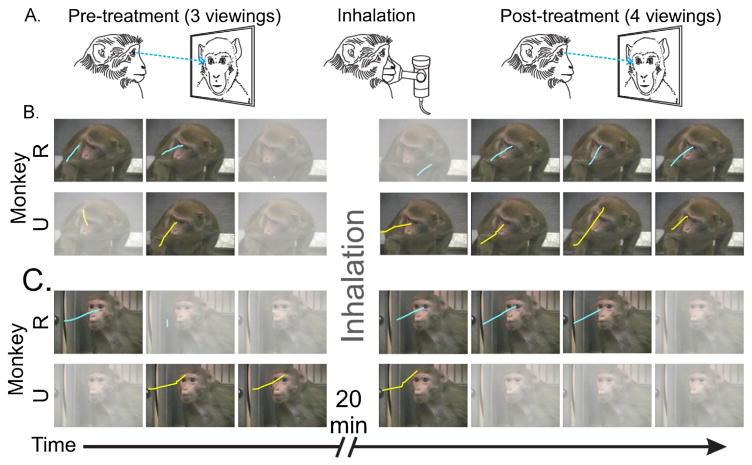
Gaze following is a basic building block of social behavior that has been observed in multiple species, including primates. The absence of gaze following is associated with abnormal development of social cognition, such as in autism spectrum disorders (ASD). Some social deficits in ASD, including the failure to look at eyes and the inability to recognize facial expressions, are ameliorated by intranasal administration of oxytocin (IN-OT). Here we tested the hypothesis that IN-OT might enhance social processes that require active engagement with a social partner, such as gaze following. Alternatively, IN-OT may only enhance the perceptual salience of the eyes, and may not modify behavioral responses to social signals. To test this hypothesis, we presented four monkeys with videos of conspecifics displaying natural behaviors. Each video was viewed multiple times before and after the monkeys received intranasally either 50 IU of OT or saline. We found that despite a gradual decrease in attention to the repeated viewing of the same videos (habituation), IN-OT consistently increased the frequency of gaze following saccades. Further analysis confirmed that these behaviors did not occur randomly, but rather predictably in response to the same segments of the videos. These findings suggest that in response to more naturalistic social stimuli IN-OT enhances the propensity to interact with a social partner rather than merely elevating the perceptual salience of the eyes. In light of these findings, gaze following may serve as a metric for pro-social effects of oxytocin that target social action more than social perception.
目光追随是一种社会行为的基本组成部分,在包括灵长类动物在内的多个物种中都有观察到。缺乏目光追随与社会认知的异常发展有关,比如在自闭症谱系障碍(ASD)中。ASD中的一些社交缺陷,包括不看眼睛和无法识别面部表情,通过鼻内注射催产素(IN-OT)得到改善。在这里,我们测试了这样一个假设,即IN-OT可能会增强那些需要与社交伙伴积极互动的社会过程,比如目光追随。或者,IN-OT可能只是增强了眼睛的感知显著性,而不会改变对社会信号的行为反应。为了验证这个假设,我们给四只猴子播放了同种个体展示自然行为的视频。在猴子鼻内注射50国际单位的催产素或生理盐水之前和之后,每个视频都被多次观看。我们发现,尽管随着对相同视频的重复观看(习惯化)注意力逐渐下降,但IN-OT持续增加了目光追随扫视的频率。进一步分析证实,这些行为并非随机发生,而是可预测地针对视频的相同片段做出反应。这些发现表明,对于更自然主义的社会刺激,IN-OT增强了与社交伙伴互动的倾向,而不仅仅是提高眼睛的感知显著性。鉴于这些发现,目光追随可能作为一种衡量催产素亲社会效应的指标,催产素对社会行动的靶向作用超过了社会感知。


 Zotero 插件