
跨器官和物种的基因特异性表达变异模式。
Gene-specific patterns of expression variation across organs and species.
作者信息
Breschi Alessandra, Djebali Sarah, Gillis Jesse, Pervouchine Dmitri D, Dobin Alex, Davis Carrie A, Gingeras Thomas R, Guigó Roderic
机构信息
Centre for Genomic Regulation (CRG), The Barcelona Institute of Science and Technology, Dr. Aiguader 88, Barcelona, 08003, Spain.
Universitat Pompeu Fabra (UPF), Barcelona, Spain.
出版信息
Genome Biol. 2016 Jul 8;17(1):151. doi: 10.1186/s13059-016-1008-y.
BACKGROUND
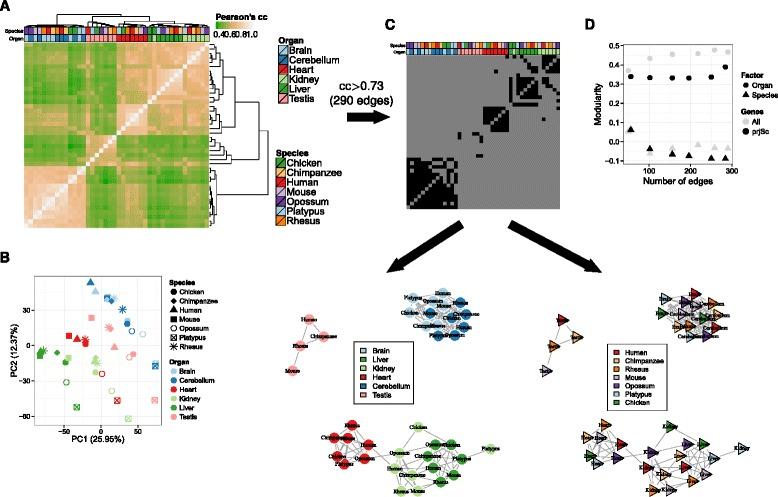
A comparison of transcriptional profiles derived from different tissues in a given species or among different species assumes that commonalities reflect evolutionarily conserved programs and that differences reflect species or tissue responses to environmental conditions or developmental program staging. Apparently conflicting results have been published regarding whether organ-specific transcriptional patterns dominate over species-specific patterns, or vice versa, making it unclear to what extent the biology of a given organism can be extrapolated to another. These studies have in common that they treat the transcriptomes monolithically, implicitly ignoring that each gene is likely to have a specific pattern of transcriptional variation across organs and species.
RESULTS
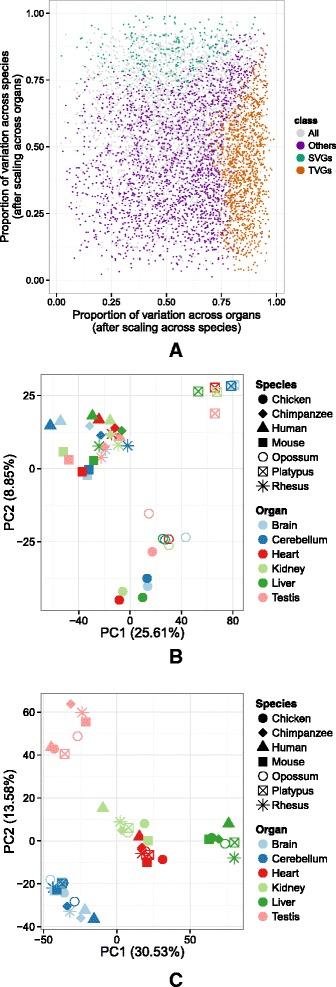
We use linear models to quantify this pattern. We find a continuum in the spectrum of expression variation: the expression of some genes varies considerably across species and little across organs, and simply reflects evolutionary distance. At the other extreme are genes whose expression varies considerably across organs and little across species; these genes are much more likely to be associated with diseases than are genes whose expression varies predominantly across species.
CONCLUSIONS
Whether transcriptomes, when considered globally, cluster preferentially according to one component or the other may not be a property of the transcriptomes, but rather a consequence of the dominant behavior of a subset of genes. Therefore, the values of the components of the variance of expression for each gene could become a useful resource when planning, interpreting, and extrapolating experimental data from mouse to humans.
背景
对给定物种不同组织或不同物种间转录谱的比较假定,共性反映进化上保守的程序,差异反映物种或组织对环境条件或发育程序阶段的反应。关于器官特异性转录模式是否比物种特异性模式占主导地位,或者反之,已有明显相互矛盾的结果发表,这使得不清楚给定生物体的生物学特性能在多大程度上外推到另一个生物体。这些研究的共同之处在于,它们将转录组作为一个整体来处理,含蓄地忽略了每个基因在器官和物种间可能有特定的转录变异模式。
结果
我们使用线性模型来量化这种模式。我们在表达变异谱中发现了一个连续体:一些基因的表达在物种间差异很大,而在器官间差异很小,仅仅反映进化距离。在另一个极端是那些基因,其表达在器官间差异很大,而在物种间差异很小;这些基因比那些主要在物种间表达有差异的基因更有可能与疾病相关。
结论
当从整体上考虑时,转录组是否优先根据一个或另一个成分聚类,可能不是转录组的特性,而是一部分基因的主导行为的结果。因此,每个基因表达方差成分的值在规划、解释和从小鼠到人类外推实验数据时可能成为一种有用的资源。


 Zotero 插件