
通过RNA共表达网络揭示肝脏在免疫中的作用。
Uncovering the liver's role in immunity through RNA co-expression networks.
作者信息
Harrall Kylie K, Kechris Katerina J, Tabakoff Boris, Hoffman Paula L, Hines Lisa M, Tsukamoto Hidekazu, Pravenec Michal, Printz Morton, Saba Laura M
机构信息
Department of Pharmaceutical Sciences, University of Colorado Skaggs School of Pharmacy and Pharmaceutical Sciences, Aurora, CO, 80045, USA.
Department of Biostatistics and Informatics, University of Colorado School of Public Health, Aurora, CO, 80045, USA.
出版信息
Mamm Genome. 2016 Oct;27(9-10):469-84. doi: 10.1007/s00335-016-9656-5. Epub 2016 Jul 11.
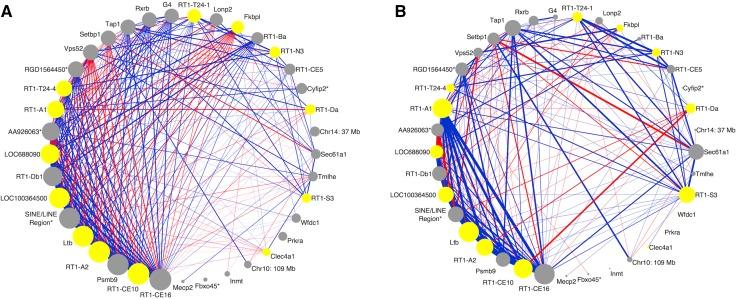
Gene co-expression analysis has proven to be a powerful tool for ascertaining the organization of gene products into networks that are important for organ function. An organ, such as the liver, engages in a multitude of functions important for the survival of humans, rats, and other animals; these liver functions include energy metabolism, metabolism of xenobiotics, immune system function, and hormonal homeostasis. With the availability of organ-specific transcriptomes, we can now examine the role of RNA transcripts (both protein-coding and non-coding) in these functions. A systems genetic approach for identifying and characterizing liver gene networks within a recombinant inbred panel of rats was used to identify genetically regulated transcriptional networks (modules). For these modules, biological consensus was found between functional enrichment analysis and publicly available phenotypic quantitative trait loci (QTL). In particular, the biological function of two liver modules could be linked to immune response. The eigengene QTLs for these co-expression modules were located at genomic regions coincident with highly significant phenotypic QTLs; these phenotypes were related to rheumatoid arthritis, food preference, and basal corticosterone levels in rats. Our analysis illustrates that genetically and biologically driven RNA-based networks, such as the ones identified as part of this research, provide insight into the genetic influences on organ functions. These networks can pinpoint phenotypes that manifest through the interaction of many organs/tissues and can identify unannotated or under-annotated RNA transcripts that play a role in these phenotypes.
基因共表达分析已被证明是一种强大的工具,可用于确定基因产物如何组织成对于器官功能至关重要的网络。像肝脏这样的器官,执行着许多对人类、大鼠和其他动物生存至关重要的功能;这些肝脏功能包括能量代谢、外源性物质代谢、免疫系统功能和激素稳态。随着器官特异性转录组的可得性,我们现在可以研究RNA转录本(包括蛋白质编码和非编码)在这些功能中的作用。一种用于在大鼠重组近交系中识别和表征肝脏基因网络的系统遗传学方法被用来识别基因调控的转录网络(模块)。对于这些模块,在功能富集分析和公开可用的表型数量性状位点(QTL)之间发现了生物学共识。特别是,两个肝脏模块的生物学功能可能与免疫反应相关。这些共表达模块的特征基因QTL位于与高度显著的表型QTL一致的基因组区域;这些表型与大鼠的类风湿性关节炎、食物偏好和基础皮质酮水平有关。我们的分析表明,基于基因和生物学驱动的RNA网络,例如作为本研究一部分所识别的那些网络,能够深入了解基因对器官功能的影响。这些网络可以精确指出通过许多器官/组织相互作用而表现出的表型,并且可以识别在这些表型中起作用的未注释或注释不足的RNA转录本。




 Zotero 插件