
肝脏外植大体检查中发现的不同结节:相关性及切片需求——来自印度的经验
Different Nodules Identified during Liver Explant Gross Examination: Relevance and Need for Sectioning-Experience from India.
作者信息
Bansal Nalini, Vij Vivek, Rastogi Mukul
机构信息
SRL Ltd., Fortis Escorts Heart Institute, New Delhi, India.
Fortis Hospital, Gurgaon, India.
出版信息
Int J Hepatol. 2016;2016:4390434. doi: 10.1155/2016/4390434. Epub 2016 Jun 22.
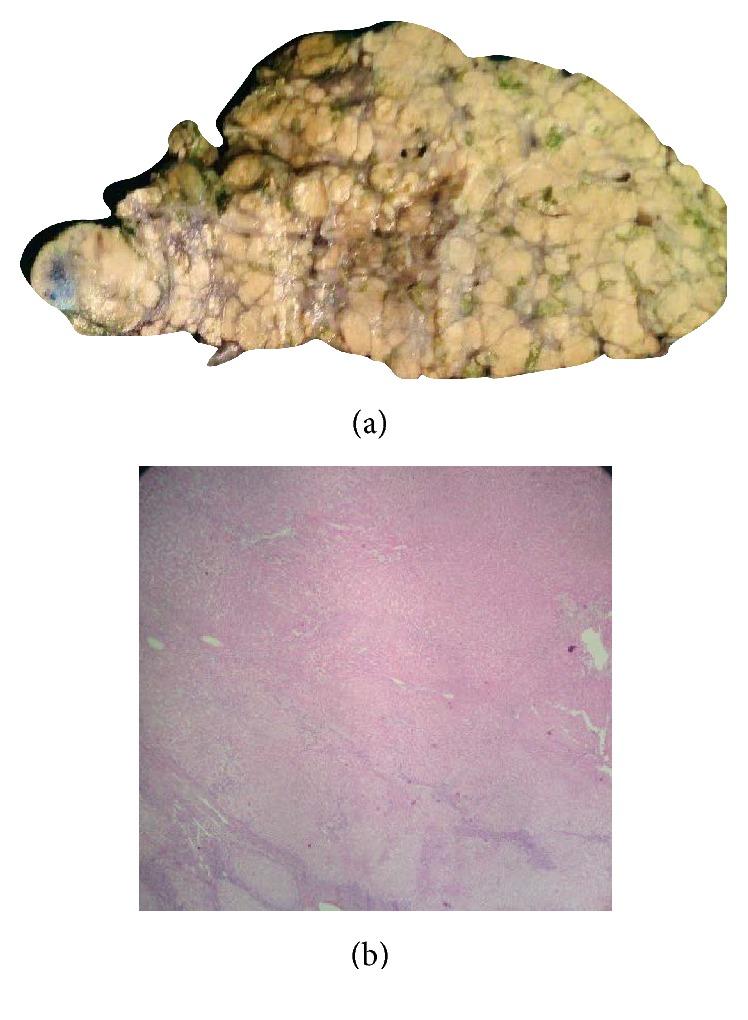
Objective. The goal of this study was to determine the etiopathological association of various hepatic nodules identified during gross examination of liver explants specimen and the grossing aspects of these abnormal nodules especially those smaller than 1 cm in diameter. Our aim was to analyze whether there is any association of macroregenerative and dysplastic nodule with hepatocellular carcinoma. Materials and Methods. Fifty consecutive liver explants specimens were analyzed for the presence of any abnormal nodule (abnormal nodule defined as any nodule different in color, texture, and appearance from adjacent liver tissue). Results. Of the total 40 abnormal nodules identified in 50 liver explant specimens, there were 12 (30%) HCC [including 5 small HCC (41% of total HCC) and 1 steatohepatitic HCC (8% of total HCC)], 11 (27%) MRNs, 8 (20%) dysplastic nodules, and 9 (22%) necrotic nodules. Most cases (72%) of MRN are seen in hepatitis C virus related cirrhosis with only 2 cases having associated HCC. Most cases of HCC were seen in cases of HBV associated cirrhosis (60%). The association of MRN was not found to be significantly associated with HCC with a p value of 1.0. Dysplastic nodules were found to be significantly associated with HCC with a p value of 0.02. Conclusion. In hepatic carcinogenesis, the role of MRN does not appear to be significant. However, the presence of dysplastic nodules is significantly associated with HCC. The study identified another variant of cirrhotic nodules herein called necrotic nodules that are mostly tan greenish in color and <0.5 cm in diameter. No dysplastic changes were identified in any of these nodules disqualifying the need of sectioning in such nodules.
目的。本研究的目的是确定在肝脏外植体标本大体检查中发现的各种肝结节的病因病理关联,以及这些异常结节的大体特征,特别是那些直径小于1厘米的结节。我们的目的是分析大再生结节和发育异常结节与肝细胞癌之间是否存在关联。材料与方法。对连续50个肝脏外植体标本进行分析,以确定是否存在任何异常结节(异常结节定义为任何在颜色、质地和外观上与相邻肝组织不同的结节)。结果。在50个肝脏外植体标本中总共鉴定出40个异常结节,其中有12个(30%)肝细胞癌[包括5个小肝细胞癌(占肝细胞癌总数的41%)和1个脂肪性肝炎相关肝细胞癌(占肝细胞癌总数的8%)],11个(27%)大再生结节,8个(20%)发育异常结节,以及9个(22%)坏死结节。大再生结节的大多数病例(72%)见于丙型肝炎病毒相关肝硬化,仅有2例伴有肝细胞癌。大多数肝细胞癌病例见于乙型肝炎病毒相关肝硬化病例(60%)。未发现大再生结节与肝细胞癌有显著关联,p值为1.0。发现发育异常结节与肝细胞癌有显著关联,p值为0.02。结论。在肝癌发生过程中,大再生结节的作用似乎不显著。然而,发育异常结节的存在与肝细胞癌显著相关。本研究在此鉴定出另一种肝硬化结节变体称为坏死结节,其颜色大多为棕绿色,直径<0.5厘米。在这些结节中均未发现发育异常改变,因此无需对这类结节进行切片检查。



 Zotero 插件