
非侵入性聚焦超声刺激可调节大鼠海马体中神经元振荡之间的相位-振幅耦合。
Noninvasive Focused Ultrasound Stimulation Can Modulate Phase-Amplitude Coupling between Neuronal Oscillations in the Rat Hippocampus.
作者信息
Yuan Yi, Yan Jiaqing, Ma Zhitao, Li Xiaoli
机构信息
Institute of Electrical Engineering, Yanshan University Qinhuangdao, China.
School of Electrical and Control Engineering, North China University of Technology Beijing, China.
出版信息
Front Neurosci. 2016 Jul 22;10:348. doi: 10.3389/fnins.2016.00348. eCollection 2016.
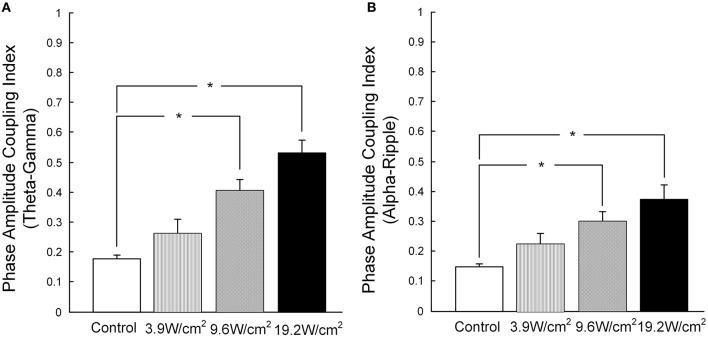
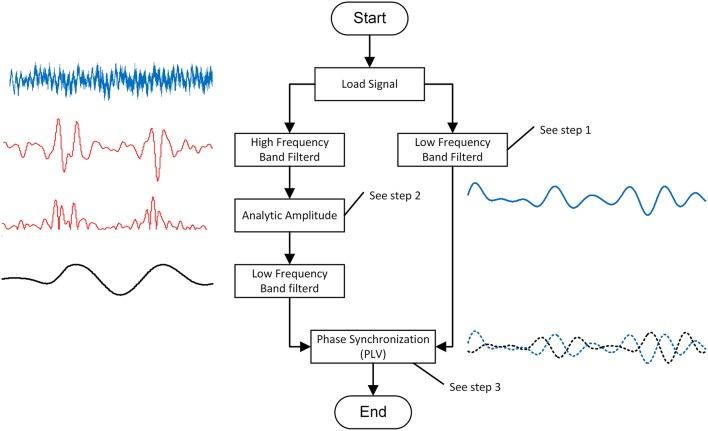
Noninvasive focused ultrasound stimulation (FUS) can be used to modulate neural activity with high spatial resolution. Phase-amplitude coupling (PAC) between neuronal oscillations is tightly associated with cognitive processes, including learning, attention, and memory. In this study, we investigated the effect of FUS on PAC between neuronal oscillations and established the relationship between the PAC index and ultrasonic intensity. The rat hippocampus was stimulated using focused ultrasound at different spatial-average pulse-average ultrasonic intensities (3.9, 9.6, and 19.2 W/cm(2)). The local field potentials (LFPs) in the rat hippocampus were recorded before and after FUS. Then, we analyzed PAC between neuronal oscillations using a PAC calculation algorithm. Our results showed that FUS significantly modulated PAC between the theta (4-8 Hz) and gamma (30-80 Hz) bands and between the alpha (9-13 Hz) and ripple (81-200 Hz) bands in the rat hippocampus, and PAC increased with incremental increases in ultrasonic intensity.
无创聚焦超声刺激(FUS)可用于以高空间分辨率调节神经活动。神经元振荡之间的相位-振幅耦合(PAC)与包括学习、注意力和记忆在内的认知过程密切相关。在本研究中,我们研究了FUS对神经元振荡之间PAC的影响,并建立了PAC指数与超声强度之间的关系。使用聚焦超声以不同的空间平均脉冲平均超声强度(3.9、9.6和19.2 W/cm²)刺激大鼠海马体。在FUS前后记录大鼠海马体中的局部场电位(LFP)。然后,我们使用PAC计算算法分析神经元振荡之间的PAC。我们的结果表明,FUS显著调节了大鼠海马体中θ(4-8 Hz)和γ(30-80 Hz)频段之间以及α(9-13 Hz)和涟漪(81-200 Hz)频段之间的PAC,并且PAC随着超声强度的增加而增加。


 Zotero 插件