
G蛋白偶联受体二聚体中胆固醇依赖性构象可塑性
Cholesterol-dependent Conformational Plasticity in GPCR Dimers.
作者信息
Prasanna Xavier, Sengupta Durba, Chattopadhyay Amitabha
机构信息
CSIR-National Chemical Laboratory, Dr. Homi Bhabha Road, Pune 411 008, India.
CSIR-Centre for Cellular and Molecular Biology, Uppal Road, Hyderabad 500 007, India.
出版信息
Sci Rep. 2016 Aug 18;6:31858. doi: 10.1038/srep31858.
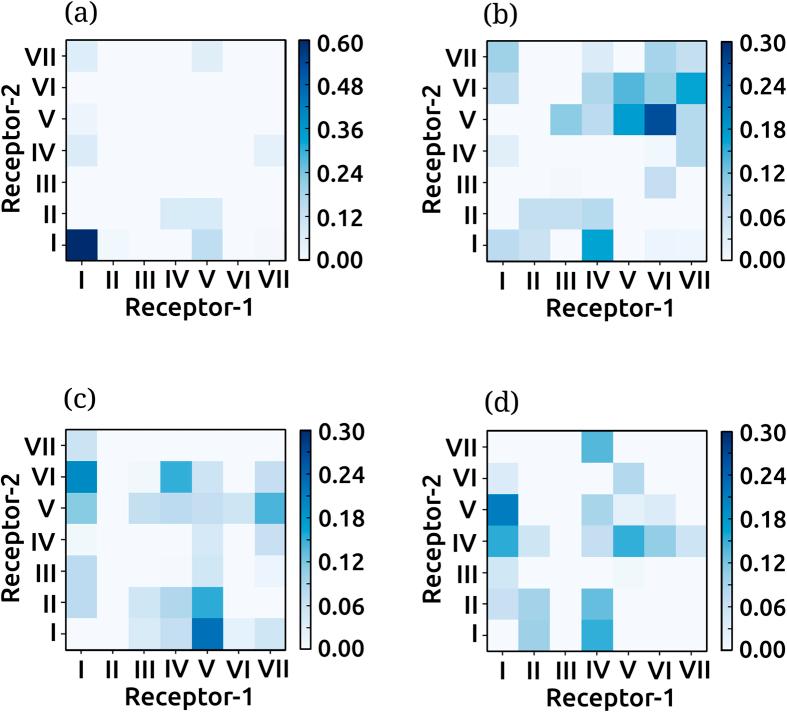
The organization and function of the serotonin1A receptor, an important member of the GPCR family, have been shown to be cholesterol-dependent, although the molecular mechanism is not clear. We performed a comprehensive structural and dynamic analysis of dimerization of the serotonin1A receptor by coarse-grain molecular dynamics simulations totaling 3.6 ms to explore the molecular details of its cholesterol-dependent association. A major finding is that the plasticity and flexibility of the receptor dimers increase with increased cholesterol concentration. In particular, a dimer interface formed by transmembrane helices I-I was found to be sensitive to cholesterol. The modulation of dimer interface appears to arise from a combination of direct cholesterol occupancy and indirect membrane effects. Interestingly, the presence of cholesterol at the dimer interface is correlated with increased dimer plasticity and flexibility. These results represent an important step in characterizing the molecular interactions in GPCR organization with potential relevance to therapeutic interventions.
血清素1A受体是GPCR家族的重要成员,其组织和功能已被证明依赖于胆固醇,尽管分子机制尚不清楚。我们通过总计3.6毫秒的粗粒度分子动力学模拟,对血清素1A受体的二聚化进行了全面的结构和动力学分析,以探索其胆固醇依赖性缔合的分子细节。一个主要发现是,受体二聚体的可塑性和灵活性随着胆固醇浓度的增加而增加。特别是,发现由跨膜螺旋I-I形成的二聚体界面对胆固醇敏感。二聚体界面的调节似乎源于直接胆固醇占据和间接膜效应的组合。有趣的是,二聚体界面处胆固醇的存在与二聚体可塑性和灵活性的增加相关。这些结果代表了表征GPCR组织中分子相互作用的重要一步,这可能与治疗干预相关。




 Zotero 插件