
使用基因开关Gal4系统在黑腹果蝇中敲低基因的实用建议。
Practical Recommendations for the Use of the GeneSwitch Gal4 System to Knock-Down Genes in Drosophila melanogaster.
作者信息
Scialo Filippo, Sriram Ashwin, Stefanatos Rhoda, Sanz Alberto
机构信息
Institute for Cell and Molecular Biosciences, Campus for Ageing and Vitality, University of Newcastle, Newcastle-upon-Tyne, NE4 5PL, United Kingdom.
出版信息
PLoS One. 2016 Aug 29;11(8):e0161817. doi: 10.1371/journal.pone.0161817. eCollection 2016.
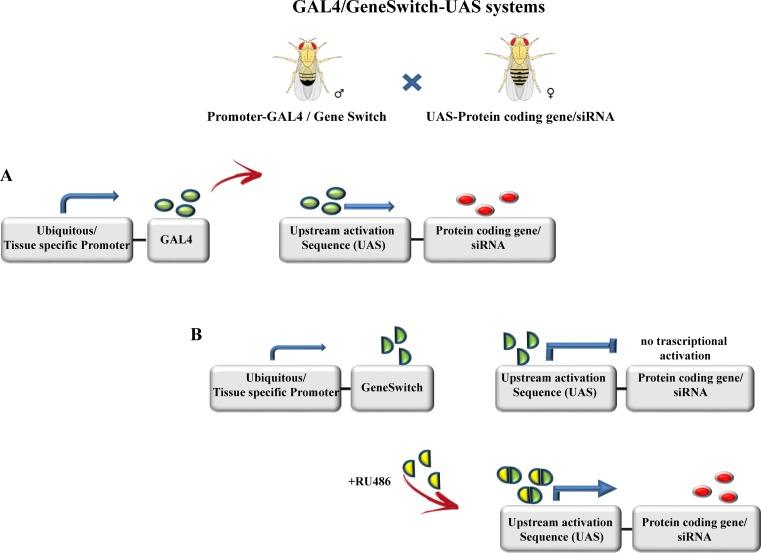
Drosophila melanogaster is a popular research model organism thanks to its' powerful genetic tools that allow spatial and temporal control of gene expression. The inducible GeneSwitch Gal4 system (GS) system is a modified version of the classic UAS/GAL4 system which allows inducible regulation of gene expression and eliminates background effects. It is widely acknowledged that the GS system is leaky, with low level expression of UAS transgenes in absence of the inducer RU-486 (the progesterone analog that activates the modified GAL4 protein). However, in the course of our experiments, we have observed that the extent of this leak depends on the nature of the transgene being expressed. In the absence of RU-486, when strong drivers are used to express protein coding transgenes, leaky expression is low or negligible, however expression of RNA interference (RNAi) transgenes results in complete depletion of protein levels. The majority of published studies, using the GS system and RNAi transgenes validate knock-down efficiency by comparing target gene mRNA levels between induced and non-induced groups. Here, we demonstrate that this approach is lacking and that both additional control groups and further validation is required at the protein level. Unfortunately, this experimental limitation of the GS system eliminates "the background advantage", but does offer the possibility of performing more complex experiments (e.g. studying depletion and overexpression of different proteins in the same genetic background). The limitations and new possible applications of the GS system are discussed in detail.
由于拥有强大的遗传工具,可实现基因表达的时空控制,黑腹果蝇是一种广受欢迎的研究模式生物。诱导型基因开关Gal4系统(GS系统)是经典UAS/GAL4系统的改良版本,它允许对基因表达进行诱导调节并消除背景效应。人们普遍认为GS系统存在渗漏现象,即在没有诱导剂RU-486(激活改良型GAL4蛋白的孕酮类似物)的情况下,UAS转基因会有低水平表达。然而,在我们的实验过程中,我们观察到这种渗漏的程度取决于所表达转基因的性质。在没有RU-486的情况下,当使用强驱动子来表达蛋白质编码转基因时,渗漏表达很低或可忽略不计,但是RNA干扰(RNAi)转基因的表达会导致蛋白质水平完全耗尽。大多数已发表的研究,使用GS系统和RNAi转基因,通过比较诱导组和非诱导组之间的靶基因mRNA水平来验证敲低效率。在这里,我们证明这种方法是不够的,在蛋白质水平上还需要额外的对照组和进一步的验证。不幸的是,GS系统的这一实验局限性消除了“背景优势”,但确实提供了进行更复杂实验的可能性(例如在相同遗传背景下研究不同蛋白质的耗尽和过表达)。我们将详细讨论GS系统的局限性和新的可能应用。



 Zotero 插件