
艰难梭菌的生长模式——与菌株、二元毒素及疾病严重程度的相关性:一项前瞻性队列研究
Growth Patterns of Clostridium difficile - Correlations with Strains, Binary Toxin and Disease Severity: A Prospective Cohort Study.
作者信息
Tschudin-Sutter Sarah, Braissant Olivier, Erb Stefan, Stranden Anne, Bonkat Gernot, Frei Reno, Widmer Andreas F
机构信息
Division of Infectious Diseases and Hospital Epidemiology, University Hospital Basel, Basel, Switzerland.
Laboratory of Biomechanics and Biocalorimetry, University of Basel, Basel, Switzerland.
出版信息
PLoS One. 2016 Sep 6;11(9):e0161711. doi: 10.1371/journal.pone.0161711. eCollection 2016.
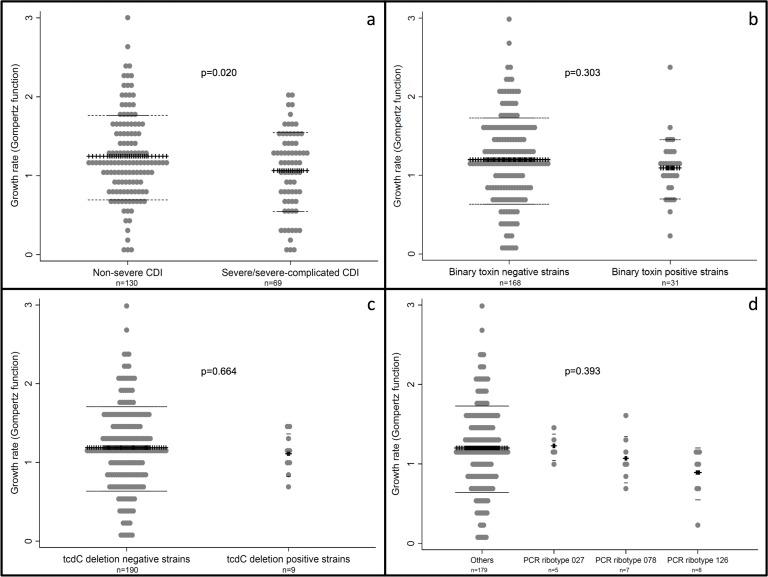
A broad spectrum of symptoms has been associated with C. difficile infection (CDI). Several studies indicate that toxin-production correlates with growth rates of C. difficile. This study aimed to correlate growth rates of C. difficile with disease severity and strain characteristics. From 01/2003 to 10/2011, strains from a prospective cohort of all inpatients with CDI at the University Hospital Basel, Switzerland were analyzed regarding binary toxin, presence of the tcdC deletion and ribotype. Isothermal microcalorimetry was performed to determine growth rates, quantified by the Gompertz function. Ordered logistic regression models were used to correlate disease severity with strain features and clinical characteristics. Among 199 patients, 31 (16%) were infected with binary toxin-producing strains, of which the tcdC gene-deletion nt117 was detected in 9 (4%). Disease severity was classified as mild in 130 patients (65.3%), as severe in 59 patients (29.7%) and as severe/complicated in 10 patients (5.0%). Growth rates were inversely associated with disease severity in univariable (OR 0.514, 95%CI 0.29-0.91, p = 0.023) and multivariable analyses (OR 0.51, 95%CI 0.26-0.97, p = 0.040). While none of the strain characteristics such as presence of the tcdC gene deletion or binary toxin predicted CDI severity, growth rates were inversely correlated with disease severity. Further investigations are needed to analyze growth-regulators and respective correlations with the level of toxin production in C. difficile, which may be important determinants of disease severity.
艰难梭菌感染(CDI)与一系列广泛的症状相关。多项研究表明,毒素产生与艰难梭菌的生长速率相关。本研究旨在将艰难梭菌的生长速率与疾病严重程度及菌株特征相关联。2003年1月至2011年10月,对瑞士巴塞尔大学医院所有CDI住院患者前瞻性队列中的菌株进行分析,检测其二元毒素、tcdC缺失情况及核糖体分型。采用等温微量热法测定生长速率,通过Gompertz函数进行量化。使用有序逻辑回归模型将疾病严重程度与菌株特征和临床特征相关联。在199例患者中,31例(16%)感染了产生二元毒素的菌株,其中9例(4%)检测到tcdC基因缺失nt117。130例患者(65.3%)疾病严重程度分类为轻度,59例患者(29.7%)为重度,10例患者(5.0%)为重度/复杂型。在单变量分析(OR 0.514,95%CI 0.29 - 0.91,p = 0.023)和多变量分析(OR 0.51,95%CI 0.26 - 0.97,p = 0.040)中,生长速率与疾病严重程度呈负相关。虽然tcdC基因缺失或二元毒素等菌株特征均不能预测CDI严重程度,但生长速率与疾病严重程度呈负相关。需要进一步研究分析艰难梭菌中的生长调节因子及其与毒素产生水平的相关性,这可能是疾病严重程度的重要决定因素。

 Zotero 插件