
不同血液嗜酸性粒细胞计数的慢性阻塞性肺疾病(COPD)患者使用更高吸入糖皮质激素剂量的有效性。
Effectiveness using higher inhaled corticosteroid dosage in patients with COPD by different blood eosinophilic counts.
作者信息
Cheng Shih-Lung, Lin Ching-Hsiung
机构信息
Department of Internal Medicine, Far Eastern Memorial Hospital, Taipei; Department of Chemical Engineering and Materials Science, Yuan Ze University, Zhongli, Taoyuan City.
Department of Internal Medicine, Division of Chest Medicine, Changhua Christian Hospital, Changhua; Department of Respiratory Care, College of Health Sciences, Chang Jung Christian University, Tainan; School of Medicine, Chung Shan Medical University, Taichung City, Taiwan.
出版信息
Int J Chron Obstruct Pulmon Dis. 2016 Sep 21;11:2341-2348. doi: 10.2147/COPD.S115132. eCollection 2016.
BACKGROUND
Blood eosinophil counts have been documented as a good biomarker for patients with chronic obstructive pulmonary disease (COPD) using inhaled corticosteroid (ICS) therapy. However, the effectiveness and safety of prescribing high or medium dose of ICS for patients with different eosinophil counts are unknown.
METHODS
A post hoc analysis of a previous prospective randomized study was performed for COPD patients using higher dose (HD: Fluticasone 1,000 μg/day) or medium dose (MD: Fluticasone 500 μg/day) of ICS combined with Salmeterol (100 μg/day). Patients were classified into two groups: those with high eosinophil counts (HE ≥3%) and those with low eosinophil counts (LE <3%). Lung function was evaluated with forced expiratory volume in 1 second, forced vital capacity, and COPD assessment test. Frequencies of acute exacerbation and pneumonia were also measured.
RESULTS
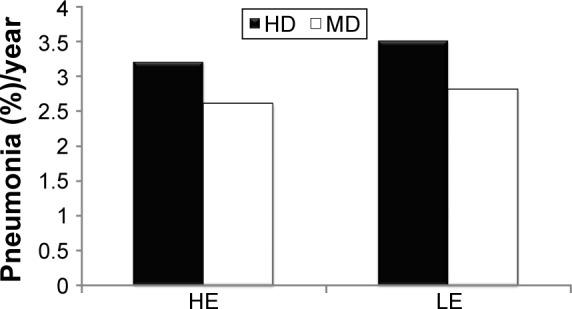
Two hundred and forty-eight patients were studied and classified into higher eosinophil (HE) (n=85, 34.3%) and lower eosinophil (LE) groups (n=163, 65.7%). The levels of forced expiratory volume in 1 second were significantly increased in patients of HE group treated with HD therapy, compared with the other groups (HE/HD: 125.9±27.2 mL vs HE/MD: 94.3±23.7 mL, vs LE/HD: 70.4±20.5 mL, vs LE/MD: 49.8±16.7 mL; <0.05) at the end of the study. Quality of life (COPD assessment test) markedly improved in HE/HD group than in MD/LE group (HE/HD: 9±5 vs LE/MD: 16±7, =0.02). The frequency of acute exacerbation was more decreased in HE/HD group patients, compared with that in LE/MD group (HE/HD: 13.5% vs LE/MD: 28.7%, <0.01). Pneumonia incidence was similar in the treatment groups (HE/HD: 3.2%, HE/MD: 2.6%, LE/HD: 3.5%, LE/MD 2.8%; =0.38).
CONCLUSION
The study results support using blood eosinophil counts as a biomarker of ICS response and show the benefits of greater improvement of lung function, quality of life, and decreased exacerbation frequency in COPD patients with blood eosinophil counts higher than 3%, especially treated with higher dose of ICS.
背景
血液嗜酸性粒细胞计数已被证明是慢性阻塞性肺疾病(COPD)患者使用吸入性糖皮质激素(ICS)治疗的良好生物标志物。然而,为不同嗜酸性粒细胞计数的患者开具高剂量或中等剂量ICS的有效性和安全性尚不清楚。
方法
对先前一项前瞻性随机研究进行事后分析,研究对象为使用高剂量(HD:氟替卡松1000μg/天)或中等剂量(MD:氟替卡松500μg/天)ICS联合沙美特罗(100μg/天)的COPD患者。患者分为两组:嗜酸性粒细胞计数高的患者(HE≥3%)和嗜酸性粒细胞计数低的患者(LE<3%)。通过第1秒用力呼气量、用力肺活量和COPD评估测试来评估肺功能。还测量了急性加重和肺炎的发生频率。
结果
共研究了248例患者,分为嗜酸性粒细胞计数高(HE)组(n = 85,34.3%)和嗜酸性粒细胞计数低(LE)组(n = 163,65.7%)。在研究结束时,与其他组相比,HD治疗的HE组患者的第1秒用力呼气量水平显著增加(HE/HD:125.9±27.2 mL vs HE/MD:94.3±23.7 mL,vs LE/HD:70.4±20.5 mL,vs LE/MD:49.8±16.7 mL;P<0.05)。HE/HD组的生活质量(COPD评估测试)比MD/LE组有显著改善(HE/HD:9±5 vs LE/MD:16±7,P = 0.02)。与LE/MD组相比,HE/HD组患者的急性加重频率降低更多(HE/HD:13.5% vs LE/MD:28.7%,P<0.01)。各治疗组的肺炎发病率相似(HE/HD:3.2%,HE/MD:2.6%,LE/HD:3.5%,LE/MD 2.8%;P = 0.38)。
结论
研究结果支持将血液嗜酸性粒细胞计数作为ICS反应的生物标志物,并表明血液嗜酸性粒细胞计数高于3%的COPD患者,尤其是接受高剂量ICS治疗时,在肺功能、生活质量改善以及加重频率降低方面有更大益处。


 Zotero 插件