
结构性染色体畸变会导致细胞核肿胀。
Structural chromosome aberrations cause swelling of the nucleus.
作者信息
Takeshita Kenji, Ogawa Hiroaki I, Maeda Toshinari
机构信息
Department of Biological Functions Engineering, Graduate School of Life Science and Systems Engineering, Kyushu Institute of Technology, 2-4 Hibikino, Wakamatsu-ku, Fukuoka, 808-0196 Japan ; UBE Scientific Analysis Laboratory, Inc, 1978-5 Kogushi, Ube, Yamaguchi 755-8633 Japan.
Department of Biological Functions Engineering, Graduate School of Life Science and Systems Engineering, Kyushu Institute of Technology, 2-4 Hibikino, Wakamatsu-ku, Fukuoka, 808-0196 Japan.
出版信息
Genes Environ. 2016 Oct 1;38:22. doi: 10.1186/s41021-016-0047-7. eCollection 2016.
BACKGROUND
Carcinogens are known to cause swelling of the mammalian cell nucleus. However, the mechanism of the swelling and its toxicological significance have not been fully elucidated. Since nuclear swelling (NS hereafter) has been frequently observed in chromosomal aberration (CA hereafter) tests (in vitro), the relationship between NS and CAs was investigated in this study.
RESULTS
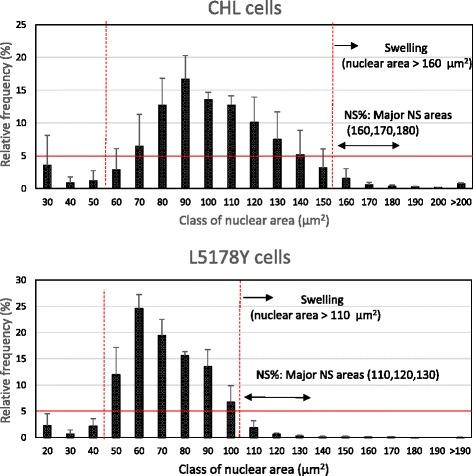
In a short-term CA test using the fibroblast CHL cell line, the appearance of NS increased in a dose-dependent manner after exposure to six types of clastogens (mitomycin C, methyl methane sulfonate, 1-methyl-3-nitro-1-nitrosoguanidine, benzo[a]pyrene, cyclophosphamide monohydrate, and 9,10-dimethyl-2-benzanthracene), and a strong correlation was found between NS (%) and CAs (%) at each dosage. Therefore, we hypothesized that clastogens cause NS in cultured mammalian cells, since the mouse lymphoma L5178Y cell line is known to have a similar sensitivity to clastogens. Thus, we measured NS for 14 compounds (clastogens) that are known to induce structural CAs, 4 aneugens, and 12 non-mutagenes. Almost all clastogens caused NS of more than 5 %, which increased in a dose-dependent manner. Among the aneugens, colchicine, and diethylstilbestrol caused the same level of NS % as the clastogens, while carbendazim and trichlorfon caused a similar level of NS % as the clastogens only at higher levels of cytotoxicity. Almost all the non-mutagens caused less than 5 % NS.
CONCLUSIONS
These results strongly suggest that NS is mainly caused by structural aberrations in the nucleus during interphase of the cell cycle.
背景
已知致癌物会导致哺乳动物细胞核肿胀。然而,肿胀的机制及其毒理学意义尚未完全阐明。由于在染色体畸变(以下简称CA)试验(体外)中经常观察到核肿胀(以下简称NS),本研究对NS与CA之间的关系进行了调查。
结果
在使用成纤维细胞CHL细胞系的短期CA试验中,暴露于六种类型的断裂剂(丝裂霉素C、甲基磺酸甲酯、1-甲基-3-硝基-1-亚硝基胍、苯并[a]芘、一水合环磷酰胺和9,10-二甲基-2-苯并蒽)后,NS的出现呈剂量依赖性增加,并且在每个剂量下NS(%)与CA(%)之间发现了很强的相关性。因此,我们推测断裂剂会在培养的哺乳动物细胞中引起NS,因为已知小鼠淋巴瘤L5178Y细胞系对断裂剂具有相似的敏感性。因此,我们测量了14种已知可诱导结构CA的化合物(断裂剂)、4种非整倍体剂和12种非诱变剂的NS。几乎所有断裂剂都会导致超过5%的NS,且呈剂量依赖性增加。在非整倍体剂中,秋水仙碱和己烯雌酚引起的NS%水平与断裂剂相同,而多菌灵和敌百虫仅在较高细胞毒性水平下引起与断裂剂相似的NS%水平。几乎所有非诱变剂引起的NS均小于5%。
结论
这些结果有力地表明,NS主要是由细胞周期间期细胞核中的结构畸变引起的。



 Zotero 插件