
动脉粥样硬化对旋股外侧动脉及其降支的影响:与非动脉粥样硬化风险的对比研究
Effect of Atherosclerosis on the Lateral Circumflex Femoral Artery and Its Descending Branch: Comparative Study to Nonatherosclerotic Risk.
作者信息
Burusapat Chairat, Nanasilp Tirapat, Kunaphensaeng Paiboon, Ruamthanthong Anuchit
机构信息
Division of Plastic and Reconstructive Surgery, Department of Surgery, and Department of Radiology, Phramongkutklao Hospital, Bangkok, Thailand.
出版信息
Plast Reconstr Surg Glob Open. 2016 Sep 7;4(9):e856. doi: 10.1097/GOX.0000000000000849. eCollection 2016 Sep.
UNLABELLED
The anterolateral thigh (ALT) flap has been widely used for reconstructions. Nevertheless, the atherosclerotic risk factors that affect the lateral circumflex femoral artery (LCFA) are still inconclusive. The aim was to study the effect of atherosclerosis on the LCFA and descending branch (dLCFA) visualized by computer tomographic angiography (CTA) between nonatherosclerosis and atherosclerosis.
METHODS
Retrospective studies of CTA of lower extremity were reviewed. The patients were divided into 2 groups: nonatherosclerotic and atherosclerotic risk factors. The angiographic study of LCFA and dLCFA was analyzed, and atherosclerotic and nonatherosclerotic risk factors were compared.
RESULTS
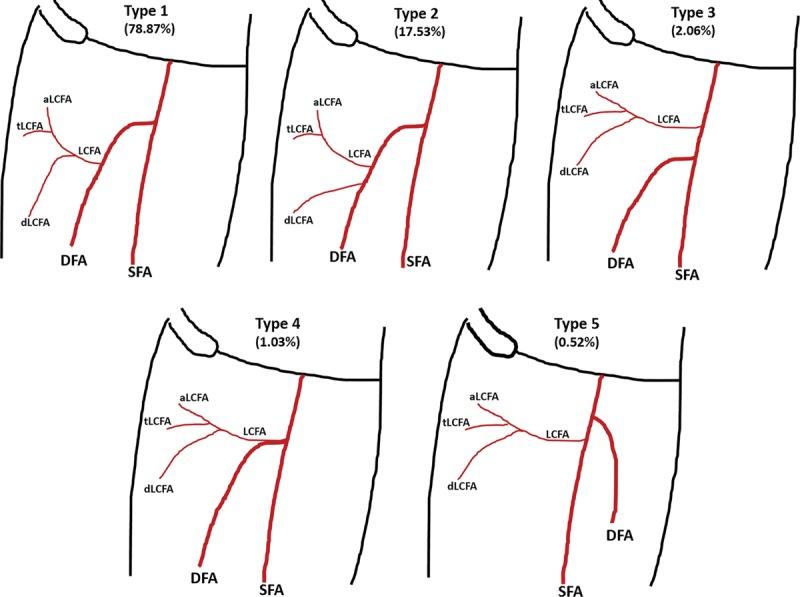
Ninety-seven patients with 194 lower extremities were enrolled. Atherosclerotic risks comprised 76 patients. A total of 14, 16, and 46 patients had 1, 2, and 3 risk factors, respectively. Musculocutaneous perforator was 79.38%. The LCFA originated from deep femoral, common femoral, and superficial femoral artery was 97.42%, 2.06%, and 0.52%, respectively. The dLCFA was classified into 5 types depending on its origin. Diameters of LCFA in nonatherosclerotic and atherosclerotic patients were 4.03 ± 0.71 and 4.07 ± 0.97 mm, respectively. No statistical significance was found between both groups in diameters of LCFA. Diameters of dLCFA in nonatherosclerotic patients were 2.28 ± 0.28 mm and in atherosclerotic patients were 2.11 ± 0.28 mm. Statistical significance of diameters of dLCFA was found in patients having 3 risk factors and smoker groups ( < 0.05).
CONCLUSIONS
LCFA is not atherosclerosis resistant. Stenosis of the LCFA and dLCFA occurred in varying degrees in atherosclerosis-risk patients. Preoperative CTA should be considered to evaluate the patency in multiple risk factors patients.
未标注
股前外侧(ALT)皮瓣已被广泛用于重建手术。然而,影响旋股外侧动脉(LCFA)的动脉粥样硬化危险因素仍不明确。本研究旨在通过计算机断层血管造影(CTA)研究非动脉粥样硬化和动脉粥样硬化患者中动脉粥样硬化对LCFA及其降支(dLCFA)的影响。
方法
回顾性分析下肢CTA研究。患者分为两组:无动脉粥样硬化危险因素组和有动脉粥样硬化危险因素组。分析LCFA和dLCFA的血管造影情况,并比较动脉粥样硬化和非动脉粥样硬化危险因素。
结果
纳入97例患者共194条下肢。有动脉粥样硬化危险因素的患者76例。分别有14例、16例和46例患者有1个、2个和3个危险因素。肌皮穿支占79.38%。LCFA起源于股深动脉、股总动脉和股浅动脉的比例分别为97.42%、2.06%和0.52%。dLCFA根据其起源分为5种类型。非动脉粥样硬化患者和动脉粥样硬化患者的LCFA直径分别为4.03±0.71mm和4.07±0.97mm。两组间LCFA直径无统计学差异。非动脉粥样硬化患者的dLCFA直径为2.28±0.28mm,动脉粥样硬化患者为2.11±0.28mm。在有3个危险因素的患者组和吸烟患者组中,dLCFA直径有统计学差异(<0.05)。
结论
LCFA并非抗动脉粥样硬化。有动脉粥样硬化风险的患者中,LCFA和dLCFA不同程度地出现狭窄。对于有多种危险因素的患者,术前应考虑行CTA评估血管通畅情况。



 Zotero 插件