
肝脏特异性敲除精氨酸酶-1会导致一种与诱导性全身精氨酸酶-1缺乏相似的严重表型。
Liver-specific knockout of arginase-1 leads to a profound phenotype similar to inducible whole body arginase-1 deficiency.
作者信息
Ballantyne Laurel L, Sin Yuan Yan, Al-Dirbashi Osama Y, Li Xinzhi, Hurlbut David J, Funk Colin D
机构信息
Department of Biomedical and Molecular Sciences, Queen's University, Kingston, ON, Canada.
Newborn Screening Ontario, Children's Hospital of Eastern Ontario, Ottawa, ON, Canada; Faculty of Medicine and Health Sciences, United Arab Emirates University, United Arab Emirates.
出版信息
Mol Genet Metab Rep. 2016 Oct 12;9:54-60. doi: 10.1016/j.ymgmr.2016.10.003. eCollection 2016 Dec.
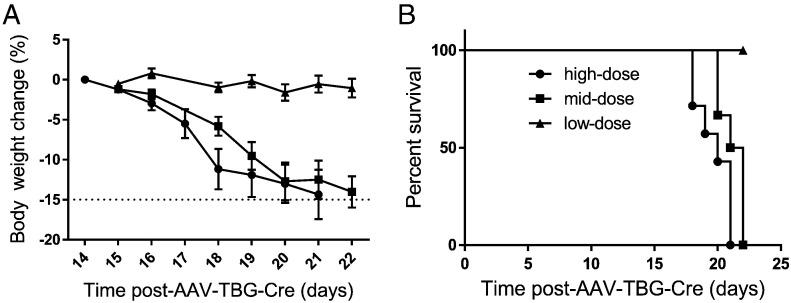
Arginase-1 (Arg1) converts arginine to urea and ornithine in the distal step of the urea cycle in liver. We previously generated a tamoxifen-inducible Arg1 deficient mouse model (Arg1-Cre) that disrupts Arg1 expression throughout the whole body and leads to lethality ≈ 2 weeks after gene disruption. Here, we evaluate if liver-selective Arg1 loss is sufficient to recapitulate the phenotype observed in global Arg1 knockout mice, as well as to gauge the effectiveness of gene delivery or hepatocyte transplantation to rescue the phenotype. Liver-selective Arg1 deletion was induced by using an adeno-associated viral (AAV)-thyroxine binding globulin (TBG) promoter-Cre recombinase vector administered to Arg1 "floxed" mice; ). An AAV vector expressing an Arg1-enhanced green fluorescent protein (Arg1-eGFP) transgene was used for gene delivery, while intrasplenic injection of wild-type (WT) C57BL/6 hepatocytes after partial hepatectomy was used for cell delivery to "rescue" tamoxifen-treated Arg1-Cre mice. The results indicate that liver-selective loss of Arg1 (> 90% deficient) leads to a phenotype resembling the whole body knockout of Arg1 with lethality ≈ 3 weeks after Cre-induced gene disruption. Delivery of Arg1-eGFP AAV rescues more than half of Arg1 global knockout male mice (survival > 4 months) but a significant proportion still succumb to the enzyme deficiency even though liver expression and enzyme activity of the fusion protein reach levels observed in WT animals. Significant Arg1 enzyme activity from engrafted WT hepatocytes into knockout livers can be achieved but not sufficient for rescuing the lethal phenotype. This raises a conundrum relating to liver-specific expression of Arg1. On the one hand, loss of expression in this organ appears to be both necessary and sufficient to explain the lethal phenotype of the genetic disorder in mice. On the other hand, gene and cell-directed therapies suggest that rescue of extra-hepatic Arg1 expression may also be necessary for disease correction. Further studies are needed in order to illuminate the detailed mechanisms for pathogenesis of Arg1-deficiency.
精氨酸酶-1(Arg1)在肝脏尿素循环的远端步骤中将精氨酸转化为尿素和鸟氨酸。我们之前构建了一种他莫昔芬诱导型Arg1缺陷小鼠模型(Arg1-Cre),该模型会破坏全身的Arg1表达,并在基因破坏后约2周导致死亡。在此,我们评估肝脏选择性缺失Arg1是否足以重现全局Arg1基因敲除小鼠中观察到的表型,以及评估基因递送或肝细胞移植挽救该表型的有效性。通过向Arg1“floxed”小鼠注射腺相关病毒(AAV)-甲状腺素结合球蛋白(TBG)启动子-Cre重组酶载体来诱导肝脏选择性Arg1缺失。使用表达Arg1-增强型绿色荧光蛋白(Arg1-eGFP)转基因的AAV载体进行基因递送,而在部分肝切除术后经脾内注射野生型(WT)C57BL/6肝细胞用于细胞递送,以“挽救”经他莫昔芬处理的Arg1-Cre小鼠。结果表明,肝脏选择性缺失Arg1(>90%缺陷)会导致一种类似于Arg1全身敲除的表型,在Cre诱导的基因破坏后约3周出现死亡。递送Arg1-eGFP AAV可挽救超过一半的Arg1全局敲除雄性小鼠(存活>4个月),但即使融合蛋白的肝脏表达和酶活性达到野生型动物中观察到的水平,仍有相当比例的小鼠因酶缺乏而死亡。将野生型肝细胞移植到敲除肝脏中可实现显著的Arg1酶活性,但不足以挽救致死表型。这就引发了一个与Arg1肝脏特异性表达相关的难题。一方面,该器官中表达的缺失似乎对于解释小鼠遗传疾病的致死表型既必要又充分。另一方面,基因和细胞定向治疗表明,挽救肝外Arg1表达对于疾病纠正可能也是必要的。需要进一步研究以阐明Arg1缺乏症发病机制的详细机制。




 Zotero 插件