
心室传导异常作为急性初发和失代偿性慢性心力衰竭长期生存的预测指标
Ventricular conduction abnormalities as predictors of long-term survival in acute de novo and decompensated chronic heart failure.
作者信息
Tolppanen Heli, Siirila-Waris Krista, Harjola Veli-Pekka, Marono David, Parenica Jiri, Kreutzinger Philipp, Nieminen Tuomo, Pavlusova Marie, Tarvasmaki Tuukka, Twerenbold Raphael, Tolonen Jukka, Miklik Roman, Nieminen Markku S, Spinar Jindrich, Mueller Christian, Lassus Johan
机构信息
Heart and Lung Center, Cardiology Helsinki University Hospital Finland.
Department of Medicine Helsinki University Hospital Finland.
出版信息
ESC Heart Fail. 2016 Mar;3(1):35-43. doi: 10.1002/ehf2.12068. Epub 2015 Oct 30.
AIMS
Data on the prognostic role of left and right bundle branch blocks (LBBB and RBBB), and nonspecific intraventricular conduction delay (IVCD; QRS ≥ 110 ms, no BBB) in acute heart failure (AHF) are controversial. Our aim was to investigate electrocardiographic predictors of long-term survival in patients with AHF and acutely decompensated chronic heart failure (ADCHF).
METHODS AND RESULTS
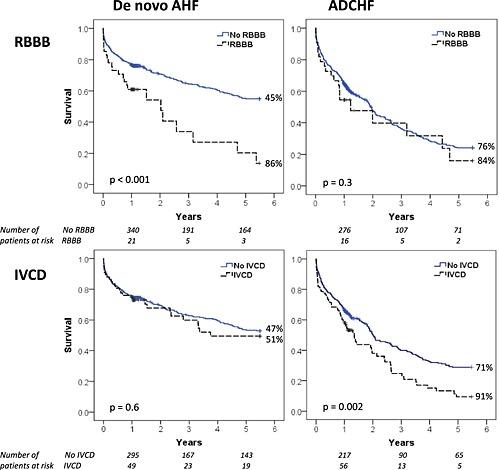
We analysed the admission electrocardiogram of 982 patients from a multicenter European cohort of AHF with 3.9 years' mean follow-up. Half (51.5%, = 506) of the patients had AHF. LBBB, and IVCD were more common in ADCHF than in AHF: 17.2% vs. 8.7% ( < 0.001) and 20.6% vs. 13.2% ( = 0.001), respectively, and RBBB was almost equally common (6.9% and 8.1%; = 0.5), respectively. Mortality during the follow-up was higher in patients with RBBB (85.4%) and IVCD (73.7%) compared with patients with normal ventricular conduction (57.0%); < 0.001 for both. The impact of RBBB on prognosis was prominent in AHF (adjusted HR 1.93, 1.03-3.60; = 0.04), and IVCD independently predicted death in ADCHF (adjusted HR 1.79, 1.28-2.52; = 0.001). Both findings were pronounced in patients with reduced ejection fraction. LBBB showed no association with increased mortality in either of the subgroups. The main results were confirmed in a validation cohort of 1511 AHF patients with 5.9 years' mean follow-up.
CONCLUSIONS
Conduction abnormalities predict long-term survival differently in AHF and ADCHF. RBBB predicts mortality in AHF, and IVCD in ADCHF. LBBB has no additive predictive value in AHF requiring hospitalization.
目的
关于左、右束支传导阻滞(LBBB和RBBB)以及非特异性室内传导延迟(IVCD;QRS≥110毫秒,无束支传导阻滞)在急性心力衰竭(AHF)中的预后作用的数据存在争议。我们的目的是研究AHF和急性失代偿性慢性心力衰竭(ADCHF)患者长期生存的心电图预测因素。
方法和结果
我们分析了来自欧洲多中心AHF队列的982例患者的入院心电图,平均随访3.9年。其中一半(51.5%,n = 506)患者为AHF。LBBB和IVCD在ADCHF中比在AHF中更常见:分别为17.2%对8.7%(P<0.001)和20.6%对13.2%(P = 0.001),而RBBB几乎同样常见(分别为6.9%和8.1%;P = 0.5)。与心室传导正常的患者(57.0%)相比,随访期间RBBB患者(85.4%)和IVCD患者(73.7%)的死亡率更高;两者均P<0.001。RBBB对AHF患者预后的影响显著(校正后HR 1.93,1.03 - 3.60;P = 0.04),IVCD独立预测ADCHF患者死亡(校正后HR 1.79,1.28 - 2.52;P = 0.001)。这两个发现在射血分数降低的患者中更为明显。LBBB在两个亚组中均未显示与死亡率增加相关。在平均随访5.9年的1511例AHF患者的验证队列中证实了主要结果。
结论
传导异常在AHF和ADCHF中对长期生存的预测不同。RBBB预测AHF患者的死亡率,IVCD预测ADCHF患者的死亡率。LBBB对需要住院治疗的AHF患者没有额外的预测价值。

 Zotero 插件