
使用可激活的细胞穿透肽递送针对Rac1的短发夹RNA(shRNA)阻断结肠癌细胞的肝转移。
Blocking hepatic metastases of colon cancer cells using an shRNA against Rac1 delivered by activatable cell-penetrating peptide.
作者信息
Bao Ying, Guo Huihui, Lu Yongliang, Feng Wenming, Sun Xinrong, Tang Chengwu, Wang Xiang, Shen Mo
机构信息
Department of Surgery, First Affiliated Hospital, Huzhou University, The First People's Hospital of Huzhou, Huzhou, 313000, China.
Department of Medicine, Huzhou University, Huzhou, 313000, China.
出版信息
Oncotarget. 2016 Nov 22;7(47):77183-77195. doi: 10.18632/oncotarget.12854.
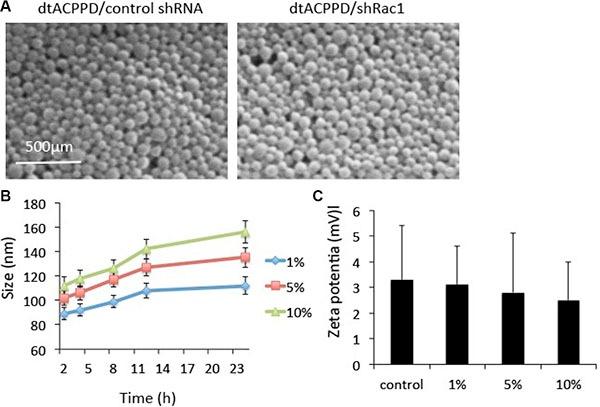
Hepatic metastasis is one of the critical progressions of colon cancer. Blocking this process is key to prolonging survival time in cancer patients. Studies on activatable cell-penetrating peptides (dtACPPs) have demonstrated their potential as gene carriers. It showed high tumor cell-targeting specificity and transfection efficiency and low cytotoxicity in the in vitro settings of drug delivery. However, using this system to silence target genes to inhibit metastasis in colorectal cancer cells has not been widely reported and requires further investigation. In this study, we observed that expression of Rac1, a key molecule for cytoskeletal reorganization, was higher in hepatic metastatic tumor tissue compared with prime colon cancer tissue and that patients with high Rac1-expressing colon cancer showed shorter survival time. Base on these findings, we created dtACPP-PEG-DGL (dtACPPD)/shRac1 nanoparticles and demonstrated that they downregulated Rac1 expression in colon cancer cells. Moreover, we observed inhibitory effects on migration, invasion and adhesion in HCT116 colorectal cancer cells in vitro, and our results showed that Rac1 regulated colon cancer cell matrix adhesion through the regulation of cytofilament dynamics. Moreover, mechanically, repression of Rac1 inhibiting cells migration and invasion by enhancing cell to cell adhesion and reducing cell to extracellular matrix adhesion. Furthermore, when atCDPPD/shRac1 nanoparticles were administered intravenously to a HCT116 xenograft model, significant tumor metastasis to the liver was inhibited. Our results suggest that atCDPP/shRac1 nanoparticles may enable the blockade of hepatic metastasis in colon cancer.
肝转移是结肠癌的关键进展之一。阻断这一过程是延长癌症患者生存时间的关键。对可激活细胞穿透肽(dtACPPs)的研究表明了它们作为基因载体的潜力。在药物递送的体外实验中,它显示出高肿瘤细胞靶向特异性、转染效率和低细胞毒性。然而,利用该系统沉默靶基因以抑制结肠癌细胞转移的研究尚未广泛报道,需要进一步研究。在本研究中,我们观察到,细胞骨架重组的关键分子Rac1在肝转移瘤组织中的表达高于原发性结肠癌组织,且Rac1高表达的结肠癌患者生存时间较短。基于这些发现,我们制备了dtACPP-PEG-DGL(dtACPPD)/shRac1纳米颗粒,并证明它们下调了结肠癌细胞中Rac1的表达。此外,我们在体外观察到对HCT116结肠癌细胞迁移、侵袭和黏附的抑制作用,我们的结果表明,Rac1通过调节细胞丝动力学来调节结肠癌细胞与基质的黏附。此外,从机制上讲,抑制Rac1可通过增强细胞间黏附并减少细胞与细胞外基质的黏附来抑制细胞迁移和侵袭。此外,当将atCDPPD/shRac1纳米颗粒静脉注射到HCT116异种移植模型中时,可显著抑制肿瘤向肝脏的转移。我们的结果表明,atCDPP/shRac1纳米颗粒可能能够阻断结肠癌的肝转移。




 Zotero 插件