
早期生活压力对生长和心血管风险的影响:自主神经印记的一个可能例子?
The Impact of Early Life Stress on Growth and Cardiovascular Risk: A Possible Example for Autonomic Imprinting?
作者信息
Buchhorn Reiner, Meint Sebastian, Willaschek Christian
机构信息
Department of Pediatrics, Caritas Krankenhaus, Bad Mergentheim, Germany.
出版信息
PLoS One. 2016 Nov 18;11(11):e0166447. doi: 10.1371/journal.pone.0166447. eCollection 2016.
INTRODUCTION
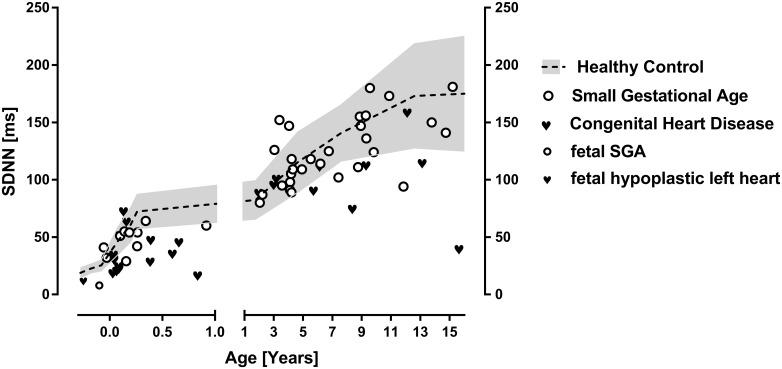
Early life stress is imprinting regulatory properties with life-long consequences. We investigated heart rate variability in a group of small children with height below the third percentile, who experienced an episode of early life stress due to heart failure or intra uterine growth retardation. These children appear to develop autonomic dysfunction in later life.
RESULTS
Compared to the healthy control group heart rate variability (HRV) is reduced on average in a group of 101 children with short stature. Low HRV correlates to groups of children born small for gestational age (SGA), children with cardiac growth failure and children with congenital syndromes, but not to those with constitutional growth delay (CGD), who had normal HRV. Reduced HRV indicated by lower RMSSD and High Frequency (HF)-Power is indicating reduced vagal activity as a sign of autonomic imbalance.
CONCLUSION
It is not short stature itself, but rather the underlying diseases that are the cause for reduced HRV in children with height below the third percentile. These high risk children-allocated in the groups with an adverse autonomic imprinting in utero or infancy (SGA, congenital heart disease and congenital syndromes)-have the highest risk for 'stress diseases' such as cardiovascular disease in later life. The incidence of attention deficit disorder is remarkably high in our group of short children.
引言
早期生活压力会留下具有终生影响的调节特性。我们对一组身高低于第三百分位数的幼儿的心率变异性进行了研究,这些幼儿因心力衰竭或子宫内生长迟缓经历了早期生活压力事件。这些儿童在以后的生活中似乎会出现自主神经功能障碍。
结果
与健康对照组相比,101名身材矮小儿童的心率变异性(HRV)平均降低。低HRV与小于胎龄儿(SGA)、心脏生长衰竭儿童和先天性综合征儿童相关,但与心率变异性正常的体质性生长迟缓(CGD)儿童无关。RMSSD和高频(HF)功率降低表明HRV降低,这表明迷走神经活动减少,是自主神经失衡的迹象。
结论
身高低于第三百分位数的儿童心率变异性降低的原因不是身材矮小本身,而是潜在疾病。这些高危儿童——被归类为在子宫内或婴儿期有不良自主神经印记的组(SGA、先天性心脏病和先天性综合征)——在以后的生活中患“应激性疾病”如心血管疾病的风险最高。在我们这组身材矮小的儿童中,注意力缺陷障碍的发病率非常高。


 Zotero 插件