
定量交联/质谱分析揭示了蛋白质细微的构象变化。
Quantitative cross-linking/mass spectrometry reveals subtle protein conformational changes.
作者信息
Chen Zhuo, Fischer Lutz, Tahir Salman, Bukowski-Wills Jimi-Carlo, Barlow Paul, Rappsilber Juri
机构信息
Wellcome Trust Centre for Cell Biology, Institute of Cell Biology, School of Biological Sciences, University of Edinburgh, Edinburgh, EH9 3BF, UK.
Schools of Chemistry and Biological Sciences, University of Edinburgh, Edinburgh, EH9 3JJ, UK.
出版信息
Wellcome Open Res. 2016 Nov 15;1:5. doi: 10.12688/wellcomeopenres.9896.1. eCollection 2016.
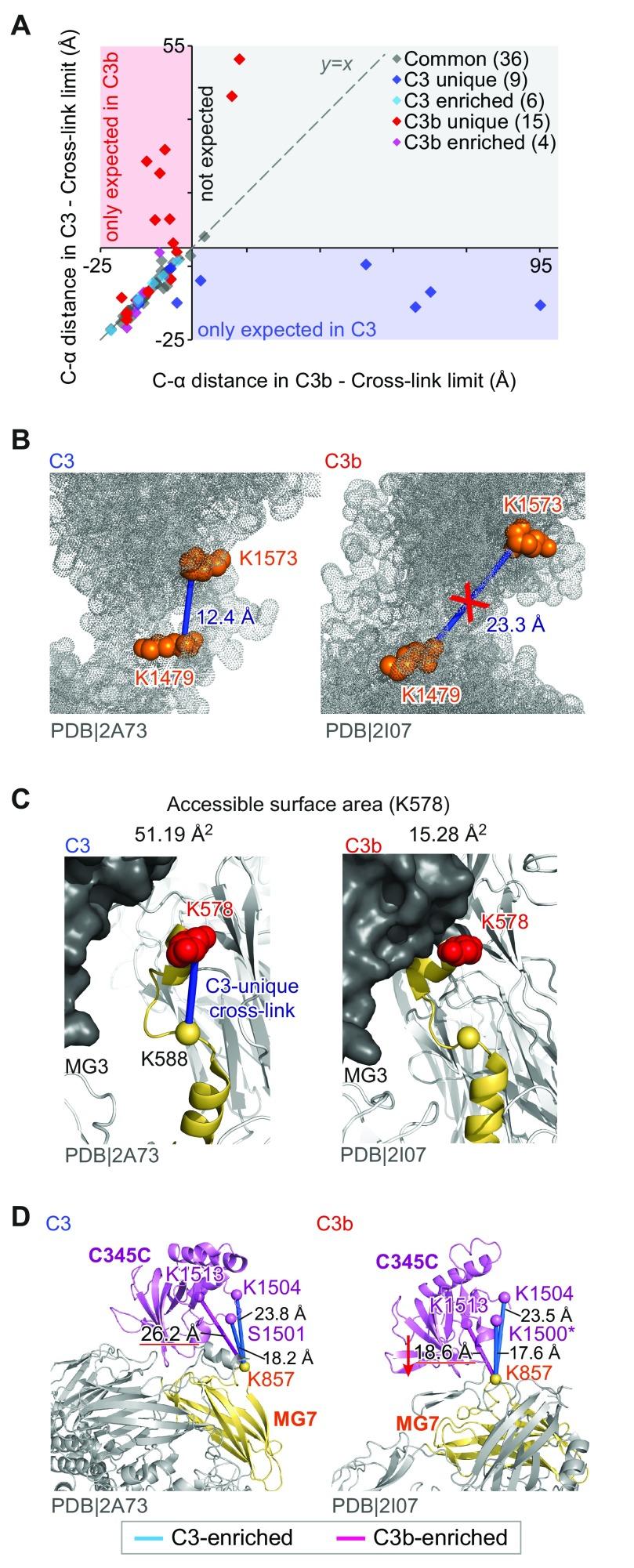
Quantitative cross-linking/mass spectrometry (QCLMS) probes protein structural dynamics in solution by quantitatively comparing the yields of cross-links between different conformational statuses. We have used QCLMS to understand the final maturation step of the proteasome lid and also to elucidate the structure of complement C3(H2O). Here we benchmark our workflow using a structurally well-described reference system, the human complement protein C3 and its activated cleavage product C3b. We found that small local conformational changes affect the yields of cross-linking residues that are near in space while larger conformational changes affect the detectability of cross-links. Distinguishing between minor and major changes required robust analysis based on replica analysis and a label-swapping procedure. By providing workflow, code of practice and a framework for semi-automated data processing, we lay the foundation for QCLMS as a tool to monitor the domain choreography that drives binary switching in many protein-protein interaction networks.
定量交联/质谱分析(QCLMS)通过定量比较不同构象状态之间的交联产率来探测溶液中蛋白质的结构动力学。我们已使用QCLMS来了解蛋白酶体盖子的最终成熟步骤,并阐明补体C3(H2O)的结构。在此,我们使用一个结构已被充分描述的参考系统——人类补体蛋白C3及其活化裂解产物C3b,对我们的工作流程进行基准测试。我们发现,小的局部构象变化会影响空间上相邻交联残基的产率,而较大的构象变化会影响交联的可检测性。区分微小和重大变化需要基于重复分析和标签交换程序进行稳健的分析。通过提供工作流程、操作规范代码和半自动数据处理框架,我们为QCLMS奠定了基础,使其成为监测驱动许多蛋白质-蛋白质相互作用网络中二元转换的结构编排的工具。


 Zotero 插件