
右美托咪定作为臂丛神经阻滞局部麻醉药的辅助用药:一项随机对照试验的荟萃分析。
Dexmedetomidine as an adjuvant to local anesthetics in brachial plexus blocks: A meta-analysis of randomized controlled trials.
作者信息
Ping Yongmei, Ye Qigang, Wang Wenwei, Ye Pingke, You Zhibin
机构信息
Department of Anaesthesiology, Maternal and Children Hospital of Lishui City, Lishui Department of Anaesthesiology, Taizhou First People's Hospital and Huangyan Hospital of Wenzhou Medical University, Taizhou, China.
出版信息
Medicine (Baltimore). 2017 Jan;96(4):e5846. doi: 10.1097/MD.0000000000005846.
BACKGROUND
Brachial plexus block (BPB) for upper extremity surgery provides superior analgesia, but this advantage is limited by the pharmacological duration of local anesthetics. Dexmedetomidine (DEX) as a local anesthetics adjuvant for BPB has been utilized to prolong the duration of the nerve block in some randomized controlled trials (RCTs) but is far from unanimous in the efficacy and safety of the perineural route. Hence, an updated meta-analysis was conducted to assess the efficacy and safety of DEX as local anesthetic adjuvants on BPB.
METHODS
A search in electronic databases was conducted to collect the RCTs that investigated the impact of adding DEX to local anesthetics for BPB. Sensory block duration, motor block duration, onset time of sensory and motor block, time to first analgesic request, the common adverse effects were analyzed.
RESULTS
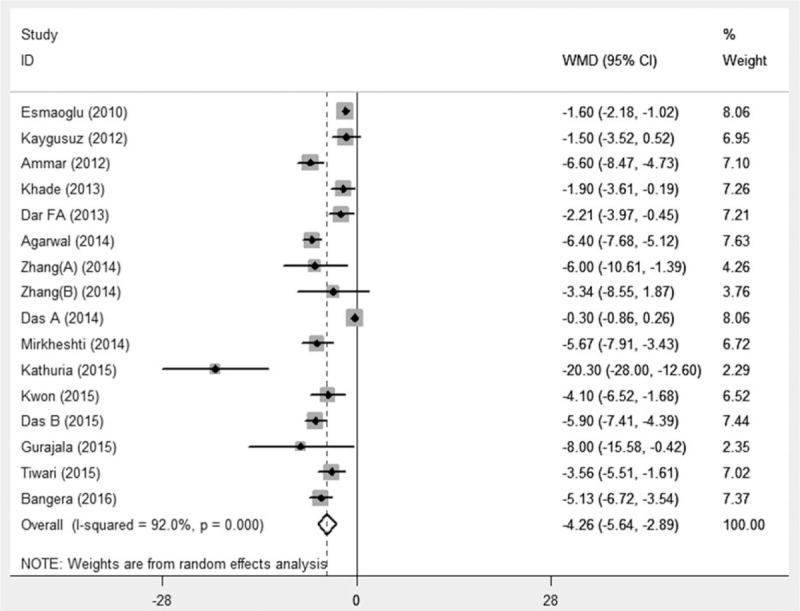
Eighteen trails (1014 patients) were included with 515 patients receiving perineural DEX. The addition of DEX prolonged the duration of sensory block (WMD 257 minutes, 95%CI 191.79-322.24, P < 0.001), motor block (WMD 242 minutes, 95%CI 174.94-309.34, P < 0.001), and analgesia (WMD 26 6 minutes, 95%CI 190.75-342.81, P < 0.001). Perineural DEX also increased the risk of bradycardia (OR=8.25, 95%CI 3.95-17.24, P < 0.001), hypotension (OR = 5.62, 95%CI 1.52-20.79, P < 0.01), and somnolence (OR = 19.67, 95%CI 3.94-98.09, P < 0.001). There was a lack of evidence that perineural DEX increased the risk of other adverse events.
CONCLUSIONS
DEX is a potential anesthetic adjuvant that can facilitate better anesthesia and analgesia when administered in BPB. However, it also increased the risk of bradycardia, hypotension, and somnolence. Further research should focus on the efficacy and safety of the preneural administration of DEX.
背景
上肢手术的臂丛神经阻滞(BPB)可提供优质的镇痛效果,但这一优势受限于局部麻醉药的药理作用持续时间。在一些随机对照试验(RCT)中,右美托咪定(DEX)作为BPB局部麻醉药的佐剂已被用于延长神经阻滞的持续时间,但在神经周围给药的疗效和安全性方面远未达成一致。因此,进行了一项更新的荟萃分析,以评估DEX作为BPB局部麻醉药佐剂的疗效和安全性。
方法
在电子数据库中进行检索,以收集研究将DEX添加到局部麻醉药用于BPB的影响的RCT。分析感觉阻滞持续时间、运动阻滞持续时间、感觉和运动阻滞的起效时间、首次要求镇痛的时间以及常见不良反应。
结果
纳入18项试验(1014例患者),其中515例患者接受神经周围DEX。添加DEX延长了感觉阻滞持续时间(加权均数差[WMD]257分钟,95%可信区间[CI]191.79 - 322.24,P < 0.001)、运动阻滞持续时间(WMD 242分钟,95%CI 174.94 - 309.34,P < 0.001)和镇痛时间(WMD 266分钟,95%CI 190.75 - 342.81,P < 0.001)。神经周围DEX也增加了心动过缓(比值比[OR]=8.25,9�%CI 3.95 - 17.24,P < 0.001)、低血压(OR = 5.62,95%CI 1.52 - 20.79,P < 0.01)和嗜睡(OR = 19.67,95%CI 3.94 - 98.09,P < 0.001)的风险。缺乏证据表明神经周围DEX增加了其他不良事件的风险。
结论
DEX是一种潜在的麻醉佐剂,在BPB中给药时可促进更好的麻醉和镇痛效果。然而,它也增加了心动过缓、低血压和嗜睡的风险。进一步的研究应聚焦于神经周围给予DEX的疗效和安全性。



 Zotero 插件