
基于水平集的磁共振图像海马分割,使用区域生长改进初始化
Level Set Based Hippocampus Segmentation in MR Images with Improved Initialization Using Region Growing.
作者信息
Jiang Xiaoliang, Zhou Zhaozhong, Ding Xiaokang, Deng Xiaolei, Zou Ling, Li Bailin
机构信息
College of Mechanical Engineering, Quzhou University, Quzhou, Zhejiang 324000, China; College of Mechanical Engineering, Southwest Jiaotong University, Chengdu, Sichuan 610031, China.
College of Mechanical Engineering, Quzhou University, Quzhou, Zhejiang 324000, China.
出版信息
Comput Math Methods Med. 2017;2017:5256346. doi: 10.1155/2017/5256346. Epub 2017 Jan 15.
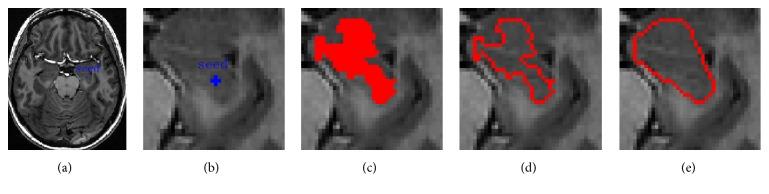
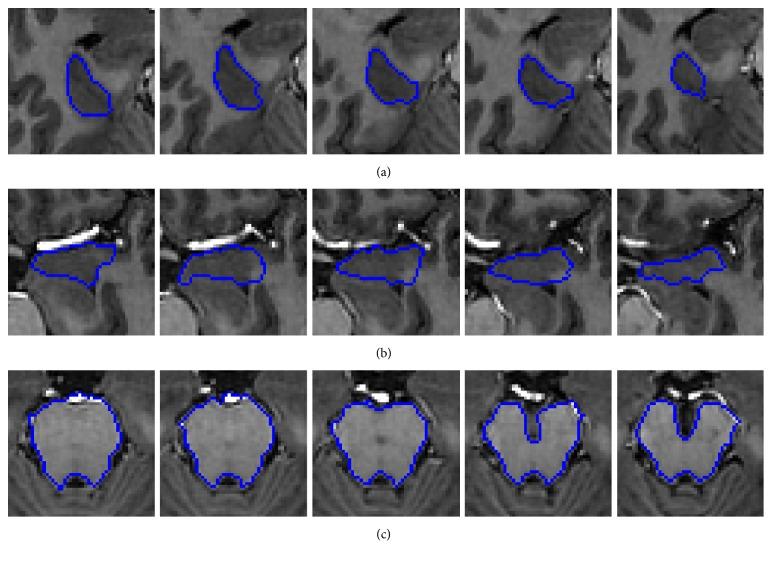
The hippocampus has been known as one of the most important structures referred to as Alzheimer's disease and other neurological disorders. However, segmentation of the hippocampus from MR images is still a challenging task due to its small size, complex shape, low contrast, and discontinuous boundaries. For the accurate and efficient detection of the hippocampus, a new image segmentation method based on adaptive region growing and level set algorithm is proposed. Firstly, adaptive region growing and morphological operations are performed in the target regions and its output is used for the initial contour of level set evolution method. Then, an improved edge-based level set method utilizing global Gaussian distributions with different means and variances is developed to implement the accurate segmentation. Finally, gradient descent method is adopted to get the minimization of the energy equation. As proved by experiment results, the proposed method can ideally extract the contours of the hippocampus that are very close to manual segmentation drawn by specialists.
海马体一直被认为是与阿尔茨海默病和其他神经疾病相关的最重要结构之一。然而,由于海马体尺寸小、形状复杂、对比度低以及边界不连续,从磁共振图像中分割出海马体仍然是一项具有挑战性的任务。为了准确、高效地检测海马体,提出了一种基于自适应区域生长和水平集算法的新图像分割方法。首先,在目标区域执行自适应区域生长和形态学操作,其输出用于水平集演化方法的初始轮廓。然后,开发了一种利用具有不同均值和方差的全局高斯分布的改进型基于边缘的水平集方法来实现精确分割。最后,采用梯度下降法使能量方程最小化。实验结果证明,所提出的方法能够理想地提取出海马体的轮廓,这些轮廓与专家手动绘制的分割结果非常接近。





 Zotero 插件