
用于长期活体成像的成像窗口:概述与技术见解
Imaging windows for long-term intravital imaging: General overview and technical insights.
作者信息
Alieva Maria, Ritsma Laila, Giedt Randy J, Weissleder Ralph, van Rheenen Jacco
机构信息
Cancer Genomics Netherlands; Hubrecht Institute-KNAW and University Medical Centre Utrecht; CT Utrecht, The Netherlands.
Center for Cancer Research and Center for Regenerative Medicine; Massachusetts General Hospital; Richard B. Simches Research Center; Harvard Medical School; Boston, MA USA; Broad Institute of Harvard and Massachusetts Institute for Technology; Cambridge, MA USA.
出版信息
Intravital. 2014 Aug 11;3(2):e29917. doi: 10.4161/intv.29917. eCollection 2014.
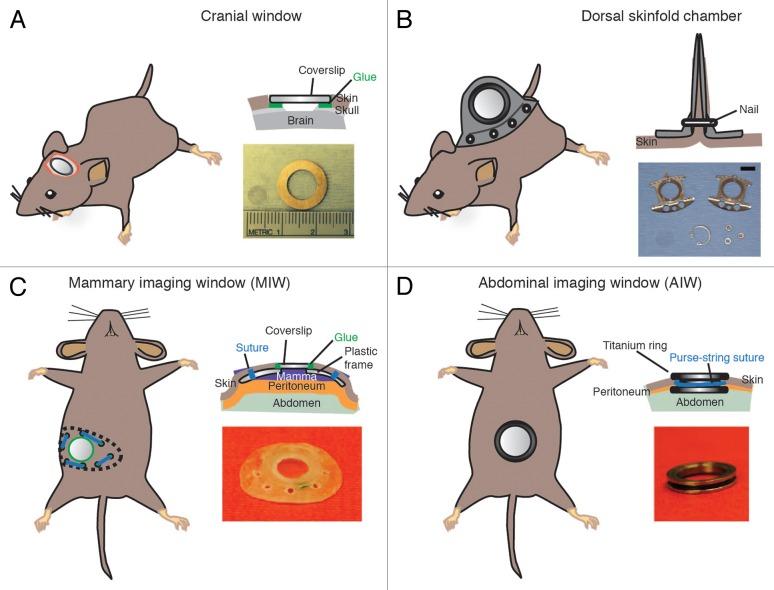
Intravital microscopy is increasingly used to visualize and quantitate dynamic biological processes at the (sub)cellular level in live animals. By visualizing tissues through imaging windows, individual cells (e.g., cancer, host, or stem cells) can be tracked and studied over a time-span of days to months. Several imaging windows have been developed to access tissues including the brain, superficial fascia, mammary glands, liver, kidney, pancreas, and small intestine among others. Here, we review the development of imaging windows and compare the most commonly used long-term imaging windows for cancer biology: the cranial imaging window, the dorsal skin fold chamber, the mammary imaging window, and the abdominal imaging window. Moreover, we provide technical details, considerations, and trouble-shooting tips on the surgical procedures and microscopy setups for each imaging window and explain different strategies to assure imaging of the same area over multiple imaging sessions. This review aims to be a useful resource for establishing the long-term intravital imaging procedure.
活体显微镜检查越来越多地用于在活体动物的(亚)细胞水平上可视化和定量动态生物学过程。通过成像窗口对组织进行可视化,可以在数天至数月的时间跨度内跟踪和研究单个细胞(例如癌细胞、宿主细胞或干细胞)。已经开发了几种成像窗口来观察包括大脑、浅筋膜、乳腺、肝脏、肾脏、胰腺和小肠等在内的组织。在这里,我们回顾了成像窗口的发展,并比较了癌症生物学中最常用的长期成像窗口:颅骨成像窗口、背部皮肤褶皱腔、乳腺成像窗口和腹部成像窗口。此外,我们提供了每个成像窗口的手术程序和显微镜设置的技术细节、注意事项和故障排除技巧,并解释了在多个成像会话中确保对同一区域进行成像的不同策略。本综述旨在成为建立长期活体成像程序的有用资源。




 Zotero 插件