
中华按蚊和致倦库蚊蛹气管系统的三维结构。
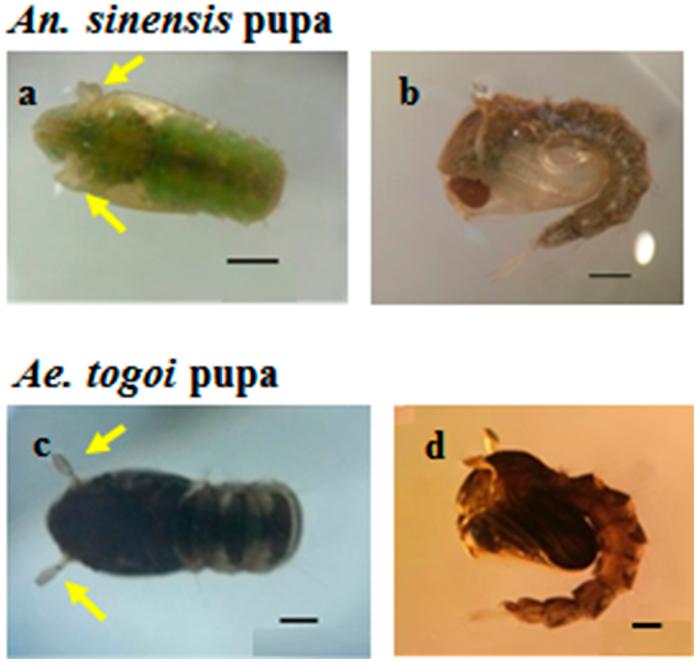
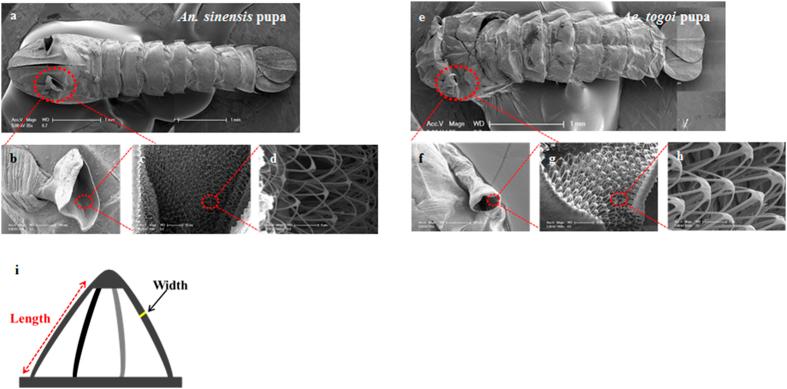
Three-dimensional structures of the tracheal systems of Anopheles sinensis and Aedes togoi pupae.
机构信息
Center for Biofluid and Biomimic Research, Pohang University of Science and Technology, Pohang, 790-784, Republic of Korea.
School of Mechanical Engineering, Pusan National University, Pusan, 609-735, Republic of Korea.
出版信息
Sci Rep. 2017 Mar 13;7:44490. doi: 10.1038/srep44490.
Mosquitoes act as a vector for the transmission of disease. The World Health Organization has recommended strict control of mosquito larvae because of their "few, fixed, and findable" features. The respiratory system of mosquito larvae and pupae in the water has a weak point. As aquatic organisms, mosquito larvae and pupae inhale atmosphere oxygen. However, the mosquito pupae have a non-feeding stage, unlike the larvae. Therefore, detailed study on the tracheal system of mosquito pupae is helpful for understanding their survival strategy. In this study, the three-dimensional (3D) structures of the tracheal systems of Anopheles sinensis and Aedes togoi pupae were comparatively investigated using synchrotron X-ray microscopic computed tomography. The respiratory frequencies of the dorsal trunks were also investigated. Interestingly, the pupae of the two mosquito species possess special tracheal systems of which the morphological and functional features are distinctively different. The respiratory frequency of Ae. togoi is higher than that of An. sinensis. These differences in the breathing phenomena and 3D structures of the respiratory systems of these two mosquito species provide an insight into the tracheal systems of mosquito pupae.
蚊子是疾病传播的媒介。世界卫生组织建议严格控制蚊虫幼虫,因为它们具有“数量少、固定、易于发现”的特点。水中的蚊虫幼虫和蛹的呼吸系统有一个弱点。作为水生生物,蚊子幼虫和蛹吸入大气中的氧气。然而,与幼虫不同,蚊子蛹有一个不取食的阶段。因此,详细研究蚊子蛹的气管系统有助于了解它们的生存策略。在这项研究中,利用同步辐射 X 射线微焦点计算机断层扫描技术比较研究了中华按蚊和埃及伊蚊蛹的气管系统的三维结构。还研究了背干的呼吸频率。有趣的是,这两种蚊子的蛹都具有特殊的气管系统,其形态和功能特征明显不同。埃及伊蚊的呼吸频率高于中华按蚊。这两种蚊子呼吸现象和呼吸系统三维结构的差异为了解蚊子蛹的气管系统提供了线索。



 Zotero 插件