
强直性肌营养不良症患者呼吸肌力量和活动的无创评估
Noninvasive assessment of respiratory muscle strength and activity in Myotonic dystrophy.
作者信息
Evangelista Morgana de Araújo, Dias Fernando Augusto Lavezzo, Dourado Júnior Mário Emílio Teixeira, do Nascimento George Carlos, Sarmento Antonio, Gualdi Lucien Peroni, Aliverti Andrea, Resqueti Vanessa, Fregonezi Guilherme Augusto de Freitas
机构信息
PneumoCardioVascular Lab, Departamento de Fisioterapia, Universidade Federal do Rio Grande Do Norte, Natal, Rio Grande do Norte, Brasil.
PneumoCardioVascular Lab/HUOL, Empresa Brasileira de Serviços Hospitalares (EBSERH), Universidade Federal do Rio Grande do Norte, Natal, Rio Grande do Norte, Brasil.
出版信息
PLoS One. 2017 Jun 8;12(6):e0177318. doi: 10.1371/journal.pone.0177318. eCollection 2017.
OBJECTIVE
To evaluate sensitivity/specificity of the maximum relaxation rate (MRR) of inspiratory muscles, amplitude of electromyographic activity of the sternocleidomastoid (SCM), scalene (SCA), parasternal (2ndIS) and rectus abdominis (RA) muscles; lung function and respiratory muscle strength in subjects with Myotonic dystrophy type 1 (DM1) compared with healthy subjects.
DESIGN AND METHODS
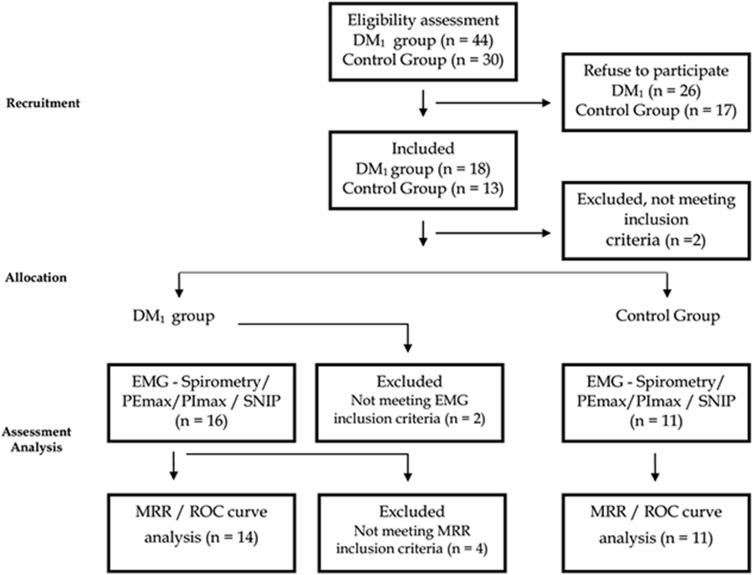
Quasi-experimental observational study with control group. MRR of inspiratory muscles, lung function and amplitude of the electromyographic activity of SCM, SCA, 2ndIS and RA muscles during maximum inspiratory pressure (PImax), maximum expiratory pressure (PEmax) and sniff nasal inspiratory pressure (SNIP) tests were assessed in eighteen DM1 subjects and eleven healthy.
RESULTS
MRR was lower in DM1 group compared to healthy (P = 0.001) and was considered sensitive and specific to identify disease in DM1 and discard it in controls, as well as SNIP% (P = 0.0026), PImax% (P = 0.0077) and PEmax% (P = 0.0002). Contraction time of SCM and SCA was higher in DM1 compared to controls, respectively, during PImax (P = 0.023 and P = 0.017) and SNIP (P = 0.015 and P = .0004). The DM1 group showed lower PImax (P = .0006), PEmax (P = 0.0002), SNIP (P = 0.0014), and higher electromyographic activity of the SCM (P = 0.002) and SCA (P = 0.004) at rest; of 2ndIS (P = 0.003) during PEmax and of SCM (P = 0.02) and SCA (P = 0.03) during SNIP test.
CONCLUSIONS
MD1 subjects presented restrictive pattern, reduced respiratory muscle strength, muscular electrical activity and MRR when compared to higher compared to controls. In addition, the lower MRR found in MD1 subjects showed to be reliable to sensitivity and specificity in identifying the delayed relaxation of respiratory muscles.
目的
评估1型强直性肌营养不良(DM1)患者与健康受试者相比,吸气肌的最大松弛率(MRR)、胸锁乳突肌(SCM)、斜角肌(SCA)、胸骨旁肌(第二肋间肌,2ndIS)和腹直肌(RA)的肌电图活动幅度;肺功能和呼吸肌力量。
设计与方法
有对照组的准实验性观察研究。在18名DM1患者和11名健康受试者中,评估了吸气肌的MRR、肺功能以及在最大吸气压力(PImax)、最大呼气压力(PEmax)和嗅鼻吸气压力(SNIP)测试期间SCM、SCA、第二肋间肌和RA肌肉的肌电图活动幅度。
结果
与健康组相比,DM1组的MRR较低(P = 0.001),并且被认为在识别DM1疾病和排除对照组疾病方面具有敏感性和特异性,嗅鼻吸气压力百分比(SNIP%,P = 0.0026)、最大吸气压力百分比(PImax%)(P = 0.0077)和最大呼气压力百分比(PEmax%)(P = 0.0002)也是如此。在PImax(P = 0.023和P = 0.017)和SNIP(P = 0.015和P = 0.0004)期间,与对照组相比,DM1组SCM和SCA的收缩时间分别更高。DM1组在静息时表现出较低的PImax(P = 0.0006)、PEmax(P = 0.0002)、SNIP(P = 0.0014),以及SCM(P = 0.002)和SCA(P = 0.004)更高的肌电图活动;在PEmax期间第二肋间肌的肌电图活动更高(P = 0.003),在SNIP测试期间SCM(P = 0.02)和SCA(P = 0.03)的肌电图活动更高。
结论
与对照组相比,DM1患者呈现限制性模式、呼吸肌力量降低、肌肉电活动和MRR降低。此外,在DM1患者中发现的较低MRR在识别呼吸肌延迟松弛方面显示出敏感性和特异性方面是可靠的。



 Zotero 插件