
人类心脏对心肌梗死的动态水肿反应:对评估心肌梗死危险区和挽救心肌面积的意义。
Dynamic Edematous Response of the Human Heart to Myocardial Infarction: Implications for Assessing Myocardial Area at Risk and Salvage.
作者信息
Fernández-Jiménez Rodrigo, Barreiro-Pérez Manuel, Martin-García Ana, Sánchez-González Javier, Agüero Jaume, Galán-Arriola Carlos, García-Prieto Jaime, Díaz-Pelaez Elena, Vara Pedro, Martinez Irene, Zamarro Ivan, Garde Beatriz, Sanz Javier, Fuster Valentin, Sánchez Pedro L, Ibanez Borja
机构信息
From Centro Nacional de Investigaciones Cardiovasculares Carlos III (CNIC), Madrid, Spain (R.F.-J., J.A., C.G.-A., J.G.-P., J.S., V.F., B.I.); CIBER de Enfermedades Cardiovasculares (CIBERCV), Madrid, Spain (R.F.-J., M.B.-P., A.M.-G., J.A., C.G.-A., J.G.-P., B.G., P.L.S., B.I.); The Zena and Michael A. Wiener CVI, Icahn School of Medicine at Mount Sinai, New York (R.F.-J., J.S., V.F.); Hospital Universitario de Salamanca, Spain (M.B.-P., A.M.-G., E.D.-P., P.V., I.M., I.Z., B.G., P.L.S.); Philips Healthcare, Madrid, Spain (J.S.-G.); Cardiology Department, Hospital Universtitari i Politecnic La Fe, Valencia, Spain (J.A.); and IIS-Fundación Jiménez Díaz Hospital, Madrid, Spain (B.I.).
出版信息
Circulation. 2017 Oct 3;136(14):1288-1300. doi: 10.1161/CIRCULATIONAHA.116.025582. Epub 2017 Jul 7.
BACKGROUND
Clinical protocols aimed to characterize the post-myocardial infarction (MI) heart by cardiac magnetic resonance (CMR) need to be standardized to take account of dynamic biological phenomena evolving early after the index ischemic event. Here, we evaluated the time course of edema reaction in patients with ST-segment-elevation MI by CMR and assessed its implications for myocardium-at-risk (MaR) quantification both in patients and in a large-animal model.
METHODS
A total of 16 patients with anterior ST-segment-elevation MI successfully treated by primary angioplasty and 16 matched controls were prospectively recruited. In total, 94 clinical CMR examinations were performed: patients with ST-segment-elevation MI were serially scanned (within the first 3 hours after reperfusion and at 1, 4, 7, and 40 days), and controls were scanned only once. T2 relaxation time in the myocardium (T2 mapping) and the extent of edema on T2-weighted short-tau triple inversion-recovery (ie, CMR-MaR) were evaluated at all time points. In the experimental study, 20 pigs underwent 40-minute ischemia/reperfusion followed by serial CMR examinations at 120 minutes and 1, 4, and 7 days after reperfusion. Reference MaR was assessed by contrast-multidetector computed tomography during the index coronary occlusion. Generalized linear mixed models were used to take account of repeated measurements.
RESULTS
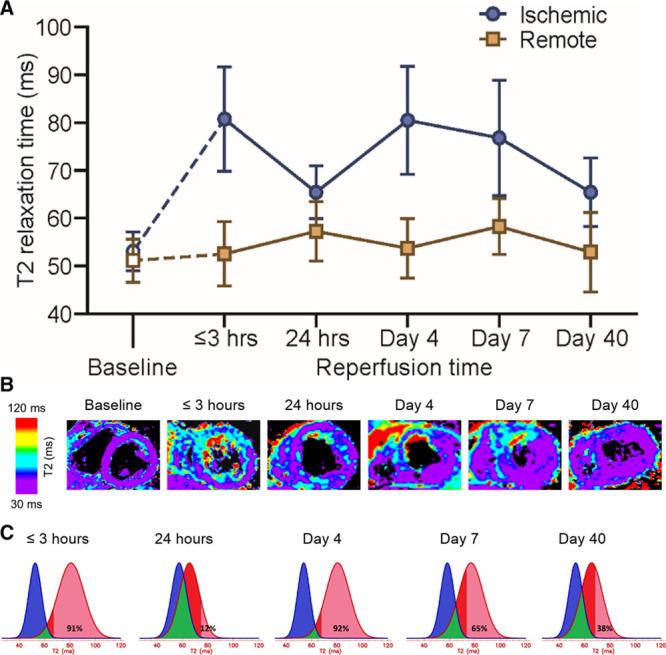
In humans, T2 relaxation time in the ischemic myocardium declines significantly from early after reperfusion to 24 hours, and then increases up to day 4, reaching a plateau from which it decreases from day 7. Consequently, edema extent measured by T2-weighted short-tau triple inversion-recovery (CMR-MaR) varied with the timing of the CMR examination. These findings were confirmed in the experimental model by showing that only CMR-MaR values for day 4 and day 7 postreperfusion, coinciding with the deferred edema wave, were similar to values measured by reference contrast-multidetector computed tomography.
CONCLUSIONS
Post-MI edema in patients follows a bimodal pattern that affects CMR estimates of MaR. Dynamic changes in post-ST-segment-elevation MI edema highlight the need for standardization of CMR timing to retrospectively delineate MaR and quantify myocardial salvage. According to the present clinical and experimental data, a time window between days 4 and 7 post-MI seems a good compromise solution for standardization. Further studies are needed to study the effect of other factors on these variables.
背景
旨在通过心脏磁共振成像(CMR)对心肌梗死(MI)后心脏进行特征描述的临床方案需要标准化,以考虑到在首次缺血事件后早期演变的动态生物学现象。在此,我们通过CMR评估了ST段抬高型MI患者水肿反应的时间进程,并评估了其对患者及大型动物模型中危险心肌(MaR)定量的影响。
方法
前瞻性招募了16例经直接血管成形术成功治疗的前壁ST段抬高型MI患者和16例匹配的对照者。总共进行了94次临床CMR检查:对ST段抬高型MI患者进行系列扫描(再灌注后3小时内以及1、4、7和40天),对照者仅扫描一次。在所有时间点评估心肌的T2弛豫时间(T2 mapping)以及T2加权短tau三重反转恢复序列上的水肿范围(即CMR-MaR)。在实验研究中,20头猪经历40分钟的缺血/再灌注,然后在再灌注后120分钟以及1、4和7天进行系列CMR检查。在首次冠状动脉闭塞期间通过对比增强多排计算机断层扫描评估参考MaR。使用广义线性混合模型来考虑重复测量。
结果
在人类中,缺血心肌的T2弛豫时间从再灌注后早期到24小时显著下降,然后在第4天之前增加,从第7天开始达到平台期并开始下降。因此,通过T2加权短tau三重反转恢复序列测量的水肿范围(CMR-MaR)随CMR检查时间而变化。在实验模型中证实了这些发现,即仅再灌注后第4天和第7天的CMR-MaR值与延迟水肿波一致,与通过参考对比增强多排计算机断层扫描测量的值相似。
结论
MI后患者的水肿呈双峰模式,影响CMR对MaR的估计。ST段抬高型MI后水肿的动态变化凸显了标准化CMR检查时间的必要性,以便回顾性地描绘MaR并量化心肌挽救。根据目前的临床和实验数据,MI后第4天至第7天的时间窗似乎是标准化的一个较好折衷方案。需要进一步研究其他因素对这些变量的影响。



 Zotero 插件