
纤维素异常
Cellulose Perversions.
作者信息
Canejo João P, Godinho Maria H
机构信息
CENIMAT/I3N, Materials Science Department, Faculty of Science and Technology, New University of Lisbon, Caparica 2829-516, Portugal.
出版信息
Materials (Basel). 2013 Mar 28;6(4):1377-1390. doi: 10.3390/ma6041377.
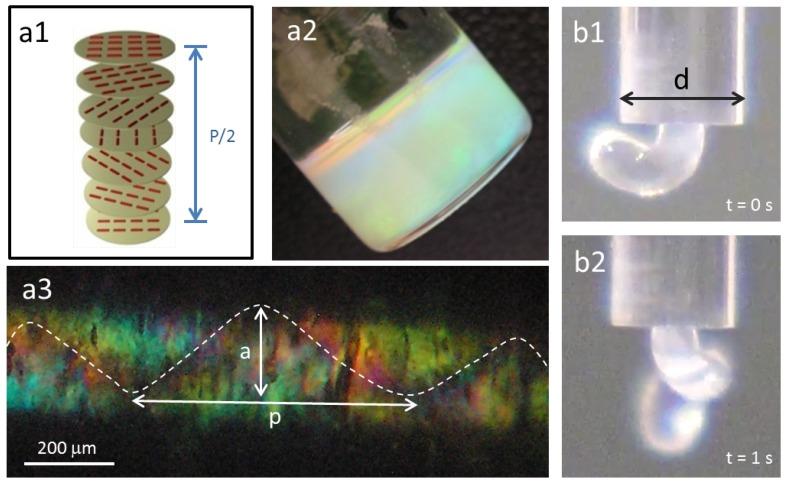
Cellulose micro/nano-fibers can be produced by electrospinning from liquid crystalline solutions. Scanning electron microscopy (SEM), as well as atomic force microscopy (AFM) and polarizing optical microscopy (POM) measurements showed that cellulose-based electrospun fibers can curl and twist, due to the presence of an off-core line defect disclination, which was present when the fibers were prepared. This permits the mimicking of the shapes found in many systems in the living world, e.g., the tendrils of climbing plants, three to four orders of magnitude larger. In this work, we address the mechanism that is behind the spirals' and helices' appearance by recording the trajectories of the fibers toward diverse electrospinning targets. The intrinsic curvature of the system occurs via asymmetric contraction of an internal disclination line, which generates different shrinkages of the material along the fiber. The completely different instabilities observed for isotropic and anisotropic electrospun solutions at the exit of the needle seem to corroborate the hypothesis that the intrinsic curvature of the material is acquired during liquid crystalline sample processing inside the needle. The existence of perversions, which joins left and right helices, is also investigated by using suspended, as well as flat, targets. Possible routes of application inspired from the living world are addressed.
纤维素微/纳米纤维可通过从液晶溶液中进行静电纺丝来制备。扫描电子显微镜(SEM)以及原子力显微镜(AFM)和偏光光学显微镜(POM)测量表明,基于纤维素的静电纺丝纤维会卷曲和扭曲,这是由于存在离核线缺陷位错,该缺陷在制备纤维时就已存在。这使得能够模仿生物界许多系统中发现的形状,例如攀缘植物的卷须,其尺寸要大三个到四个数量级。在这项工作中,我们通过记录纤维朝向不同静电纺丝目标的轨迹,来探究螺旋和螺旋状外观背后的机制。系统的固有曲率是通过内部位错线的不对称收缩产生的,这会导致材料沿纤维产生不同程度的收缩。在针的出口处,各向同性和各向异性静电纺丝溶液观察到的完全不同的不稳定性似乎证实了这样一种假设,即材料的固有曲率是在针内的液晶样品加工过程中获得的。还通过使用悬挂式和平板式目标来研究连接左旋和右旋螺旋的扭曲的存在情况。探讨了受生物界启发的可能应用途径。



 Zotero 插件