
基于空间多准则分析的道路规划自然灾害易发性评估
Natural Hazard Susceptibility Assessment for Road Planning Using Spatial Multi-Criteria Analysis.
作者信息
Karlsson Caroline S J, Kalantari Zahra, Mörtberg Ulla, Olofsson Bo, Lyon Steve W
机构信息
Division of Land and Water Resources Engineering, KTH Royal Institute of Technology, SE-100 44, Stockholm, Sweden.
Department of Physical Geography, Stockholm University, SE-106 91, Stockholm, Sweden.
出版信息
Environ Manage. 2017 Nov;60(5):823-851. doi: 10.1007/s00267-017-0912-6. Epub 2017 Aug 18.
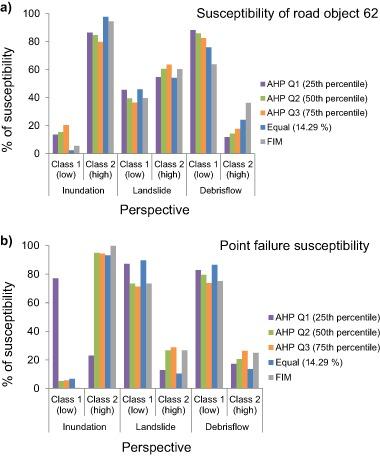
Inadequate infrastructural networks can be detrimental to society if transport between locations becomes hindered or delayed, especially due to natural hazards which are difficult to control. Thus determining natural hazard susceptible areas and incorporating them in the initial planning process, may reduce infrastructural damages in the long run. The objective of this study was to evaluate the usefulness of expert judgments for assessing natural hazard susceptibility through a spatial multi-criteria analysis approach using hydrological, geological, and land use factors. To utilize spatial multi-criteria analysis for decision support, an analytic hierarchy process was adopted where expert judgments were evaluated individually and in an aggregated manner. The estimates of susceptible areas were then compared with the methods weighted linear combination using equal weights and factor interaction method. Results showed that inundation received the highest susceptibility. Using expert judgment showed to perform almost the same as equal weighting where the difference in susceptibility between the two for inundation was around 4%. The results also showed that downscaling could negatively affect the susceptibility assessment and be highly misleading. Susceptibility assessment through spatial multi-criteria analysis is useful for decision support in early road planning despite its limitation to the selection and use of decision rules and criteria. A natural hazard spatial multi-criteria analysis could be used to indicate areas where more investigations need to be undertaken from a natural hazard point of view, and to identify areas thought to have higher susceptibility along existing roads where mitigation measures could be targeted after in-situ investigations.
如果地点之间的交通受到阻碍或延误,尤其是由于难以控制的自然灾害,基础设施网络不足可能会对社会造成损害。因此,确定自然灾害易损区域并将其纳入初始规划过程,从长远来看可能会减少基础设施的损坏。本研究的目的是通过使用水文、地质和土地利用因素的空间多标准分析方法,评估专家判断在评估自然灾害易损性方面的有用性。为了利用空间多标准分析进行决策支持,采用了层次分析法,对专家判断进行单独和综合评估。然后将易损区域的估计结果与使用等权重的加权线性组合方法和因素交互方法进行比较。结果表明,洪水的易损性最高。使用专家判断的结果与等权重法几乎相同,两者在洪水易损性方面的差异约为4%。结果还表明,降尺度可能会对易损性评估产生负面影响,并具有很大的误导性。尽管通过空间多标准分析进行易损性评估在决策规则和标准的选择和使用方面存在局限性,但它在早期道路规划的决策支持中是有用的。自然灾害空间多标准分析可用于指出从自然灾害角度需要进行更多调查的区域,并识别沿现有道路被认为易损性较高的区域,以便在现场调查后针对这些区域采取缓解措施。






 Zotero 插件