
50 年病程 1 型糖尿病患者的肾脏并发症累积风险:性别、年龄和发病时的日历年份的影响。
Cumulative Kidney Complication Risk by 50 Years of Type 1 Diabetes: The Effects of Sex, Age, and Calendar Year at Onset.
机构信息
Department of Epidemiology, University of Pittsburgh, Pittsburgh, PA
Department of Epidemiology, University of Pittsburgh, Pittsburgh, PA.
出版信息
Diabetes Care. 2018 Mar;41(3):426-433. doi: 10.2337/dc17-1118. Epub 2017 Sep 20.
OBJECTIVE
A common belief is that only a minority of patients with type 1 diabetes (T1D) develop advanced kidney disease and that incidence is higher among men and lower in those diagnosed at a younger age. However, because few patients with T1D survived to older ages until recently, long-term risks have been unclear.
RESEARCH DESIGN AND METHODS
We examined the 50-year cumulative kidney complication risk in a childhood-onset T1D cohort diagnosed during 1950-80 ( = 932; mean baseline age 29 years, duration 19 years). Participants comprised 144 who died prior to baseline, 130 followed with periodic surveys, and 658 followed with biennial surveys and a maximum of nine examinations for 25 years. Micro- and macroalbuminuria were defined as an albumin excretion rate of 20-199 and ≥200 μg/min, respectively, and end-stage renal disease (ESRD) was defined as dialysis or kidney transplantation. Cumulative incidence was estimated at 10-year intervals between 20 and 50 years duration and compared by calendar year of diabetes onset.
RESULTS
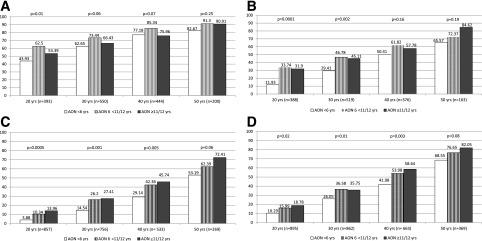
By 50 years T1D duration, ESRD affected 60% of the cohort; macroalbuminuria, 72%; and microalbuminuria, 88%. Little evidence existed for declines in cumulative incidence in recent cohorts, except for ESRD (microalbuminuria 3% increase, macroalbuminuria no change; ESRD 45% decrease by 40 years of T1D duration). Onset before age 6 years was associated with the lowest risk; incidence generally did not differ by sex.
CONCLUSIONS
Some degree of kidney disease in T1D is virtually universal at long durations and not declining, which has major implications for formulating health care and research strategies. ESRD has declined, but continues to affect >25% of the population by 40 years duration.
目的
有一种普遍的观点认为,只有少数 1 型糖尿病(T1D)患者会发展为晚期肾病,而且男性的发病率更高,而在较年轻确诊的患者中发病率较低。然而,由于直到最近才有少数 T1D 患者能存活到老年,因此长期风险尚不清楚。
研究设计和方法
我们检查了 1950-80 年期间确诊的儿童起病 T1D 队列(=932 例;基线年龄 29 岁,病程 19 年)的 50 年累积肾脏并发症风险。参与者包括在基线前死亡的 144 例,接受定期调查的 130 例,以及接受两年一次调查且最多随访 25 年、共进行了 9 次检查的 658 例。微量白蛋白尿和大量白蛋白尿分别定义为尿白蛋白排泄率为 20-199 和≥200μg/min,终末期肾病(ESRD)定义为透析或肾移植。在 20 至 50 年病程的 10 年间隔内估计累积发生率,并按糖尿病发病年份进行比较。
结果
在 50 年的 T1D 病程中,ESRD 影响了队列中的 60%;大量白蛋白尿,72%;微量白蛋白尿,88%。最近的队列中,除了 ESRD(微量白蛋白尿增加 3%,大量白蛋白尿无变化;ESRD 在 40 年的 T1D 病程中减少 45%)外,几乎没有证据表明累积发病率下降。发病年龄在 6 岁之前与最低风险相关;发病率在性别上没有差异。
结论
在长期病程中,T1D 患者几乎普遍存在某种程度的肾脏疾病,而且没有下降,这对制定医疗保健和研究策略具有重要意义。ESRD 已经下降,但在 40 年病程时仍影响超过 25%的人群。
 Zotero 插件