
自主激活肌肉协同作用的实证评估
Empirical Evaluation of Voluntarily Activatable Muscle Synergies.
作者信息
Togo Shunta, Imamizu Hiroshi
机构信息
Graduate School of Informatics and Engineering, The University of Electro-CommunicationsTokyo, Japan.
Cognitive Mechanisms Laboratories, Advanced Telecommunications Research Institute InternationalKyoto, Japan.
出版信息
Front Comput Neurosci. 2017 Sep 6;11:82. doi: 10.3389/fncom.2017.00082. eCollection 2017.
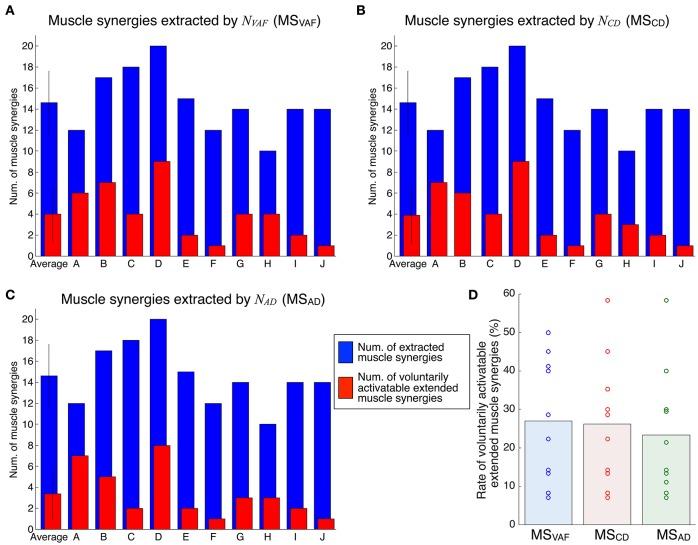
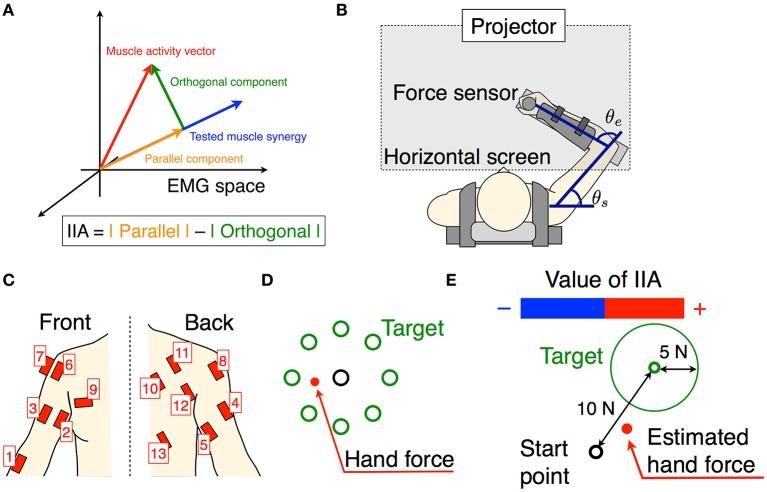
The muscle synergy hypothesis assumes that individual muscle synergies are independent of each other and voluntarily controllable. However, this assumption has not been empirically tested. This study tested if human subjects can voluntarily activate individual muscle synergies extracted by non-negative matrix factorization (NMF), the standard mathematical method for synergy extraction. We defined the activation of a single muscle synergy as the generation of a muscle activity pattern vector parallel to the single muscle synergy vector. Subjects performed an isometric force production task with their right hand, and the 13 muscle activity patterns associated with their elbow and shoulder movements were measured. We extracted muscle synergies during the task using electromyogram (EMG) data and the NMF method with varied numbers of muscle synergies. The number () of muscle synergies was determined by using the variability accounted for (VAF, ) and the coefficient of determination (CD, ). An additional muscle synergy model with was also considered. We defined a conventional muscle synergy as the muscle synergy extracted by the , , and . We also defined an extended muscle synergy as the muscle synergy extracted by the > . To examine whether the individual muscle synergy was voluntarily activatable or not, we calculated the index of independent activation, which reflects similarities between a selected single muscle synergy and the current muscle activation pattern of the subject. Subjects were visually feed-backed the index of independent activation, then instructed to generate muscle activity patterns similar to the conventional and extended muscle synergies. As a result, an average of 90.8% of the muscle synergy extracted by the was independently activated. However, the proportion of activatable muscle synergies extracted by and was lower. These results partly support the assumption of the muscle synergy hypothesis, i.e., that the conventional method can extract voluntarily and independently activatable muscle synergies by using the appropriate index of reconstruction. Moreover, an average of 25.5% of the extended muscle synergy was significantly activatable. This result suggests that the CNS can use extended muscle synergies to perform voluntary movements.
肌肉协同假说假定个体肌肉协同作用相互独立且可自主控制。然而,这一假定尚未得到实证检验。本研究测试了人类受试者是否能够自主激活通过非负矩阵分解(NMF,协同作用提取的标准数学方法)提取的个体肌肉协同作用。我们将单个肌肉协同作用的激活定义为生成与单个肌肉协同作用向量平行的肌肉活动模式向量。受试者用右手执行等长力产生任务,并测量与他们肘部和肩部运动相关的13种肌肉活动模式。我们在任务期间使用肌电图(EMG)数据和具有不同数量肌肉协同作用的NMF方法提取肌肉协同作用。肌肉协同作用的数量()通过解释变异率(VAF,)和决定系数(CD,)来确定。还考虑了一个额外的具有的肌肉协同作用模型。我们将传统肌肉协同作用定义为通过、和提取的肌肉协同作用。我们还将扩展肌肉协同作用定义为通过>提取的肌肉协同作用。为了检验个体肌肉协同作用是否可自主激活,我们计算了独立激活指数,该指数反映了所选单个肌肉协同作用与受试者当前肌肉激活模式之间的相似性。向受试者视觉反馈独立激活指数,然后指示他们生成与传统和扩展肌肉协同作用相似的肌肉活动模式。结果,通过提取的肌肉协同作用平均有90.8%被独立激活。然而,通过和提取的可激活肌肉协同作用的比例较低。这些结果部分支持了肌肉协同假说的假定,即传统方法可以通过使用适当的重建指数来提取可自主且独立激活的肌肉协同作用。此外,扩展肌肉协同作用平均有25.5%可被显著激活。这一结果表明中枢神经系统可以利用扩展肌肉协同作用来执行自主运动。


 Zotero 插件