
定向纳米孔阵列表面上神经干细胞的细胞密度依赖性差异增殖。
Cell density-dependent differential proliferation of neural stem cells on omnidirectional nanopore-arrayed surface.
机构信息
Department of Mechanical Engineering, Pohang University of Science and Technology (POSTECH), San 31 Hyoja-dong Nam-gu, Pohang, 790-784, South Korea.
Ultimate Fabrication Technology Group, Korea Institute of Industrial Technology (KITECH), Techno sunhwan-ro Yuga-myeon Dalseong-gun, Deagu, 711-880, South Korea.
出版信息
Sci Rep. 2017 Oct 12;7(1):13077. doi: 10.1038/s41598-017-13372-6.
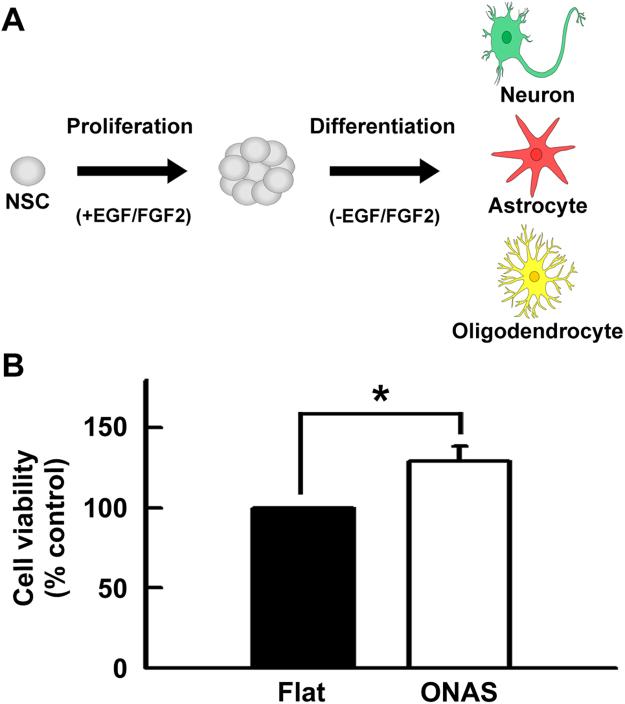
Recently, the importance of surface nanotopography in the determination of stem cell fate and behavior has been revealed. In the current study, we generated polystyrene cell-culture dishes with an omnidirectional nanopore arrayed surface (ONAS) (diameter: 200 nm, depth: 500 nm, center-to-center distance: 500 nm) and investigated the effects of nanotopography on rat neural stem cells (NSCs). NSCs cultured on ONAS proliferated better than those on the flat surface when cell density was low and showed less spontaneous differentiation during proliferation in the presence of mitogens. Interestingly, NSCs cultured on ONAS at clonal density demonstrated a propensity to generate neurospheres, whereas those on the flat surface migrated out, proliferated as individuals, and spread out to attach to the surface. However, the differential patterns of proliferation were cell density-dependent since the distinct phenomena were lost when cell density was increased. ONAS modulated cytoskeletal reorganization and inhibited formation of focal adhesion, which is generally observed in NSCs grown on flat surfaces. ONAS appeared to reinforce NSC-NSC interaction, restricted individual cell migration and prohibited NSC attachment to the nanopore surface. These data demonstrate that ONAS maintains NSCs as undifferentiated while retaining multipotency and is a better topography for culturing low density NSCs.
最近,表面纳米形貌在决定干细胞命运和行为方面的重要性已经被揭示出来。在本研究中,我们制备了具有各向同性纳米孔阵列表面(ONAS)的聚苯乙烯细胞培养皿(直径:200nm,深度:500nm,中心到中心距离:500nm),并研究了纳米形貌对大鼠神经干细胞(NSCs)的影响。当细胞密度较低时,在有丝分裂原存在的情况下,培养在 ONAS 上的 NSCs 比在平面上的 NSCs 增殖得更好,并且增殖过程中自发性分化较少。有趣的是,在克隆密度下培养在 ONAS 上的 NSCs 表现出生成神经球的倾向,而那些在平面上的 NSCs 则迁移出去,作为个体增殖并扩散到表面附着。然而,增殖的差异模式是依赖于细胞密度的,因为当细胞密度增加时,这些明显的现象就消失了。ONAS 调节细胞骨架的重组并抑制焦点粘连的形成,这在生长在平面上的 NSCs 中通常是可见的。ONAS 似乎增强了 NSC-NSC 之间的相互作用,限制了单个细胞的迁移并阻止了 NSC 附着到纳米孔表面。这些数据表明,ONAS 可以在保持 NSCs 未分化状态的同时保留其多能性,并且是培养低细胞密度 NSCs 的更好的形貌。




 Zotero 插件