
将错失机会工具用作生命拯救工具(LiST)的一种应用,以确定干预措施的优先级。
Using the missed opportunity tool as an application of the Lives Saved Tool (LiST) for intervention prioritization.
作者信息
Tam Yvonne, Pearson Luwei
机构信息
Institute for International Programs, Department of International Health, Bloomberg School of Public Health, Johns Hopkins University, 615 N. Wolfe Street, Baltimore, MD, 21205, USA.
United Nations Children's Fund UNICEF, 3 UN Plaza, New York City, NY10017, USA.
出版信息
BMC Public Health. 2017 Nov 7;17(Suppl 4):735. doi: 10.1186/s12889-017-4736-3.
BACKGROUND
The Missed Opportunity tool was developed as an application in the Lives Saved Tool (LiST) to allow users to quickly compare the relative impact of interventions. Global Financing Facility (GFF) investment cases have been identified as a potential application of the Missed Opportunity analyses in Democratic Republic of the Congo (DRC), Ethiopia, Kenya, and Tanzania, to use 'lives saved' as a normative factor to set priorities.
METHODS
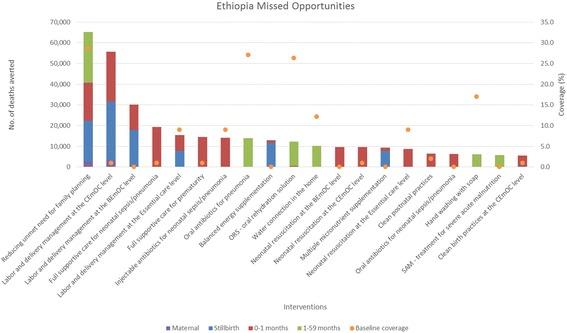
The Missed Opportunity analysis draws on data and methods in LiST to project maternal, stillbirth, and child deaths averted based on changes in interventions' coverage. Coverage of each individual intervention in LiST was automated to be scaled up from current coverage to 90% in the next year, to simulate a scenario where almost every mother and child receive proven interventions that they need. The main outcome of the Missed Opportunity analysis is deaths averted due to each intervention.
RESULTS
When reducing unmet need for contraception is included in the analysis, it ranks as the top missed opportunity across the four countries. When it is not included in the analysis, top interventions with the most total deaths averted are hospital-based interventions such as labor and delivery management in the CEmOC and BEmOC level, and full treatment and supportive care for premature babies, and for sepsis/pneumonia.
CONCLUSIONS
The Missed Opportunity tool can be used to provide a quick, first look at missed opportunities in a country or geographic region, and help identify interventions for prioritization. While it is a useful advocate for evidence-based priority setting, decision makers need to consider other factors that influence decision making, and also discuss how to implement, deliver, and sustain programs to achieve high coverage.
背景
错失机会工具是作为挽救生命工具(LiST)中的一个应用程序开发的,用于让用户快速比较干预措施的相对影响。全球融资机制(GFF)投资案例已被确定为错失机会分析在刚果民主共和国、埃塞俄比亚、肯尼亚和坦桑尼亚的一个潜在应用,以将“挽救的生命”作为确定优先事项的规范性因素。
方法
错失机会分析利用LiST中的数据和方法,根据干预措施覆盖率的变化预测避免的孕产妇、死产和儿童死亡情况。LiST中每项单独干预措施的覆盖率被自动设定为从当前覆盖率在下一年扩大到90%,以模拟几乎每个母亲和儿童都能获得他们所需的经过验证的干预措施的情景。错失机会分析的主要结果是每项干预措施避免的死亡人数。
结果
当分析中纳入减少未满足的避孕需求时,它在这四个国家中位列错失机会之首。当不将其纳入分析时,避免死亡总数最多的首要干预措施是基于医院的干预措施,如CEmOC和BEmOC级别的分娩管理,以及对早产儿和败血症/肺炎的全面治疗和支持性护理。
结论
错失机会工具可用于快速初步了解一个国家或地理区域的错失机会,并有助于确定优先干预措施。虽然它是基于证据确定优先事项的有用倡导者,但决策者需要考虑影响决策的其他因素,并讨论如何实施、提供和维持各项计划以实现高覆盖率。



 Zotero 插件