
tau PET 示踪剂 THK5117、THK5351、PBB3 和 T807 在阿尔茨海默病死后大脑中的比较结合特性。
Comparative binding properties of the tau PET tracers THK5117, THK5351, PBB3, and T807 in postmortem Alzheimer brains.
机构信息
Division of Translational Alzheimer Neurobiology, Department of Neurobiology, Care Sciences and Society, Karolinska Institutet, Stockholm, Sweden.
Department of Clinical Neuroscience, Center for Psychiatric Research, Karolinska Institutet, Stockholm, Sweden.
出版信息
Alzheimers Res Ther. 2017 Dec 11;9(1):96. doi: 10.1186/s13195-017-0325-z.
BACKGROUND
The aim of this study was to compare the binding properties of several tau positron emission tomography tracers-THK5117, THK5351, T807 (also known as AV1451; flortaucipir), and PBB3-head to head in the same human brain tissue.
METHODS
Binding assays were performed to compare the regional distribution of H-THK5117 and H-THK5351 in postmortem tissue from three Alzheimer's disease (AD) cases and three control subjects in frontal and temporal cortices as well as in the hippocampus. Competition binding assays between THK5351, THK5117, PBB3, and T807, as well as off-target binding of THK5117 and T807 toward monoamine oxidase B (MAO-B), were performed using binding assays in brain homogenates and autoradiography of three AD cases.
RESULTS
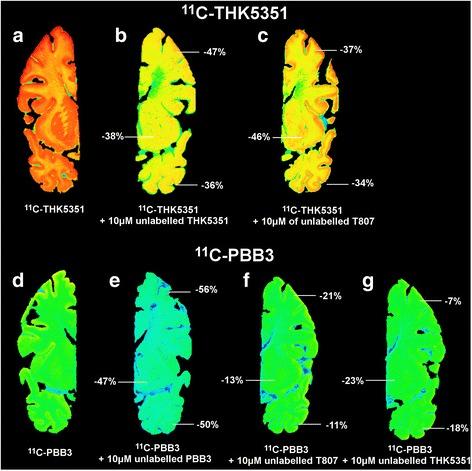
Regional binding of H-THK5117 and H-THK5351 was similar, except in the temporal cortex, which showed higher H-THK5117 binding. Saturation studies demonstrated two binding sites for H-THK5351 (K = 5.6 nM, B = 76 pmol/g; K = 1 nM, B = 40 pmol/g). Competition studies in the hippocampus between H-THK5351 and unlabeled THK5351, THK5117, and T807 revealed super-high-affinity sites for all three tracers (THK5351 K = 0.1 pM; THK5117 K = 0.3 pM; T807 K = 0.2 pM) and an additional high-affinity site (THK5351 K = 16 nM; THK5117 K = 20 nM; T807 K = 78nM). F-T807, C-THK5351, and C-PBB3 autoradiography of large frozen sections from three AD brains showed similar regional binding for the three tracers, with lower binding intensity for C-PBB3. Unlabeled THK5351 and T807 displaced C-THK5351 to a similar extent and a lower extent, respectively, compared with C-PBB3. Competition with the MAO-B inhibitor H-L-deprenyl was observed for THK5117 and T807 in the hippocampus (THK5117 K = 286 nM; T807 K = 227 nM) and the putamen (THK5117 K = 148 nM; T807 K = 135 nM). H-THK5351 binding was displaced using autoradiography competition with unlabeled THK5351 and T807 in cortical areas by 70-80% and 60-77%, respectively, in the basal ganglia, whereas unlabeled deprenyl displaced H-THK5351 binding by 40% in the frontal cortex and 50% in the basal ganglia.
CONCLUSIONS
THK5351, THK5117, and T807 seem to target similar binding sites, but with different affinities, whereas PBB3 seems to target its own binding site. Both THK5117 and T807 demonstrated off-target binding in the hippocampus and putamen with a ten times lower binding affinity to the MAO-B inhibitor deprenyl compared with H-THK5351.
背景
本研究旨在比较几种 tau 正电子发射断层扫描示踪剂——THK5117、THK5351、T807(也称为 AV1451;flortaucipir)和 PBB3 的结合特性,在相同的人脑组织中进行头对头比较。
方法
进行结合测定,以比较三种阿尔茨海默病(AD)病例和三种对照的死后组织中 H-THK5117 和 H-THK5351 在额叶和颞叶皮质以及海马体中的区域性分布。在脑匀浆中进行 THK5351、THK5117、PBB3 和 T807 的竞争结合测定,并使用 AD 病例的 autoradiography 测定 THK5117 和 T807 对单胺氧化酶 B(MAO-B)的非靶点结合,进行 THK5351、THK5117、T807 和 T807 的非靶点结合。
结果
H-THK5117 和 H-THK5351 的区域性结合相似,除了颞叶皮质,其 H-THK5117 结合更高。饱和研究表明 H-THK5351 有两个结合位点(K = 5.6 nM,B = 76 pmol/g;K = 1 nM,B = 40 pmol/g)。在海马体中,H-THK5351 与未标记的 THK5351、THK5117 和 T807 的竞争研究表明,所有三种示踪剂的超高亲和力位点(THK5351 K = 0.1 pM;THK5117 K = 0.3 pM;T807 K = 0.2 pM)和一个额外的高亲和力位点(THK5351 K = 16 nM;THK5117 K = 20 nM;T807 K = 78 nM)。在三个 AD 大脑的大冷冻切片的 F-T807、C-THK5351 和 C-PBB3 autoradiography 中,三种示踪剂的区域性结合相似,C-PBB3 的结合强度较低。与 C-PBB3 相比,未标记的 THK5351 和 T807 分别以相似和较低的程度置换 C-THK5351。在海马体(THK5117 K = 286 nM;T807 K = 227 nM)和壳核(THK5117 K = 148 nM;T807 K = 135 nM)中,THK5117 和 T807 观察到与 MAO-B 抑制剂 H-L-去甲肾上腺素的竞争结合。用 autoradiography 竞争测定,THK5351 和 T807 在皮质区分别置换 H-THK5351 结合 70-80%和 60-77%,而未标记的去甲肾上腺素在额叶皮质和基底节中分别置换 H-THK5351 结合 40%和 50%。
结论
THK5351、THK5117 和 T807 似乎靶向相似的结合位点,但亲和力不同,而 PBB3 似乎靶向其自身的结合位点。THK5117 和 T807 均在海马体和壳核中表现出非靶点结合,与 MAO-B 抑制剂去甲肾上腺素相比,其对 H-THK5351 的结合亲和力低十倍。



 Zotero 插件