
训练和未训练的人体骨骼肌中基因表达的调控
Regulation of gene expression in trained and untrained human skeletal muscle.
作者信息
Popov Daniil V, Lysenko Evgeny A, Makhnovskii Pavel A, Kurochkina Nadia S, Vinogradova Olga L
机构信息
Laboratory of exercise physiology, Institute of Biomedical problems of the Russian Academy of Sciences, Moscow, Russia.
Faculty of Fundamental Medicine, M.V. Lomonosov Moscow State University, Moscow, Russia.
出版信息
Physiol Rep. 2017 Dec;5(23). doi: 10.14814/phy2.13543.
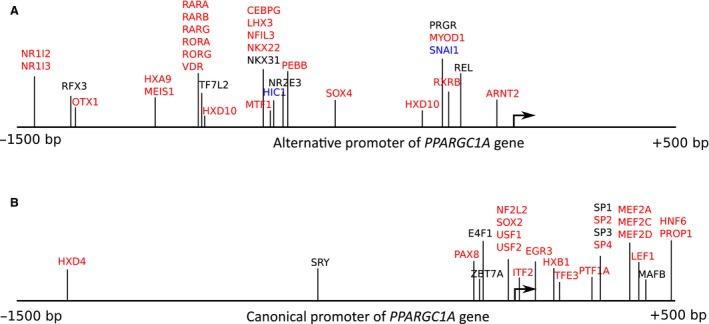
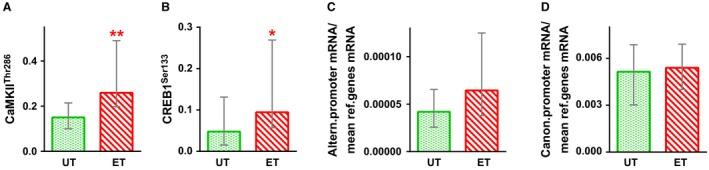
Promoter-specific expression of the gene in untrained and trained human skeletal muscle was investigated. Ten untrained males performed a one-legged knee extension exercise (for 60 min) with the same relative intensity both before and after 8 weeks of cycling training. Samples from the of each leg were taken before and after exercise. Postexercise gene expression via the canonical promoter increased by ~100% ( < 0.05) in exercised and nonexercised untrained muscles, but did not change in either leg after training program. In untrained and trained exercised muscle, gene expression via the alternative promoter increased by two orders of magnitude ( < 0.01). We found increases in postexercise content of dephosphorylated (activated) CRTC2, a coactivator of CREB1, in untrained exercised muscle and in expression of CREB1-related genes in untrained and trained exercised muscle ( < 0.01-0.05); this may partially explain the increased expression of via the alternative promoter. In addition, comparison of the regulatory regions of both promoters revealed unique conserved motifs in the alternative promoter that were associated with transcriptional repressors SNAI1 and HIC1. In conclusion, in untrained muscle, exercise-induced expression of the gene via the canonical promoter may be regulated by systemic factors, while in trained muscle the canonical promoter shows constitutive expression at rest and after exercise. Exercise-induced expression of via the alternative promoter relates to intramuscular factors and associates with activation of CRTC2-CREB1. Apparently, expression via the alternative promoter is regulated by other transcription factors, particularly repressors.
研究了该基因在未经训练和经过训练的人体骨骼肌中的启动子特异性表达。10名未经训练的男性在进行8周的自行车训练前后,以相同的相对强度进行单腿膝关节伸展运动(持续60分钟)。在运动前后采集每条腿的样本。运动后,通过经典启动子的基因表达在未经训练的运动和未运动肌肉中增加了约100%(P<0.05),但在训练计划后两条腿均未改变。在未经训练和经过训练的运动肌肉中,通过替代启动子的基因表达增加了两个数量级(P<0.01)。我们发现,在未经训练的运动肌肉中,运动后去磷酸化(活化)的CRTC2(CREB1的共激活因子)含量增加,在未经训练和经过训练的运动肌肉中,CREB1相关基因的表达增加(P<0.01-0.05);这可能部分解释了通过替代启动子的基因表达增加的原因。此外,对两个启动子调控区域的比较揭示了替代启动子中与转录抑制因子SNAI1和HIC1相关的独特保守基序。总之,在未经训练的肌肉中,运动诱导的通过经典启动子的基因表达可能受全身因素调控,而在经过训练的肌肉中,经典启动子在休息和运动后均表现为组成型表达。运动诱导的通过替代启动子的基因表达与肌肉内因素有关,并与CRTC2-CREB1的激活相关。显然,通过替代启动子的表达受其他转录因子调控,尤其是抑制因子。


 Zotero 插件