
使用 n 型主体的长寿命高效延迟荧光有机发光二极管。
Long-lived efficient delayed fluorescence organic light-emitting diodes using n-type hosts.
机构信息
Center for Organic Photonics and Electronics Research (OPERA), Kyushu University, 744 Motooka, Nishi, Fukuoka, 819-0395, Japan.
JST, ERATO, Adachi Molecular Exciton Engineering Project, 744 Motooka, Nishi, Fukuoka, 819-0395, Japan.
出版信息
Nat Commun. 2017 Dec 21;8(1):2250. doi: 10.1038/s41467-017-02419-x.
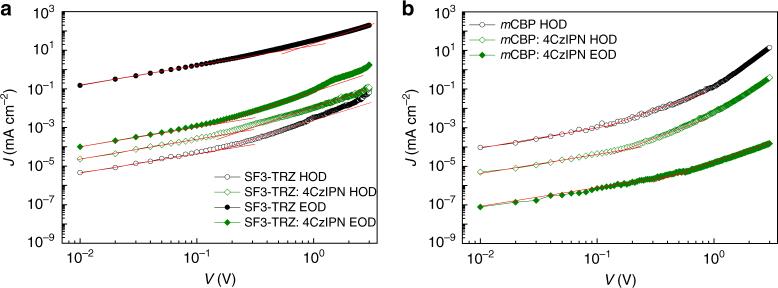
Organic light-emitting diodes have become a mainstream display technology because of their desirable features. Third-generation electroluminescent devices that emit light through a mechanism called thermally activated delayed fluorescence are currently garnering much attention. However, unsatisfactory device stability is still an unresolved issue in this field. Here we demonstrate that electron-transporting n-type hosts, which typically include an acceptor moiety in their chemical structure, have the intrinsic ability to balance the charge fluxes and broaden the recombination zone in delayed fluorescence organic electroluminescent devices, while at the same time preventing the formation of high-energy excitons. The n-type hosts lengthen the lifetimes of green and blue delayed fluorescence devices by > 30 and 1000 times, respectively. Our results indicate that n-type hosts are suitable to realize stable delayed fluorescence organic electroluminescent devices.
有机发光二极管因其理想的特性已成为主流显示技术。目前,通过一种称为热激活延迟荧光的机制发光的第三代电致发光器件受到了广泛关注。然而,器件稳定性不理想仍然是该领域尚未解决的问题。在这里,我们证明了电子传输 n 型主体(其化学结构中通常包含受主部分)具有内在的能力,可以在延迟荧光有机电致发光器件中平衡电荷流并拓宽复合区,同时防止高能激子的形成。n 型主体使绿光和蓝光延迟荧光器件的寿命分别延长了 >30 倍和 1000 倍。我们的结果表明,n 型主体适合实现稳定的延迟荧光有机电致发光器件。


 Zotero 插件