
维生素D受体表达在视网膜血管发育以及1,25(OH)₂D₃对新生血管形成的抑制过程中至关重要。
Vitamin D receptor expression is essential during retinal vascular development and attenuation of neovascularization by 1, 25(OH)2D3.
作者信息
Jamali Nasim, Wang Shoujian, Darjatmoko Soesiawati R, Sorenson Christine M, Sheibani Nader
机构信息
Departments of Ophthalmology and Visual Sciences, University of Wisconsin School of Medicine and Public Health, Madison, WI, United States of America.
McPherson Eye Research Institute, University of Wisconsin School of Medicine and Public Health, Madison, WI, United States of America.
出版信息
PLoS One. 2017 Dec 22;12(12):e0190131. doi: 10.1371/journal.pone.0190131. eCollection 2017.
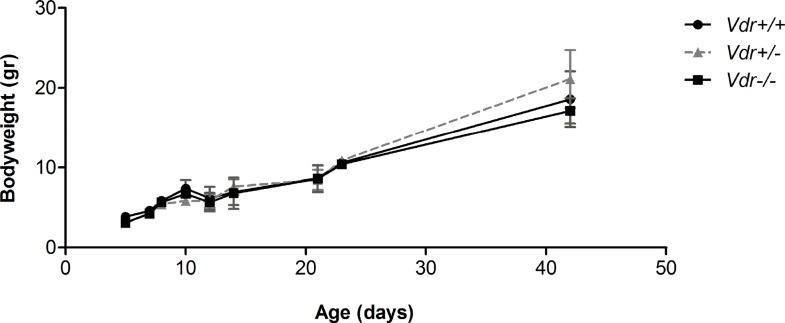
Vitamin D provides a significant benefit to human health, and its deficiency has been linked to a variety of diseases including cancer. Vitamin D exhibits anticancer effects perhaps through inhibition of angiogenesis. We previously showed that the active form of vitamin D (1, 25(OH)2D3; calcitriol) is a potent inhibitor of angiogenesis in mouse model of oxygen-induced ischemic retinopathy (OIR). Many of vitamin D's actions are mediated through vitamin D receptor (VDR). However, the role VDR expression plays in vascular development and inhibition of neovascularization by 1, 25(OH)2D3 remains unknown. Here using wild type (Vdr +/+) and Vdr-deficient (Vdr -/-) mice, we determined the impact of Vdr expression on postnatal development of retinal vasculature and retinal neovascularization during OIR. We observed no significant effect on postnatal retinal vascular development in Vdr -/- mice up to postnatal day 21 (P21) compared with Vdr +/+ mice. However, we observed an increase in density of pericytes (PC) and a decrease in density of endothelial cells (EC) in P42 Vdr -/- mice compared with Vdr +/+ mice, resulting in a significant decrease in the EC/PC ratio. Although we observed no significant impact on vessel obliteration and retinal neovascularization in Vdr -/- mice compared with Vdr +/+ mice during OIR, the VDR expression was essential for inhibition of retinal neovascularization by 1, 25(OH)2D3. In addition, the adverse impact of 1, 25(OH)2D3 treatment on the mouse bodyweight was also dependent on VDR expression. Thus, VDR expression plays a significant role during retinal vascular development, especially during maturation of retinal vasculature by promoting PC quiescence and EC survival, and inhibition of ischemia-mediated retinal neovascularization by 1, 25(OH)2D3.
维生素D对人类健康有显著益处,其缺乏与包括癌症在内的多种疾病有关。维生素D可能通过抑制血管生成发挥抗癌作用。我们之前表明,维生素D的活性形式(1,25(OH)2D3;骨化三醇)在氧诱导的缺血性视网膜病变(OIR)小鼠模型中是一种有效的血管生成抑制剂。维生素D的许多作用是通过维生素D受体(VDR)介导的。然而,VDR表达在血管发育以及1,25(OH)2D3对新生血管形成的抑制作用中所起的作用仍不清楚。在此,我们使用野生型(Vdr +/+)和Vdr基因缺陷型(Vdr -/-)小鼠,确定了Vdr表达对OIR期间视网膜血管系统的产后发育和视网膜新生血管形成的影响。与Vdr +/+小鼠相比,我们观察到在出生后第21天(P21)之前,Vdr -/-小鼠的产后视网膜血管发育没有显著影响。然而,与Vdr +/+小鼠相比,我们观察到P42期Vdr -/-小鼠的周细胞(PC)密度增加,内皮细胞(EC)密度降低,导致EC/PC比值显著下降。尽管在OIR期间,与Vdr +/+小鼠相比,我们观察到Vdr -/-小鼠的血管闭塞和视网膜新生血管形成没有显著影响,但VDR表达对于1,25(OH)2D3抑制视网膜新生血管形成至关重要。此外,1,25(OH)2D3治疗对小鼠体重的不利影响也依赖于VDR表达。因此,VDR表达在视网膜血管发育过程中发挥重要作用,特别是在视网膜血管系统成熟过程中,通过促进PC静止和EC存活,以及1,25(OH)2D3抑制缺血介导的视网膜新生血管形成。




 Zotero 插件