
麦芽糖结合蛋白在 GroEL 内外的折叠。
Folding of maltose binding protein outside of and in GroEL.
机构信息
Johnson Research Foundation, Department of Biochemistry and Biophysics, Perelman School of Medicine, University of Pennsylvania, Philadelphia, PA 19104.
Johnson Research Foundation, Department of Biochemistry and Biophysics, Perelman School of Medicine, University of Pennsylvania, Philadelphia, PA 19104
出版信息
Proc Natl Acad Sci U S A. 2018 Jan 16;115(3):519-524. doi: 10.1073/pnas.1716168115. Epub 2018 Jan 2.
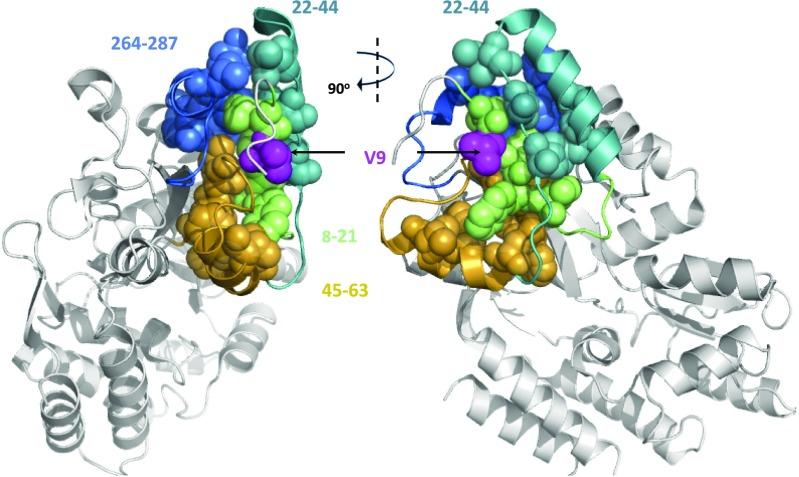
We used hydrogen exchange-mass spectrometry (HX MS) and fluorescence to compare the folding of maltose binding protein (MBP) in free solution and in the GroEL/ES cavity. Upon refolding, MBP initially collapses into a dynamic molten globule-like ensemble, then forms an obligatory on-pathway native-like folding intermediate (1.2 seconds) that brings together sequentially remote segments and then folds globally after a long delay (30 seconds). A single valine to glycine mutation imposes a definable folding defect, slows early intermediate formation by 20-fold, and therefore subsequent global folding by approximately twofold. Simple encapsulation within GroEL repairs the folding defect and reestablishes fast folding, with or without ATP-driven cycling. Further examination exposes the structural mechanism. The early folding intermediate is stabilized by an organized cluster of 24 hydrophobic side chains. The cluster preexists in the collapsed ensemble before the H-bond formation seen by HX MS. The V9G mutation slows folding by disrupting the preintermediate cluster. GroEL restores wild-type folding rates by restabilizing the preintermediate, perhaps by a nonspecific equilibrium compression effect within its tightly confining central cavity. These results reveal an active GroEL function other than previously proposed mechanisms, suggesting that GroEL possesses different functionalities that are able to relieve different folding problems. The discovery of the preintermediate, its mutational destabilization, and its restoration by GroEL encapsulation was made possible by the measurement of a previously unexpected type of low-level HX protection, apparently not dependent on H-bonding, that may be characteristic of proteins in confined spaces.
我们使用氢氚交换质谱(HX MS)和荧光技术比较了游离溶液中和 GroEL/ES 腔中的麦芽糖结合蛋白(MBP)的折叠情况。在重折叠过程中,MBP 最初会坍缩成一个动态的无规卷曲样集合体,然后形成一个必需的、沿特定途径的天然样折叠中间态(1.2 秒),该中间态会使顺序上较远的片段聚集在一起,然后在长时间延迟(30 秒)后进行全局折叠。一个单一的缬氨酸到甘氨酸的突变会导致可定义的折叠缺陷,使早期中间态的形成速度减慢 20 倍,因此随后的全局折叠速度减慢约两倍。简单地将其包裹在 GroEL 内可以修复折叠缺陷并恢复快速折叠,无论是否有 ATP 驱动的循环。进一步的研究揭示了结构机制。早期折叠中间态由 24 个疏水侧链组成的有序簇稳定。在 HX MS 观察到的氢键形成之前,该簇就已经存在于折叠的集合体中。V9G 突变通过破坏预中间态簇来减缓折叠。GroEL 通过重新稳定预中间态来恢复野生型折叠速率,这可能是通过其紧密限制的中央腔中的非特异性平衡压缩效应。这些结果揭示了 GroEL 的一种不同于以前提出的机制的主动功能,表明 GroEL 具有不同的功能,能够缓解不同的折叠问题。预中间态的发现、其突变的不稳定性以及其被 GroEL 包埋的恢复,是通过测量以前未预料到的低水平 HX 保护类型实现的,这种保护类型显然不依赖于氢键,可能是限制空间中蛋白质的特征。




 Zotero 插件