
竞争影响力最大化和非同质 Kuramoto 振子群体中的同步增强。
Competitive influence maximization and enhancement of synchronization in populations of non-identical Kuramoto oscillators.
机构信息
University of Southampton, Electronics and Computer Science, Southampton, SO171BJ, UK.
Fondazione Bruno Kessler, Trento, Italy.
出版信息
Sci Rep. 2018 Jan 15;8(1):702. doi: 10.1038/s41598-017-18961-z.
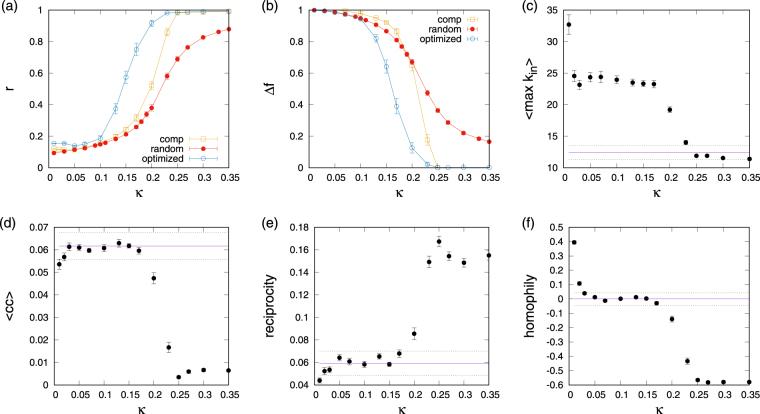
Many networked systems have evolved to optimize performance of function. Much literature has considered optimization of networks by central planning, but investigations of network formation amongst agents connecting to achieve non-aligned goals are comparatively rare. Here we consider the dynamics of synchronization in populations of coupled non-identical oscillators and analyze adaptations in which individual nodes attempt to rewire network topology to optimize node-specific aims. We demonstrate that, even though individual nodes' goals differ very widely, rewiring rules in which each node attempts to connect to the rest of the network in such a way as to maximize its influence on the system can enhance synchronization of the collective. The observed speed-up of consensus finding in this competitive dynamics might explain enhanced synchronization in real world systems and shed light on mechanisms for improved consensus finding in society.
许多网络系统已经进化到可以优化功能性能。许多文献已经考虑了通过中央规划来优化网络,但对于代理之间为实现非对齐目标而连接的网络形成的研究相对较少。在这里,我们考虑了耦合非同质振荡器群体中的同步动力学,并分析了个体节点试图重新布线网络拓扑以优化节点特定目标的适应性。我们证明,即使个体节点的目标差异非常大,但是每个节点都试图以最大化其对系统影响的方式连接到网络其余部分的重连规则,可以增强集体的同步性。在这种竞争动力学中观察到的共识发现速度的加快,可能解释了现实世界系统中同步性的增强,并揭示了社会中提高共识发现的机制。


 Zotero 插件