
深部脑刺激诱导局部调制神经元活动的稀疏分布。
Deep brain stimulation induces sparse distributions of locally modulated neuronal activity.
机构信息
Biomedical Engineering, University of Minnesota, Minneapolis, USA.
Neurology, University of Minnesota, Minneapolis, USA.
出版信息
Sci Rep. 2018 Feb 1;8(1):2062. doi: 10.1038/s41598-018-20428-8.
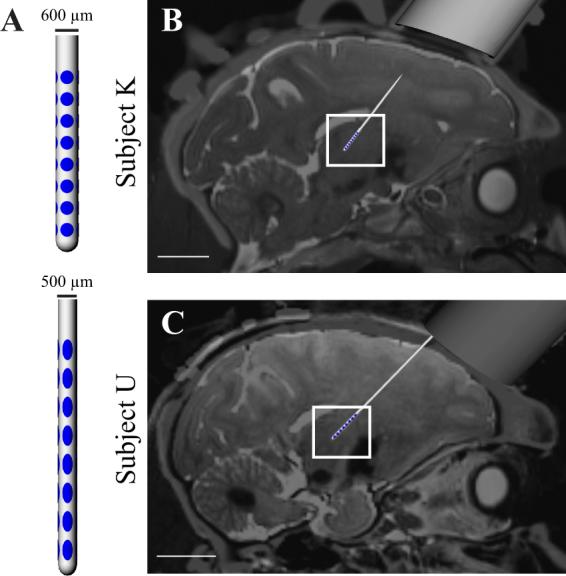
Deep brain stimulation (DBS) therapy is a potent tool for treating a range of brain disorders. High frequency stimulation (HFS) patterns used in DBS therapy are known to modulate neuronal spike rates and patterns in the stimulated nucleus; however, the spatial distribution of these modulated responses are not well understood. Computational models suggest that HFS modulates a volume of tissue spatially concentrated around the active electrode. Here, we tested this theory by investigating modulation of spike rates and patterns in non-human primate motor thalamus while stimulating the cerebellar-receiving area of motor thalamus, the primary DBS target for treating Essential Tremor. HFS inhibited spike activity in the majority of recorded cells, but increasing stimulation amplitude also shifted the response to a greater degree of spike pattern modulation. Modulated responses in both categories exhibited a sparse and long-range spatial distribution within motor thalamus, suggesting that stimulation preferentially affects afferent and efferent axonal processes traversing near the active electrode and that the resulting modulated volume strongly depends on the local connectome of these axonal processes. Such findings have important implications for current clinical efforts building predictive computational models of DBS therapy, developing directional DBS lead technology, and formulating closed-loop DBS strategies.
深部脑刺激(DBS)疗法是治疗一系列脑部疾病的有力工具。DBS 疗法中使用的高频刺激(HFS)模式已知可调节刺激核内的神经元尖峰率和模式;然而,这些调制响应的空间分布尚不清楚。计算模型表明,HFS 调节了活性电极周围空间集中的组织体积。在这里,我们通过研究刺激治疗原发性震颤的主要 DBS 靶点——运动丘脑的小脑接受区时,非人类灵长类动物运动丘脑的尖峰率和模式的调制,来检验这一理论。HFS 抑制了大多数记录细胞的尖峰活动,但增加刺激幅度也会使反应向更大程度的尖峰模式调制转变。这两种类型的调制反应在运动丘脑内呈现稀疏和长程的空间分布,表明刺激优先影响穿过活性电极附近的传入和传出轴突过程,并且由此产生的调制体积强烈依赖于这些轴突过程的局部连接组。这些发现对当前的临床努力具有重要意义,这些努力正在构建 DBS 治疗的预测计算模型、开发定向 DBS 引线技术和制定闭环 DBS 策略。



 Zotero 插件