
氟哌啶醇与奥氮平治疗谵妄的疗效比较。
Comparison of efficacy of haloperidol and olanzapine in the treatment of delirium.
作者信息
Jain Rajan, Arun Priti, Sidana Ajeet, Sachdev Atul
机构信息
Department of Psychiatry, Government Medical College and Hospital, Chandigarh, India.
Department of General Medicine, Government Medical College and Hospital, Chandigarh, India.
出版信息
Indian J Psychiatry. 2017 Oct-Dec;59(4):451-456. doi: 10.4103/psychiatry.IndianJPsychiatry_59_17.
OBJECTIVE
Till date, typical antipsychotic haloperidol is the treatment of choice for delirium. But, due to higher side effects with haloperidol, newer atypical antipsychotics (e.g., olanzapine) are increasingly being used in the treatment of delirious patients. The aim of the current research was to study the efficacy and tolerability of haloperidol and olanzapine in the treatment of delirium.
MATERIALS AND METHODS
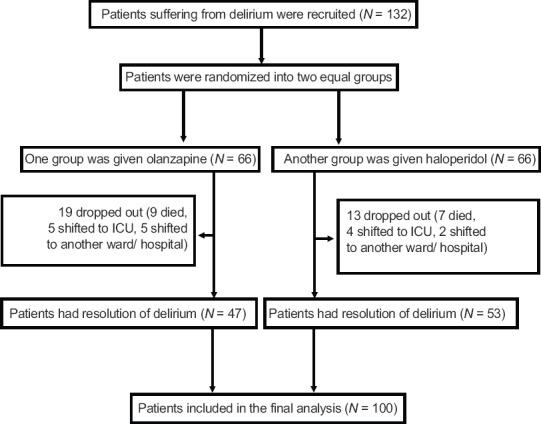
This was an open-label, randomized controlled study carried out in a tertiary care hospital at Chandigarh, India. A total of 100 patients admitted in medicine, surgery, and orthopedic wards and diagnosed as having delirium on Confusion Assessment Method scale were included in the study. Patients were given either haloperidol (1-4 mg/day either orally or by nasogastric tube) or olanzapine (2.5-10 mg/day either orally or by nasogastric tube). Severity of delirium and pattern of symptom improvement were assessed by Memorial Delirium Assessment Scale (MDAS). Extrapyramidal side effects were assessed by Simpson-Angus Scale.
RESULTS
There was an improvement in delirium severity in both groups with treatment. Mean daily dose of haloperidol and olanzapine used per patient was 2.10 and 5.49 mg, respectively, and the mean duration of treatment in olanzapine group and haloperidol group was 3.57 days and 3.37 days, respectively. There was no significant difference in the mean duration of treatment in both groups. At the end of study period, the MDAS scores in olanzapine and haloperidol groups were 8.43 and 8.00, respectively, and the difference was not significant statistically with = 0.765. Five patients experienced drug-related mild side effects.
CONCLUSION
Low-dose haloperidol and olanzapine were equally efficacious and well tolerated in delirium.
目的
迄今为止,典型抗精神病药物氟哌啶醇是谵妄的首选治疗药物。但是,由于氟哌啶醇的副作用较大,新型非典型抗精神病药物(如奥氮平)越来越多地用于谵妄患者的治疗。本研究的目的是探讨氟哌啶醇和奥氮平治疗谵妄的疗效和耐受性。
材料与方法
这是一项在印度昌迪加尔的一家三级护理医院进行的开放标签随机对照研究。共有100名在内科、外科和骨科病房住院且根据混乱评估方法量表诊断为谵妄的患者纳入研究。患者分别给予氟哌啶醇(1 - 4毫克/天,口服或经鼻胃管给药)或奥氮平(2.5 - 10毫克/天,口服或经鼻胃管给药)。通过纪念性谵妄评估量表(MDAS)评估谵妄的严重程度和症状改善模式。通过辛普森 - 安格斯量表评估锥体外系副作用。
结果
两组治疗后谵妄严重程度均有改善。每位患者使用氟哌啶醇和奥氮平的平均日剂量分别为2.10毫克和5.49毫克,奥氮平组和氟哌啶醇组的平均治疗持续时间分别为3.57天和3.37天。两组的平均治疗持续时间无显著差异。在研究期结束时,奥氮平组和氟哌啶醇组的MDAS评分分别为8.43和8.00,差异无统计学意义(P = 0.765)。5名患者出现与药物相关的轻度副作用。
结论
低剂量氟哌啶醇和奥氮平治疗谵妄的疗效相当且耐受性良好。
 Zotero 插件