
乳腺癌与乳腺密度相关的起源:一个可检验的生物学假说。
The origins of breast cancer associated with mammographic density: a testable biological hypothesis.
机构信息
Princess Margaret Cancer Centre, 610 University Avenue, Room 9-502, Toronto, ON, M5G 2M9, Canada.
Imaging Research, Sunnybrook Health Sciences Centre, Toronto, ON, Canada.
出版信息
Breast Cancer Res. 2018 Mar 7;20(1):17. doi: 10.1186/s13058-018-0941-y.
BACKGROUND
Our purpose is to develop a testable biological hypothesis to explain the known increased risk of breast cancer associated with extensive percent mammographic density (PMD), and to reconcile the apparent paradox that although PMD decreases with increasing age, breast cancer incidence increases.
METHODS
We used the Moolgavkar model of carcinogenesis as a framework to examine the known biological properties of the breast tissue components associated with PMD that includes epithelium and stroma, in relation to the development of breast cancer. In this model, normal epithelial cells undergo a mutation to become intermediate cells, which, after further mutation, become malignant cells. A clone of such cells grows to become a tumor. The model also incorporates changes with age in the number of susceptible epithelial cells associated with menarche, parity, and menopause. We used measurements of the radiological properties of breast tissue in 4454 healthy subjects aged from 15 to 80+ years to estimate cumulative exposure to PMD (CBD) in the population, and we examined the association of CBD with the age-incidence curve of breast cancer in the population.
RESULTS
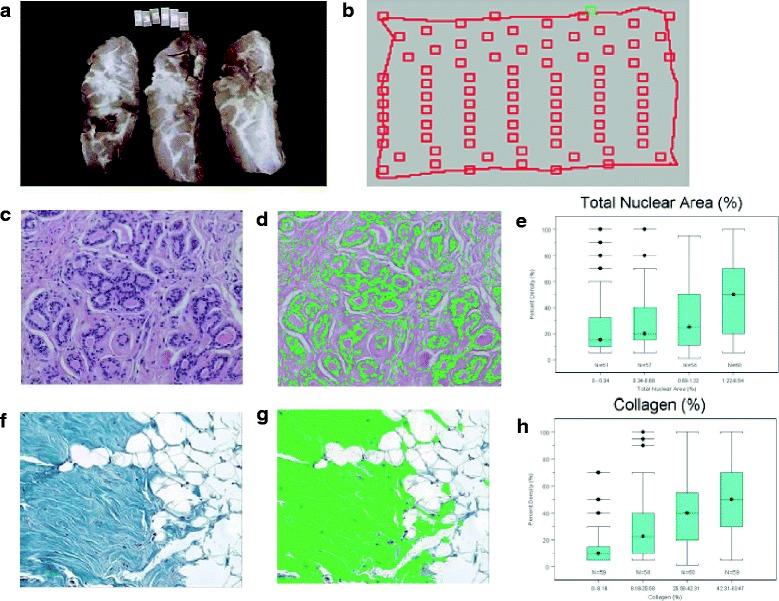
Extensive PMD is associated with a greater number of breast epithelial cells, lobules, and fibroblasts, and greater amounts of collagen and extracellular matrix. The known biological properties of these tissue components may, singly or in combination, promote the acquisition of mutations by breast epithelial cells specified by the Moolgavkar model, and the subsequent growth of a clone of malignant cells to form a tumor. We also show that estimated CBD in the population from ages 15 to 80+ years is closely associated with the age-incidence curve of breast cancer in the population.
CONCLUSIONS
These findings are consistent with the hypothesis that the biological properties of the breast tissue components associated with PMD increase the probability of the transition of normal epithelium to malignant cells, and that the accumulation of mutations with CBD may influence the age-incidence curve of breast cancer. This hypothesis gives rise to several testable predictions.
背景
我们的目的是提出一个可检验的生物学假设,以解释已知的广泛乳腺密度(PMD)与乳腺癌风险增加之间的关系,并调和一个明显的悖论,即尽管 PMD 随年龄增长而降低,但乳腺癌发病率却在增加。
方法
我们使用 Moolgavkar 致癌模型作为框架,研究与 PMD 相关的乳腺组织成分的已知生物学特性,包括上皮和基质,与乳腺癌的发展有关。在这个模型中,正常上皮细胞发生突变成为中间细胞,进一步突变后成为恶性细胞。这样的细胞克隆生长成为肿瘤。该模型还包含与青春期、生育和绝经相关的易感性上皮细胞数量随年龄的变化。我们使用 4454 名年龄在 15 至 80 岁以上的健康受试者的乳腺组织放射学特性测量值来估计人群中 PMD 的累积暴露量(CBD),并研究 CBD 与人群中乳腺癌的年龄发病率曲线的关系。
结果
广泛的 PMD 与更多的乳腺上皮细胞、小叶和成纤维细胞以及更多的胶原蛋白和细胞外基质有关。这些组织成分的已知生物学特性可能单独或联合促进 Moolgavkar 模型指定的乳腺上皮细胞获得突变,随后形成一个恶性细胞克隆的生长形成肿瘤。我们还表明,从 15 岁到 80 岁以上人群的 CBD 估计值与人群中乳腺癌的年龄发病率曲线密切相关。
结论
这些发现与假设一致,即与 PMD 相关的乳腺组织成分的生物学特性增加了正常上皮向恶性细胞转化的可能性,并且 CBD 累积的突变可能影响乳腺癌的年龄发病率曲线。这个假设产生了几个可测试的预测。



 Zotero 插件