
一款面向巴西中学的预防皮肤癌的面部抗衰移动应用程序:以外观为重点的干预性研究。
A Skin Cancer Prevention Facial-Aging Mobile App for Secondary Schools in Brazil: Appearance-Focused Interventional Study.
作者信息
Brinker Titus Josef, Heckl Marlene, Gatzka Martina, Heppt Markus V, Resende Rodrigues Henrique, Schneider Sven, Sondermann Wiebke, de Almeida E Silva Carolina, Kirchberger Michael C, Klode Joachim, Enk Alexander H, Knispel Sarah, von Kalle Christof, Stoffels Ingo, Schadendorf Dirk, Nakamura Yasuhiro, Esser Stefan, Assis Aisllan, Bernardes-Souza Breno
机构信息
Department of Dermatology, University Hospital Heidelberg, University of Heidelberg, Heidelberg, Germany.
Department of Translational Oncology, National Center for Tumor Diseases, German Cancer Research Center, Heidelberg, Germany.
出版信息
JMIR Mhealth Uhealth. 2018 Mar 9;6(3):e60. doi: 10.2196/mhealth.9794.
BACKGROUND
The incidence of melanoma is increasing faster than any other major cancer both in Brazil and worldwide. Southeast Brazil has especially high incidences of melanoma, and early detection is low. Exposure to ultraviolet (UV) radiation is a primary risk factor for developing melanoma. Increasing attractiveness is a major motivation among adolescents for tanning. A medical student-delivered intervention that takes advantage of the broad availability of mobile phones and adolescents' interest in their appearance indicated effectiveness in a recent study from Germany. However, the effect in a high-UV index country with a high melanoma prevalence and the capability of medical students to implement such an intervention remain unknown.
OBJECTIVE
In this pilot study, our objective was to investigate the preliminary success and implementability of a photoaging intervention to prevent skin cancer in Brazilian adolescents.
METHODS
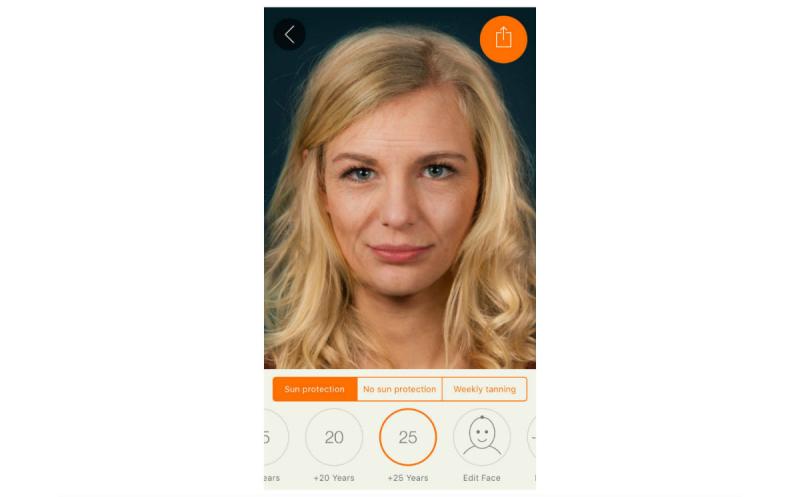
We implemented a free photoaging mobile phone app (Sunface) in 15 secondary school classes in southeast Brazil. Medical students "mirrored" the pupils' altered 3-dimensional (3D) selfies reacting to touch on tablets via a projector in front of their whole grade accompanied by a brief discussion of means of UV protection. An anonymous questionnaire capturing sociodemographic data and risk factors for melanoma measured the perceptions of the intervention on 5-point Likert scales among 356 pupils of both sexes (13-19 years old; median age 16 years) in grades 8 to 12 of 2 secondary schools in Brazil.
RESULTS
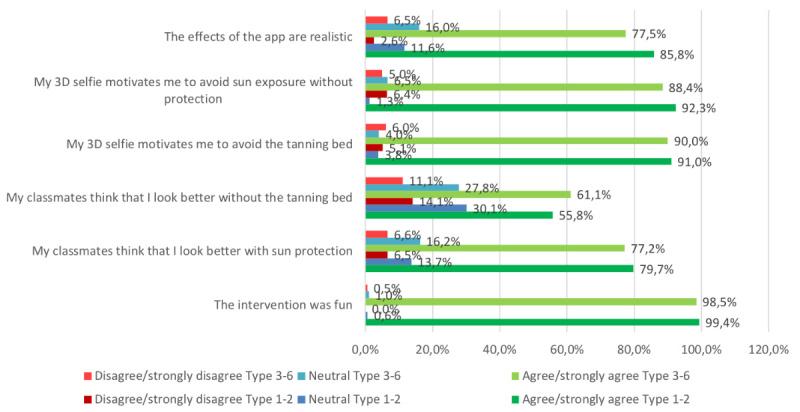
We measured more than 90% agreement in both items that measured motivation to reduce UV exposure and only 5.6% disagreement: 322 (90.5%) agreed or strongly agreed that their 3D selfie motivated them to avoid using a tanning bed, and 321 (90.2%) that it motivated them to improve their sun protection; 20 pupils (5.6%) disagreed with both items. The perceived effect on motivation was higher in female pupils in both tanning bed avoidance (n=198, 92.6% agreement in females vs n=123, 87.2% agreement in males) and increased use of sun protection (n=197, 92.1% agreement in females vs n=123, 87.2% agreement in males) and independent of age or skin type. All medical students involved filled in a process evaluation revealing that they all perceived the intervention as effective and unproblematic, and that all pupils tried the app in their presence.
CONCLUSIONS
The photoaging intervention was effective in changing behavioral predictors for UV protection in Brazilian adolescents. The predictors measured indicated an even higher prospective effectiveness in southeast Brazil than in Germany (>90% agreement in Brazil vs >60% agreement in Germany to both items that measured motivation to reduce UV exposure) in accordance with the theory of planned behavior. Medical students are capable of complete implementation. A randomized controlled trial measuring prospective effects in Brazil is planned as a result of this study.
背景
在巴西和全球范围内,黑色素瘤的发病率增长速度超过其他任何主要癌症。巴西东南部黑色素瘤发病率尤其高,且早期检测率低。紫外线(UV)辐射暴露是黑色素瘤发病的主要风险因素。日益追求吸引力是青少年晒黑的主要动机。德国最近的一项研究表明,一项由医学生实施的干预措施利用了手机的广泛普及以及青少年对外貌的关注,显示出了有效性。然而,在紫外线指数高、黑色素瘤患病率高的国家该干预措施的效果以及医学生实施此类干预的能力仍不明确。
目的
在这项试点研究中,我们的目的是调查一项光老化干预措施在预防巴西青少年皮肤癌方面的初步成效和可实施性。
方法
我们在巴西东南部的15个中学班级中应用了一款免费的光老化手机应用程序(Sunface)。医学生通过投影仪在全年级学生面前“镜像”学生在平板电脑上触摸后改变的三维(3D)自拍,并伴有关于紫外线防护方法的简短讨论。一份收集社会人口统计学数据和黑色素瘤风险因素的匿名问卷,在巴西两所中学8至12年级的356名男女学生(13 - 19岁;中位年龄16岁)中,以5分量表测量了他们对该干预措施效果的看法。
结果
在衡量减少紫外线暴露动机的两个项目中,我们测得超过90%的人表示同意,只有5.6%的人表示不同意:322人(90.5%)同意或强烈同意他们的3D自拍促使他们避免使用晒黑床,321人(90.2%)表示这促使他们加强防晒;20名学生(5.6%)在这两个项目上都不同意。在避免使用晒黑床(女性n = 198,同意率92.6%;男性n = 123,同意率87.2%)和增加使用防晒措施(女性n = 197,同意率92.1%;男性n = 123,同意率87.2%)方面,女性学生对动机的感知效果更高,且与年龄或皮肤类型无关。所有参与的医学生都填写了一份过程评估表,表明他们都认为该干预措施有效且没有问题,并且所有学生都在他们在场的情况下试用了该应用程序。
结论
光老化干预措施在改变巴西青少年紫外线防护行为预测因素方面是有效的。根据计划行为理论,所测量的预测因素表明,在巴西东南部该干预措施的预期效果甚至高于德国(在衡量减少紫外线暴露动机的两个项目上,巴西同意率>90%,德国同意率>60%)。医学生有能力完全实施该措施。基于这项研究,计划在巴西进行一项测量预期效果的随机对照试验。





 Zotero 插件