
视紫红质-2 的视网膜异构化和水孔形成。
Retinal isomerization and water-pore formation in channelrhodopsin-2.
机构信息
Department of Theoretical Biophysics, Max Planck Institute of Biophysics, 60438 Frankfurt am Main, Germany;
Department of Physics, Goethe University Frankfurt, 60438 Frankfurt am Main, Germany.
出版信息
Proc Natl Acad Sci U S A. 2018 Apr 3;115(14):3557-3562. doi: 10.1073/pnas.1700091115. Epub 2018 Mar 19.
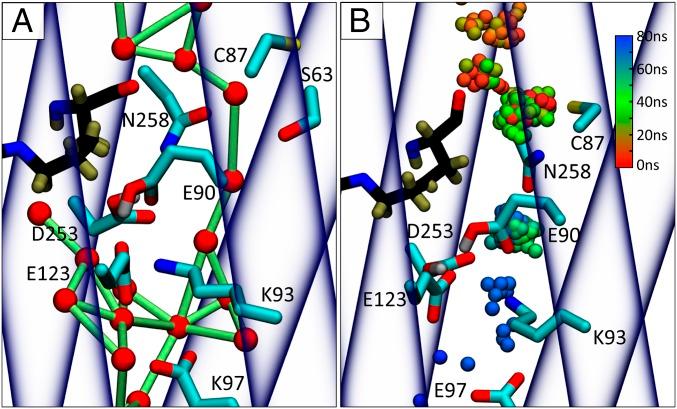
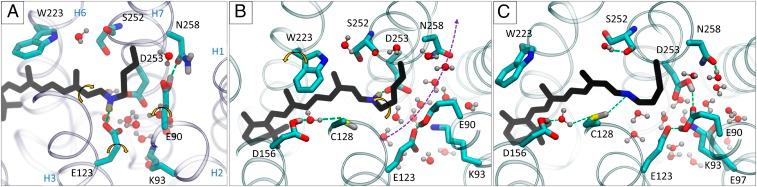
Channelrhodopsin-2 (ChR2) is a light-sensitive ion channel widely used in optogenetics. Photoactivation triggers a -to- isomerization of a covalently bound retinal. Ensuing conformational changes open a cation-selective channel. We explore the structural dynamics in the early photocycle leading to channel opening by classical (MM) and quantum mechanical (QM) molecular simulations. With QM/MM simulations, we generated a protein-adapted force field for the retinal chromophore, which we validated against absorption spectra. In a 4-µs MM simulation of a dark-adapted ChR2 dimer, water entered the vestibules of the closed channel. Retinal all- to 13- isomerization, simulated with metadynamics, triggered a major restructuring of the charge cluster forming the channel gate. On a microsecond time scale, water penetrated the gate to form a membrane-spanning preopen pore between helices H1, H2, H3, and H7. This influx of water into an ion-impermeable preopen pore is consistent with time-resolved infrared spectroscopy and electrophysiology experiments. In the retinal 13- state, D253 emerged as the proton acceptor of the Schiff base. Upon proton transfer from the Schiff base to D253, modeled by QM/MM simulations, we obtained an early-M/P-like intermediate. Rapid rotation of the unprotonated Schiff base toward the cytosolic side effectively prevents its reprotonation from the extracellular side. From MM and QM simulations, we gained detailed insight into the mechanism of ChR2 photoactivation and early events in pore formation. By rearranging the network of charges and hydrogen bonds forming the gate, water emerges as a key player in light-driven ChR2 channel opening.
通道视紫红质 2(ChR2)是一种广泛应用于光遗传学的光敏感离子通道。光激活引发共价结合的视黄醛的 Z-to-E 异构化。随后的构象变化打开阳离子选择性通道。我们通过经典(MM)和量子力学(QM)分子模拟探索导致通道打开的早期光循环中的结构动力学。通过 QM/MM 模拟,我们针对视黄醛生成了一种适用于蛋白质的力场,并用吸收光谱对其进行了验证。在黑暗适应的 ChR2 二聚体的 4 μs MM 模拟中,水进入了关闭通道的前庭。用元动力学模拟的全至 13-异构化触发了形成通道门的电荷簇的主要重排。在微秒时间尺度上,水穿透门在 H1、H2、H3 和 H7 螺旋之间形成一个跨膜预开口孔。这种水进入不可渗透离子的预开口孔的情况与时间分辨红外光谱和电生理学实验一致。在视黄醛 13-态中,D253 成为席夫碱的质子受体。通过 QM/MM 模拟模拟席夫碱到 D253 的质子转移,我们得到了一个早期 M/P 样中间体。未质子化的席夫碱向细胞质侧的快速旋转有效地阻止了其从细胞外侧重新质子化。通过 MM 和 QM 模拟,我们深入了解了 ChR2 光激活的机制以及孔形成的早期事件。通过重新排列形成门的电荷和氢键网络,水成为光驱动 ChR2 通道打开的关键因素。



 Zotero 插件