
在斋月期间,贝都因阿拉伯人中缺血性中风住院事件增加。
Increase in Ischemic Stroke Incident Hospitalizations Among Bedouin Arabs During Ramadan Month.
机构信息
Clinical Research Center, Soroka University Medical Center, Beer-Sheva, Israel.
Faculty of Health Sciences, Ben Gurion University of the Negev, Beer-Sheva, Israel.
出版信息
J Am Heart Assoc. 2018 May 3;7(10):e008018. doi: 10.1161/JAHA.117.008018.
BACKGROUND
Previous studies have not shown any significant effect on stroke incidence during Ramadan. We aimed to investigate the association between ischemic stroke incident hospitalizations and Ramadan, accounting for seasonality and temperature.
METHODS AND RESULTS
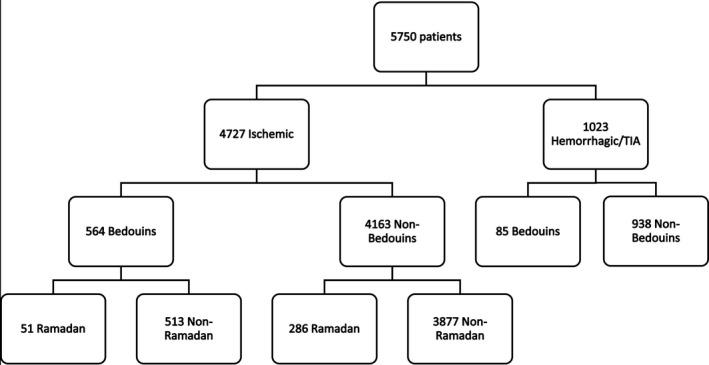
This retrospective cohort study included all patients admitted with acute ischemic stroke to Soroka University Medical Center from June 2012 to June 2016. We obtained daily mean temperatures and relative humidity rates from 2 monitoring stations in South Israel. We analyzed the association between stroke incidence and Ramadan month, adjusting for weekly temperature and seasonality using Poisson regression models. We compared the first versus the last Ramadan fortnight. We performed an effect specificity analysis by assessing stroke incidence in the non-Bedouin population. We identified 4727 cases of ischemic stroke, 564 cases of which were Bedouin Arabs. Fifty-one cases occurred during Ramadan. Ramadan was significantly associated with an increased risk for ischemic stroke (RR 1.48; 95% confidence interval, 1.04-2.09), mainly during the first fortnight (RR 1.73, 95% confidence interval, 1.13-2.66) when compared with non-Ramadan periods. Mean weekly temperatures and the summer season were not associated with stroke incidence among Bedouin Arabs (RR 0.98; 95% confidence interval, 0.82-1.18 and RR 0.77; confidence interval 0.56-1.06 accordingly). Such association was not observed in the non-Bedouin population.
CONCLUSION
The Ramadan month, particularly in its first 2 weeks, is an independent and ethnicity specific risk factor for ischemic stroke hospitalizations among the Bedouin Arab fasting population.
背景
先前的研究并未显示斋月期间中风发病率有任何显著影响。我们旨在调查斋月与缺血性脑卒中发病住院之间的关联,同时考虑季节性和温度因素。
方法和结果
本回顾性队列研究纳入了 2012 年 6 月至 2016 年 6 月期间因急性缺血性脑卒中入住索罗卡大学医学中心的所有患者。我们从以色列南部的 2 个监测站获取了每日平均温度和相对湿度数据。我们使用泊松回归模型,根据每周温度和季节性因素,分析了中风发病与斋月月份之间的关联。我们比较了第一个和最后一个斋月半月。我们通过评估非贝都因人群的中风发病率来进行效应特异性分析。我们共确定了 4727 例缺血性脑卒中病例,其中 564 例为贝都因阿拉伯人。51 例发生在斋月期间。与非斋月期间相比,斋月与缺血性中风发病风险增加显著相关(RR 1.48;95%置信区间,1.04-2.09),主要发生在第一个半月(RR 1.73,95%置信区间,1.13-2.66)。对于贝都因阿拉伯人而言,每周平均温度和夏季与中风发病率无关(RR 0.98;95%置信区间,0.82-1.18 和 RR 0.77;置信区间 0.56-1.06)。在非贝都因人群中未观察到这种关联。
结论
斋月,尤其是在其前 2 周,是贝都因阿拉伯禁食人群缺血性脑卒中发病住院的独立且具有种族特异性的危险因素。

 Zotero 插件