
加味阳和汤治疗强直性脊柱炎的临床疗效:随机对照试验。
Clinical Efficacy of Modified Yanghe Decoction in Ankylosing Spondylitis: A Randomized Controlled Trial.
机构信息
Department of Internal Medicine, Longhua Hospital affiliated to Shanghai University of Traditional Chinese Medicine, Shanghai, China (mainland).
Shanghai Municipal Hospital of Traditional Chinese Medicine Affiliated to Shanghai University of Traditional Chines Medicine, Shanghai, China (mainland).
出版信息
Med Sci Monit. 2018 May 8;24:2912-2918. doi: 10.12659/MSM.909740.
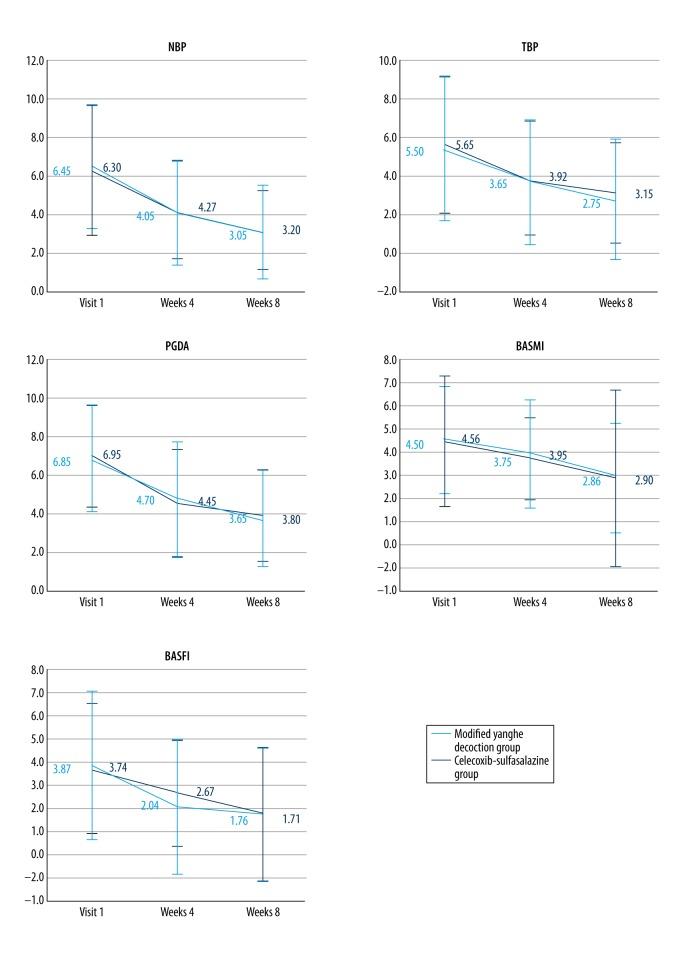
BACKGROUND This study evaluated the effects of Modified Yanghe Decoction on pain, disease activity, and functional capacity, and its safety in subjects with ankylosing spondylitis (AS). MATERIAL AND METHODS A randomized, controlled study of subjects with AS was conducted over 8 weeks to compare the efficacy of the Modified Yanghe Decoction to celecoxib-sulfasalazine therapy. Subjects were evaluated at visit 1, and at weeks 4 and 8 of the trial. The Bath ankylosing spondylitis disease activity index (BASDAI), nocturnal back pain (NBP), total back pain (TBP), patient global disease activity (PGDA), the Bath ankylosing spondylitis functional index (BASFI), and the Bath ankylosing spondylitis metrology index (BASMI) were measured at each time point. Safety was monitored throughout the study through blood, urine, and stool samples, along with heart, liver, and kidney function tests. The ASAS 20 improvement criteria were used as efficacy criteria. RESULTS A total of 80 subjects were included. Both treatment groups were effective: 32 subjects (80%) in the Modified Yanghe Decoction group and 34 (85%) in celecoxib-sulfasalazine group met ASAS 20 improvement criteria; no statistically significant difference between groups was observed (P>0.05). Two subjects in the Modified Yanghe Decoction group reported mild diarrhea during the trial. In the celecoxib-sulfasalazine group, 8 subjects experienced upper-abdominal pain; in 3 subjects this was combined with lowered white blood cell count and in 1 subject it was combined with mild proteinuria. This represents a statistically significant difference in safety (P<0.05) between the 2 treatments. CONCLUSIONS This study demonstrates the efficacy and safety of the Modified Yanghe Decoction in AS treatment, especially for patients who have poor clinical responses, severe adverse reactions, or for patients unable to afford the standard clinical options.
背景
本研究评估了加味阳和汤对强直性脊柱炎(AS)患者疼痛、疾病活动度和功能能力的影响及其安全性。
材料与方法
对 8 周内的 AS 患者进行了一项随机对照研究,以比较加味阳和汤与塞来昔布-柳氮磺胺吡啶治疗的疗效。在试验的第 1 次就诊时以及第 4 周和第 8 周对患者进行评估。在每个时间点测量 Bath 强直性脊柱炎疾病活动指数(BASDAI)、夜间背痛(NBP)、总背痛(TBP)、患者整体疾病活动度(PGDA)、Bath 强直性脊柱炎功能指数(BASFI)和 Bath 强直性脊柱炎计量学指数(BASMI)。通过血液、尿液和粪便样本以及心脏、肝脏和肾功能检查,在整个研究过程中监测安全性。ASAS20 改善标准被用作疗效标准。
结果
共纳入 80 例患者。两组治疗均有效:加味阳和汤组 32 例(80%)和塞来昔布-柳氮磺胺吡啶组 34 例(85%)符合 ASAS20 改善标准;两组间无统计学差异(P>0.05)。加味阳和汤组有 2 例患者在试验过程中报告轻度腹泻。塞来昔布-柳氮磺胺吡啶组 8 例患者出现上腹痛;其中 3 例与白细胞计数降低有关,1 例与轻度蛋白尿有关。这两种治疗方法在安全性方面存在统计学差异(P<0.05)。
结论
本研究表明加味阳和汤治疗 AS 的疗效和安全性,特别是对于临床反应不佳、严重不良反应或无法承担标准临床选择的患者。


 Zotero 插件