
主要应对策略对血液透析患者治疗依从性和共病严重程度的影响。
Influence of Major Coping Strategies on Treatment Non-adherence and Severity of Comorbid Conditions in Hemodialysis Patients.
机构信息
Department of Psychiatry, Chung-Ang University Hospital, Seoul, Korea.
Division of Nephrology, Department of Internal Medicine, Chung-Ang University Hospital, Seoul, Korea.
出版信息
J Korean Med Sci. 2018 Apr 26;33(20):e148. doi: 10.3346/jkms.2018.33.e148. eCollection 2018 May 14.
BACKGROUND
Non-adherence and comorbidities are prevalent among hemodialysis patients and are associated with increased mortality and financial burden. We aimed to investigate the influence of major coping strategies (CSs) on non-adherence and comorbidities in hemodialysis patients.
METHODS
A total of 49 patients were enrolled. We collected participant data including CS measured by a Korean version of the ways of coping questionnaire (K-WCQ), comorbidities measured by age-adjusted Charlson comorbidity index (CCI), and adherence measured by the 8-item Morisky medication adherence scale (MMAS-8).
RESULTS
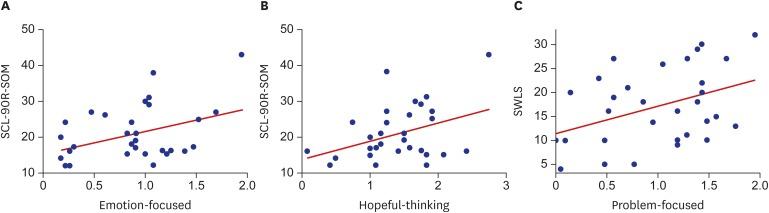
Regarding major CS, 61.2% of participants reported use of support-seeking CS (SUP group), 14.3% reported use of problem-focused CS (PRO group), and 24.5% reported use of hopeful-thinking CS (HOP group). The mean MMAS-8 score was higher in the PRO group than in the HOP group ( = 0.024). The mean CCI score was lower in the PRO group than in the HOP group ( = 0.017). In the HOP group, the severity of somatic symptoms was positively correlated with the scores for the emotion-focused CS subscale ( = 0.39, = 0.029) and the hopeful-thinking CS subscale ( = 0.38, = 0.036) of the K-WCQ. The level of life satisfaction positively correlated with the score for the problem-focused CS subscale in the HOP group ( = 0.40, = 0.027).
CONCLUSION
We should pay more attention to the CSs of hemodialysis patients and provide interventions that promote problem-focused CSs, especially for nonadherent patients with high comorbidity rates who mainly use a hopeful-thinking CS.
背景
不依从和合并症在血液透析患者中很常见,与死亡率增加和经济负担增加有关。我们旨在研究主要应对策略(CSs)对血液透析患者不依从和合并症的影响。
方法
共纳入 49 名患者。我们收集了参与者的数据,包括通过韩国版应对方式问卷(K-WCQ)测量的 CS、通过年龄调整的 Charlson 合并症指数(CCI)测量的合并症以及通过 8 项 Morisky 药物依从性量表(MMAS-8)测量的依从性。
结果
在主要 CS 方面,61.2%的参与者报告使用支持寻求 CS(SUP 组),14.3%报告使用问题焦点 CS(PRO 组),24.5%报告使用希望思维 CS(HOP 组)。PRO 组的 MMAS-8 评分均值高于 HOP 组(=0.024)。PRO 组的 CCI 评分均值低于 HOP 组(=0.017)。在 HOP 组中,躯体症状的严重程度与情绪焦点 CS 亚量表(=0.39,=0.029)和 K-WCQ 的希望思维 CS 亚量表(=0.38,=0.036)的评分呈正相关。HOP 组的生活满意度水平与问题焦点 CS 亚量表的评分呈正相关(=0.40,=0.027)。
结论
我们应该更加关注血液透析患者的 CS,并提供促进问题焦点 CS 的干预措施,特别是对于主要使用希望思维 CS 的高合并症率不依从患者。
 Zotero 插件