
在感染 HIV 的患者中强化治疗与调节性 T 细胞频率降低有关。
Treatment Intensification in HIV-Infected Patients Is Associated With Reduced Frequencies of Regulatory T Cells.
机构信息
Division of Infectious Diseases, Medizinische Klinik und Poliklinik IV, Ludwig Maximilian University of Munich, Munich, Germany.
German Center for Infection Research, Site Munich LMU, Munich, Germany.
出版信息
Front Immunol. 2018 Apr 30;9:811. doi: 10.3389/fimmu.2018.00811. eCollection 2018.
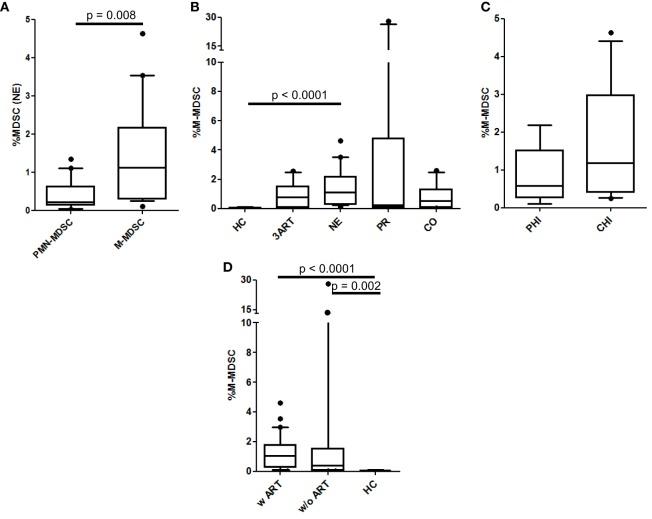
In untreated HIV infection, the efficacy of T cell responses decreases over the disease course, resulting in disease progression. The reasons for this development are not completely understood. However, immunosuppressive cells are supposedly crucially involved. Treatment strategies to avoid the induction of these cells preserve immune functions and are therefore the object of intense research efforts. In this study, we assessed the effect of treatment intensification [=5-drug antiretroviral therapy (ART)] on the development of suppressive cell subsets. The New Era (NE) study recruited patients with primary HIV infection (PHI) or chronically HIV-infected patients with conventional ART (CHI) and applied an intensified 5-drug regimen containing maraviroc and raltegravir for several years. We compared the frequencies of the immune suppressive cells, namely, the myeloid-derived suppressor cells (MDSCs), regulatory B cells (Bregs), and regulatory T cells (Tregs), of the treatment intensification patients to the control groups, especially to the patients with conventional 3-drug ART, and analyzed the Gag/Nef-specific CD8 T cell responses. There were no differences between PHI and CHI in the NE population ( > 0.11) for any of the studied cell types. Polymorphonuclear myeloid-derived suppressor cell (PMN-MDSC), monocytic myeloid-derived suppressor cell (M-MDSC), and the Breg frequencies were comparable to those of patients with a 3-drug ART. However, the Treg levels were significantly lower in the NE patients than those in 3ART-treated individuals and other control groups ( ≤ 0.0033). The Gag/Nef-specific CD8 T cell response was broader ( = 0.0134) with a higher magnitude ( = 0.026) in the NE population than that in the patients with conventional ART. However, we did not find a correlation between the frequency of the immune suppressive cells and the interferon-gamma CD8 T cell response. In the treatment intensification subjects, the frequencies of the immune suppressive cells were comparable or lower than those of the conventional ART-treated subjects, with surprisingly broad HIV-specific CD8 T cell responses, suggesting a preservation of immune function with the applied treatment regimen. Interestingly, these effects were seen in both treatment intensification subpopulations and were not attributed to the start of treatment in primary infection.
在未经治疗的 HIV 感染中,T 细胞反应的效力随着疾病的发展而降低,导致疾病进展。这种发展的原因尚不完全清楚。然而,免疫抑制细胞据称起着至关重要的作用。避免诱导这些细胞的治疗策略可以保留免疫功能,因此是研究的重点。在这项研究中,我们评估了治疗强化[=5 种抗逆转录病毒疗法(ART)]对抑制性细胞亚群发展的影响。New Era(NE)研究招募了原发性 HIV 感染(PHI)或慢性 HIV 感染接受常规 ART(CHI)的患者,并应用了含有马拉维若和雷特格韦的强化 5 种药物方案多年。我们将治疗强化患者与对照组(尤其是接受常规 3 种药物 ART 的患者)的免疫抑制细胞(即髓系来源的抑制细胞(MDSC)、调节性 B 细胞(Breg)和调节性 T 细胞(Treg)的频率进行了比较,并分析了 Gag/Nef 特异性 CD8 T 细胞反应。在 NE 人群中( > 0.11),任何研究的细胞类型在 PHI 和 CHI 之间均无差异。多形核髓系来源的抑制细胞(PMN-MDSC)、单核细胞来源的抑制细胞(M-MDSC)和 Breg 频率与接受 3 种药物 ART 的患者相似。然而,NE 患者的 Treg 水平明显低于接受 3ART 治疗的个体和其他对照组( ≤ 0.0033)。与接受常规 ART 的患者相比,NE 患者的 Gag/Nef 特异性 CD8 T 细胞反应更广泛( = 0.0134),强度更高( = 0.026)。然而,我们没有发现免疫抑制细胞的频率与干扰素-γ CD8 T 细胞反应之间存在相关性。在治疗强化组中,免疫抑制细胞的频率与接受常规 ART 治疗的组相似或更低,但 HIV 特异性 CD8 T 细胞反应却非常广泛,这表明应用的治疗方案保留了免疫功能。有趣的是,这些作用见于治疗强化亚群,并且与原发性感染中的治疗开始无关。




 Zotero 插件