
导致肺动脉高压中持续激活的细胞表型的机制。
Mechanisms contributing to persistently activated cell phenotypes in pulmonary hypertension.
机构信息
Department of Craniofacial Biology, School of Dental Medicine, University of Colorado Anschutz Medical Campus, Aurora, CO, USA.
Cardiovascular Pulmonary Research Laboratories, Departments of Pediatrics and Medicine, University of Colorado Anschutz Medical Campus, Aurora, CO, USA.
出版信息
J Physiol. 2019 Feb;597(4):1103-1119. doi: 10.1113/JP275857. Epub 2018 Aug 7.
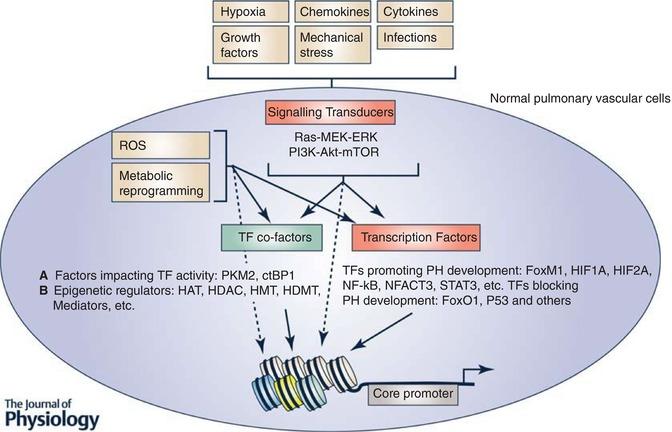
Chronic pulmonary hypertension (PH) is characterized by the accumulation of persistently activated cell types in the pulmonary vessel exhibiting aberrant expression of genes involved in apoptosis resistance, proliferation, inflammation and extracellular matrix (ECM) remodelling. Current therapies for PH, focusing on vasodilatation, do not normalize these activated phenotypes. Furthermore, current approaches to define additional therapeutic targets have focused on determining the initiating signals and their downstream effectors that are important in PH onset and development. Although these approaches have produced a large number of compelling PH treatment targets, many promising human drugs have failed in PH clinical trials. Herein, we propose that one contributing factor to these failures is that processes important in PH development may not be good treatment targets in the established phase of chronic PH. We hypothesize that this is due to alterations of chromatin structure in PH cells, resulting in functional differences between the same factor or pathway in normal or early PH cells versus cells in chronic PH. We propose that the high expression of genes involved in the persistently activated phenotype of PH vascular cells is perpetuated by an open chromatin structure and multiple transcription factors (TFs) via the recruitment of high levels of epigenetic regulators including the histone acetylases P300/CBP, histone acetylation readers including BRDs, the Mediator complex and the positive transcription elongation factor (Abstract figure). Thus, determining how gene expression is controlled by examining chromatin structure, TFs and epigenetic regulators associated with aberrantly expressed genes in pulmonary vascular cells in chronic PH, may uncover new PH therapeutic targets.
慢性肺动脉高压(PH)的特征是肺血管中持续激活的细胞类型积累,表现出涉及抗细胞凋亡、增殖、炎症和细胞外基质(ECM)重塑的基因异常表达。目前针对 PH 的治疗方法侧重于血管舒张,但不能使这些激活表型正常化。此外,目前确定其他治疗靶点的方法主要集中在确定在 PH 发病和发展中重要的起始信号及其下游效应物。尽管这些方法产生了大量有前景的 PH 治疗靶点,但许多有前途的人类药物在 PH 临床试验中失败。在此,我们提出,这些失败的一个促成因素是,在慢性 PH 的既定阶段,对 PH 发展很重要的过程可能不是很好的治疗靶点。我们假设,这是由于 PH 细胞中染色质结构的改变,导致正常或早期 PH 细胞与慢性 PH 细胞中相同因子或途径的功能差异。我们假设,PH 血管细胞中持续激活表型涉及的基因的高表达是由开放的染色质结构和多个转录因子(TFs)通过募集高水平的表观遗传调节剂(包括组蛋白乙酰转移酶 P300/CBP、组蛋白乙酰化读码器包括 BRDs、中介复合物和正转录延伸因子)来维持的(摘要图)。因此,通过检查与慢性 PH 肺血管细胞中异常表达的基因相关的染色质结构、TFs 和表观遗传调节剂,确定基因表达是如何受到控制的,可能会发现新的 PH 治疗靶点。



 Zotero 插件