
癌症患者中程序性细胞死亡蛋白1抑制剂导致血液学毒性的风险:当前研究的荟萃分析
Risk of hematologic toxicities with programmed cell death-1 inhibitors in cancer patients: a meta-analysis of current studies.
作者信息
Sui Jiang-Dong, Wang Ying, Wan Yue, Wu Yong-Zhong
机构信息
Radiation Oncology Center, Chongqing University Cancer Hospital & Chongqing Cancer Institute & Chongqing Cancer Hospital, Chongqing, China.
出版信息
Drug Des Devel Ther. 2018 Jun 8;12:1645-1657. doi: 10.2147/DDDT.S167077. eCollection 2018.
BACKGROUND
Programmed cell death-1 (PD-1) inhibitor-related hematologic toxicities are a category of rare but clinically serious and potentially life-threatening adverse events; however, little is known about their risks across different treatment regimens and tumor types. The objective of this study was to compare the incidences of PD-1 inhibitor-related hematologic toxicities among different therapeutic regimens and tumor types.
METHODS
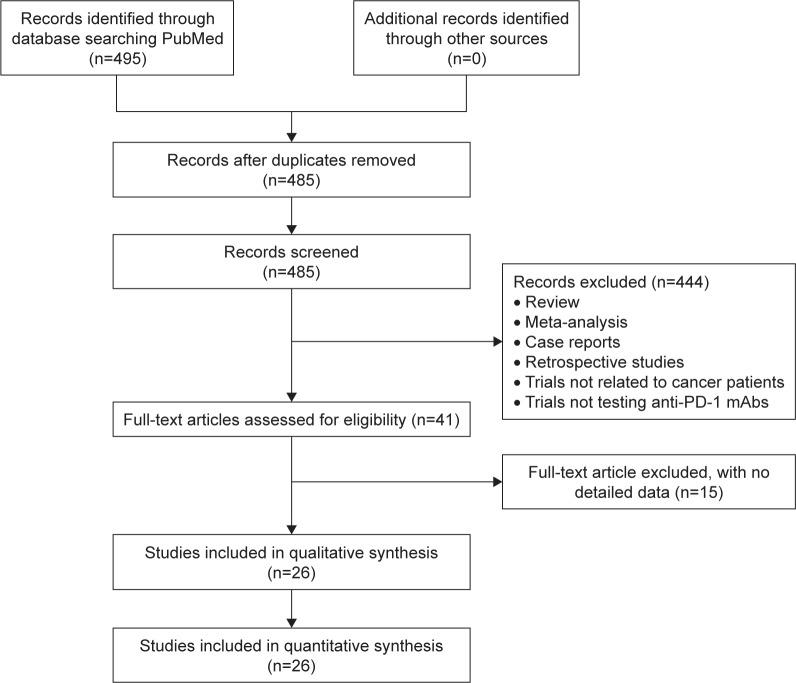
Twenty-six original articles on PD-1 inhibitor trials were identified based on a PubMed search completed on September 26, 2017. The incidences of hematologic toxicities were collected.
RESULTS
A total of 26 studies containing 5,088 patients were included in the meta-analysis. PD-1 inhibitor monotherapy was associated with an increased risk of all-grade anemia in cancer patients (5%, 95% CI 4%-6%), particularly in patients with renal cell carcinoma (RCC) (8%, 95% CI 6%-12%), compared with all-grade thrombocytopenia (2%, 95% CI 1%-5%), leukopenia (2%, 95% CI 1%-3%), and neutropenia (1%, 95% CI 0-1%). However, low incidences of high-grade hematologic toxicities were observed in cancer patients treated with PD-1 inhibitor monotherapy. The use of PD-1 inhibitors in combination with ipilimumab, peptide vaccines, or chemotherapy had significantly higher risks than PD-1 inhibitor monotherapy for all-grade anemia (13%, 95% CI 5%-31%), thrombocytopenia (6%, 95% CI 2%-18%), leukopenia (5%, 95% CI 1%-35%), neutropenia (4%, 95% CI 1%-26%), and only high-grade thrombocytopenia (4%, 95% CI 1%-15%). In addition, all-grade and high-grade hematologic toxicities in chemotherapy and everolimus treatment arms were more frequent than in PD-1 inhibitor monotherapy arms.
CONCLUSION
The risks of PD-1 inhibitor-related hematologic toxicities were higher in RCC than in other cancers, and during combination therapy. These results may contribute toward enhancing awareness among clinicians about frequent clinical monitoring when managing PD-1 inhibitors.
背景
程序性细胞死亡蛋白1(PD-1)抑制剂相关血液学毒性是一类罕见但临床严重且可能危及生命的不良事件;然而,对于不同治疗方案和肿瘤类型中其风险的了解甚少。本研究的目的是比较不同治疗方案和肿瘤类型中PD-1抑制剂相关血液学毒性的发生率。
方法
基于2017年9月26日完成的PubMed搜索,确定了26篇关于PD-1抑制剂试验的原始文章。收集血液学毒性的发生率。
结果
荟萃分析共纳入26项研究,包含5088例患者。与所有级别的血小板减少症(2%,95%CI 1%-5%)、白细胞减少症(2%,95%CI 1%-3%)和中性粒细胞减少症(1%,95%CI 0-1%)相比,PD-1抑制剂单药治疗与癌症患者所有级别贫血风险增加相关(5%,95%CI 4%-6%),特别是肾细胞癌(RCC)患者(8%,95%CI 6%-12%)。然而,接受PD-1抑制剂单药治疗的癌症患者中,高级别血液学毒性的发生率较低。与PD-1抑制剂单药治疗相比,PD-1抑制剂与伊匹木单抗、肽疫苗或化疗联合使用时,所有级别贫血(13%,95%CI 5%-31%)、血小板减少症(6%,95%CI 2%-18%)、白细胞减少症(5%,95%CI 1%-35%)、中性粒细胞减少症(4%,95%CI 1%-26%)以及仅高级别血小板减少症(4%,95%CI 1%-15%)的风险显著更高。此外,化疗和依维莫司治疗组中所有级别和高级别血液学毒性比PD-1抑制剂单药治疗组更常见。
结论
RCC患者中PD-1抑制剂相关血液学毒性的风险高于其他癌症患者,且联合治疗期间风险更高。这些结果可能有助于提高临床医生在管理PD-1抑制剂时对频繁临床监测的认识。



 Zotero 插件