
髌股疼痛综合征女性在特定运动动作中髋部和膝部肌肉的肌电图分析:一项观察性研究。
Electromyographic analysis of hip and knee muscles during specific exercise movements in females with patellofemoral pain syndrome: An observational study.
作者信息
Chen Shuya, Chang Wen-Dien, Wu Jhih-Yun, Fong Yi-Chin
机构信息
Department of Physical Therapy Department of Sports Medicine, China Medical University, Taichung, Taiwan (R.O.C) Department of Sport Performance, National Taiwan University of Sport, Taichung, Taiwan (R.O.C).
出版信息
Medicine (Baltimore). 2018 Jul;97(28):e11424. doi: 10.1097/MD.0000000000011424.
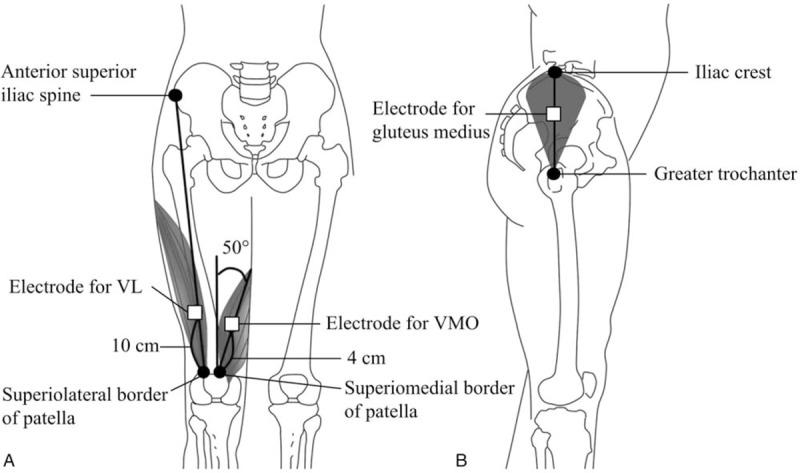
Hip muscle strengthening and knee extensor strengthening are common training exercises for patellofemoral pain syndrome (PFPS). PFPS engendered by insufficient hip abductor and external rotator muscle strength has been of interest, but these exercise movements may increase the lateral vector force of the patella warrants clarification. So, the purpose of this study was to assess muscular activations of vastus lateralis (VL), vastus medialis oblique (VMO), and gluteus medius muscles in electromyographic analysis during hip abduction and external rotator movements and open and closed kinetic chain knee extension movements.The gluteus medius, VMO, and VL muscles, in addition to the ratio of the VL and VMO muscles, were assessed through surface electromyography in 4 movements. Each muscle's amplitude expressed as a percent of maximum voluntary contraction (MVC). The differences on MVC at the terminal joint angle and during the movements were compared.Thirty female patients with PFPS were recruited. During hip abduction and external rotation movements, the MVC of the gluteus medius muscle increased, and those of the VMO and VL muscles increased in the open and closed kinetic chain knee extension movements. The MVCs of VL in the hip abduction and external rotation movements were significantly higher than those of the VMO muscle (P < .05). The ratios of the VL and VMO muscles in the open and closed kinetic chain knee extension movements approached 1, and they were significantly higher than those in the hip abduction and external rotation movements (P < .05). The highest MVC of the VMO muscle was observed at the terminal joint angle in the closed kinetic chain knee extension movement.Selective gluteus medius muscle activation was induced during the hip abduction and external rotation movements, accompanied by an increase in VL muscle activation. In open and closed kinetic chain knee movements, the ratios of the VL and VMO muscles approached 1. More selective VMO muscle activation was induced during the closed kinetic chain knee movements.
髋部肌肉强化和膝关节伸肌强化是髌股疼痛综合征(PFPS)常见的训练练习。由髋外展肌和外旋肌力量不足引起的PFPS一直受到关注,但这些练习动作可能会增加髌骨的外侧矢量力,这一点有待阐明。因此,本研究的目的是在肌电图分析中评估髋外展和外旋运动以及开链和闭链膝关节伸展运动期间股外侧肌(VL)、股内侧斜肌(VMO)和臀中肌的肌肉激活情况。通过表面肌电图在4种运动中评估臀中肌、VMO和VL肌肉,以及VL和VMO肌肉的比例。每块肌肉的幅度表示为最大自主收缩(MVC)的百分比。比较了终末关节角度和运动期间MVC的差异。招募了30名患有PFPS的女性患者。在髋外展和外旋运动期间,臀中肌的MVC增加,在开链和闭链膝关节伸展运动中,VMO和VL肌肉的MVC增加。髋外展和外旋运动中VL的MVC显著高于VMO肌肉(P<0.05)。开链和闭链膝关节伸展运动中VL和VMO肌肉的比例接近1,且显著高于髋外展和外旋运动中的比例(P<0.05)。在闭链膝关节伸展运动的终末关节角度观察到VMO肌肉的最高MVC。在髋外展和外旋运动期间诱导了选择性臀中肌激活,同时VL肌肉激活增加。在开链和闭链膝关节运动中,VL和VMO肌肉的比例接近1。在闭链膝关节运动期间诱导了更具选择性的VMO肌肉激活。



 Zotero 插件