
婴幼儿的食物消费模式:来自喂养婴幼儿研究(FITS)2016 的发现。
Food Consumption Patterns of Infants and Toddlers: Findings from the Feeding Infants and Toddlers Study (FITS) 2016.
机构信息
The George Washington University, Milken Institute School of Public Health, Washington, DC.
Nestlé Research, Lausanne, Switzerland.
出版信息
J Nutr. 2018 Sep 1;148(suppl_3):1525S-1535S. doi: 10.1093/jn/nxy171.
BACKGROUND
The prevalence of obesity and type 2 diabetes continues to increase. These conditions disproportionately affect minorities and are associated with poor nutrition early in life. Current food-consumption patterns can inform pending dietary guidelines for infants and toddlers.
OBJECTIVE
The aim of this study was to describe infant feeding, complementary feeding, and food and beverage consumption patterns of 0- to 23.9-mo-olds in the general population.
METHODS
The Feeding Infants and Toddlers Study 2016 is a cross-sectional survey of caregivers of children aged <4 y. Dietary data were collected from a national random sample by using a 24-h dietary recall (n = 3235). The percentage of children consuming foods from >400 food groups was calculated. Differences in the percentage consuming between Hispanic, non-Hispanic white, and non-Hispanic black children aged 0-23.9 mo were evaluated with the use of ORs and 95% CIs.
RESULTS
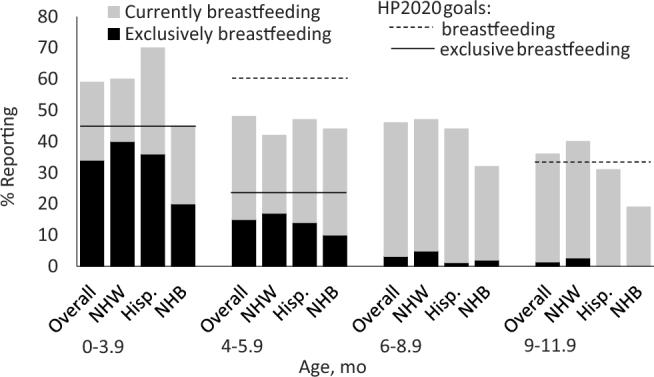
Eighty-three percent of 0- to 23.9-mo-olds (n = 2635) were ever breastfed, 34% of 0- to 3.9-mo-olds (n = 305) and 15% of 4- to 5.9-mo-olds (n = 295) were exclusively breastfed, and 24% of 12- to 14.9-mo-olds (n = 412) consumed breast milk on the day of the recall. Complementary foods were more likely to be introduced before 4 mo in formula-fed infants (27%) than in infants who did not consume formula (5%). Half of 4- to 5.9-mo-olds consumed iron-fortified infant cereal, but few consumed iron-rich meats. Among toddlers (12-23.9 mo; n = 1133), >20% consumed no servings of fruit or vegetables on the day of the recall, approximately half consumed 100% fruit juice, and one-quarter to one-third consumed a sugar-sweetened beverage (SSB).
CONCLUSIONS
Breastfeeding initiation and duration have improved, but exclusivity remains low. Low consumption of iron-rich foods, fruit, and vegetables and lack of variety in vegetable consumption are problems. Efforts to reduce the consumption of SSBs and 100% fruit juice are warranted in early childhood.
背景
肥胖症和 2 型糖尿病的患病率持续上升。这些疾病在少数民族中更为普遍,并且与生命早期的不良营养有关。当前的食物消费模式可以为即将出台的婴儿和幼儿饮食指南提供信息。
目的
本研究旨在描述一般人群中 0-23.9 月龄婴儿的喂养方式、补充喂养以及食物和饮料的消费模式。
方法
《喂养婴儿和幼儿研究 2016》是一项针对 4 岁以下儿童照料者的横断面调查。通过 24 小时膳食回忆(n=3235)从全国随机样本中收集膳食数据。计算了摄入>400 种食物组的儿童比例。使用 OR 和 95%CI 评估了西班牙裔、非西班牙裔白人和非西班牙裔黑人 0-23.9 月龄儿童之间在消费百分比上的差异。
结果
83%的 0-23.9 月龄儿童(n=2635)曾接受过母乳喂养,34%的 0-3.9 月龄儿童(n=305)和 15%的 4-5.9 月龄儿童(n=295)曾接受过纯母乳喂养,12-14.9 月龄儿童(n=412)中有 24%在回忆当天摄入了母乳。配方奶喂养的婴儿比未食用配方奶的婴儿更早(27%比 5%)引入补充食物。一半的 4-5.9 月龄儿童食用了铁强化婴儿谷类食品,但很少食用富含铁的肉类。在幼儿(12-23.9 月龄;n=1133)中,超过 20%的儿童在回忆当天没有摄入任何水果或蔬菜,大约一半的儿童摄入了 100%纯果汁,四分之一到三分之一的儿童摄入了含糖饮料(SSB)。
结论
母乳喂养的开始和持续时间有所改善,但仍不够专一。铁含量高的食物、水果和蔬菜的摄入量低,以及蔬菜摄入量的种类单一,都是存在的问题。在幼儿期减少 SSB 和 100%纯果汁的摄入量是有必要的。

 Zotero 插件