
物理模型除了能带来积极参与的好处外,还能提供卓越的学习机会。
Physical models can provide superior learning opportunities beyond the benefits of active engagements.
作者信息
Newman Dina L, Stefkovich Megan, Clasen Catherine, Franzen Margaret A, Wright L Kate
机构信息
Thomas H. Gosnell School of Life Sciences, Rochester Institute of Technology, Rochester, New York, 14623.
University of Wisconsin-Madison, Madison, Wisconsin, 53706.
出版信息
Biochem Mol Biol Educ. 2018 Sep;46(5):435-444. doi: 10.1002/bmb.21159. Epub 2018 Oct 3.
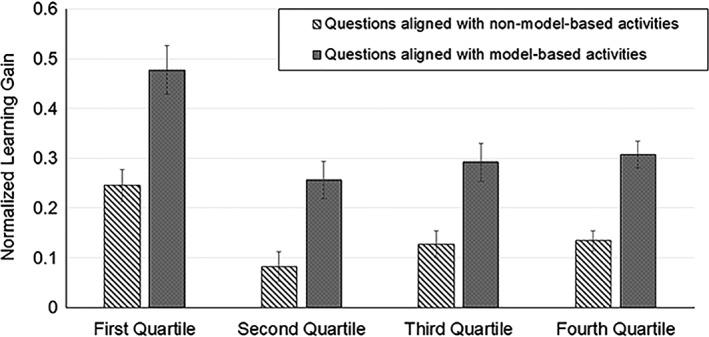
The essence of molecular biology education lies in understanding of gene expression, with subtopics including the central dogma processes, such as transcription and translation. While these concepts are core to the discipline, they are also notoriously difficult for students to learn, probably because they cannot be directly observed. While nearly all active learning strategies have been shown to improve learning compared with passive lectures, little has been done to compare different types of active learning. We hypothesized that physical models of central dogma processes would be especially helpful for learning, because they provide a resource that students can see, touch, and manipulate while trying to build their knowledge. For students enrolled in an entirely active-learning-based Cell & Molecular Biology course, we examined whether model-based activities were more effective than non-model based activities. To test their understanding at the beginning and end of the semester, we employed the multiple-select Central Dogma Concept Inventory (CDCI). Each student acted as their own control, as all students engaged in all lessons yet some questions related to model-based activities and some related to clicker questions, group problem-solving, and other non-model-based activities. While all students demonstrated learning gains on both types of question, they showed much higher learning gains on model-based questions. Examining their selected answers in detail showed that while higher performing students were prompted to refine their already-good mental models to be even better, lower performing students were able to construct new knowledge that was much more consistent with an expert's understanding. © 2018 The Authors. Biochemistry and Molecular Biology Education published by Wiley Periodicals, Inc. on behalf of International Union of Biochemistry and Molecular Biology., 46(5):435-444, 2018.
分子生物学教育的核心在于对基因表达的理解,其分支主题包括中心法则过程,如转录和翻译。虽然这些概念是该学科的核心,但学生们 notoriously 难以掌握,可能是因为它们无法直接观察到。虽然几乎所有主动学习策略都已被证明与被动讲授相比能提高学习效果,但对于比较不同类型的主动学习却做得很少。我们假设中心法则过程的物理模型对学习特别有帮助,因为它们提供了一种资源,学生在构建知识时可以看到、触摸和操作。对于参加完全基于主动学习的细胞与分子生物学课程的学生,我们研究了基于模型的活动是否比非基于模型的活动更有效。为了在学期开始和结束时测试他们的理解,我们采用了多选的中心法则概念量表(CDCI)。每个学生都作为自己的对照,因为所有学生都参与了所有课程,但有些问题与基于模型的活动有关,有些与课堂应答系统问题、小组问题解决及其他非基于模型的活动有关。虽然所有学生在这两类问题上都有学习收获,但他们在基于模型的问题上的收获要高得多。详细检查他们所选的答案表明,虽然成绩较好的学生被促使完善他们原本就不错的心智模型,使其变得更好,但成绩较差的学生能够构建出与专家理解更一致的新知识。© 2018 作者。《生物化学与分子生物学教育》由威利期刊公司代表国际生物化学与分子生物学联盟出版,2018 年,46(5):435 - 444。


 Zotero 插件